Vietnamese Food in Berlin: Where to Eat and What to Order
Ask ten guidebooks what to eat in Berlin and you will get the same two answers: currywurst and doner. Both are worth trying, and I send guests to my favourite doner counters all the time. But on a normal weeknight, Vietnamese food is just as much a part of everyday Berlin. The useful question is not which restaurant wins a citywide ranking. It is which part of the city's Vietnamese story fits your evening.
The reason it is so good is a real piece of Berlin history, not a marketing story. And once you understand the shape of it, the city's hundreds of Vietnamese kitchens stop feeling random and start making sense.
Why Berlin has such good Vietnamese food
This is one of those Berlin things where the food and the history are the same story. A Lichtenberg district study counted 36,473 Berlin residents with a Vietnamese migration reference in 2023, including 12,500 in Lichtenberg. That is a dated administrative snapshot, not a perfect count of everybody with Vietnamese roots, but it shows why the food is not a niche here.
The routes into the divided city were different. West Berlin accepted South Vietnamese refugees from the late 1970s. In the East, the GDR and Vietnam signed a labour agreement in 1980 and Vietnamese contract workers were placed around industrial workplaces, including in Lichtenberg and Marzahn. Berlin's civic-education portal gives the GDR agreement and migration context. After reunification, many people stayed, opened businesses and built new community institutions.
Two arrivals, two halves of the city, one food culture that outlasted the country that first invited it. If you have ever bought a late snack from a Vietnamese-run Spaeti, you have already met a small piece of this history without noticing.
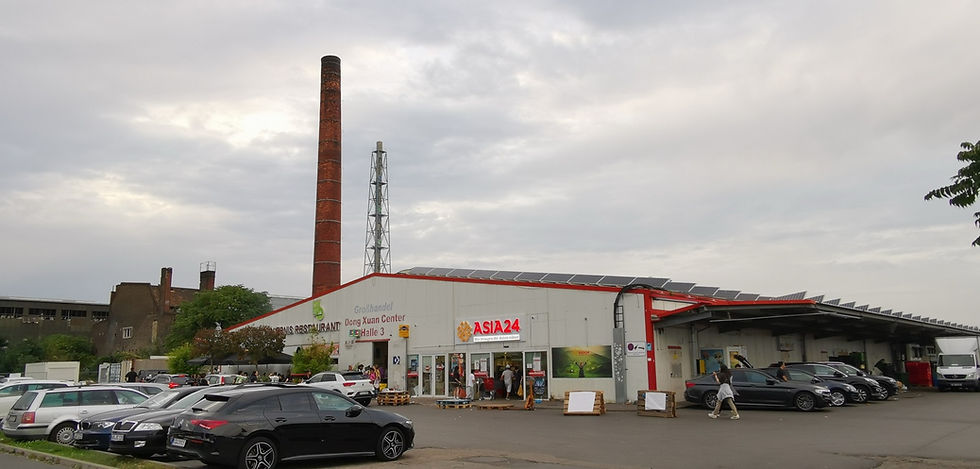
The Dong Xuan Center in Lichtenberg grew out of the eastern contract-worker districts and is now the trade heart of Vietnamese Berlin.
The three worlds of Vietnamese Berlin
Here is the mental map I give guests. Vietnamese food in Berlin lives in three worlds, and knowing which one you want saves you a lot of aimless scrolling.
Central classics in Mitte
If you are staying near the middle and want a bowl without a cross-city detour, Mitte is the practical answer. Monsieur Vuong on Alte Schönhauser Straße has been running since 1999; its current site accepts reservations and also keeps space for walk-ins. A few minutes away, District Mot on Rosenthaler Straße uses a colourful Saigon street-food setting and works well for a group. Check each restaurant's own menu and hours on the day, because both can change.
Both are walkable from the eastern end of my free walking tour route, which is why I know them well.

Pho, the clear beef or chicken noodle soup, is the dish to order first if you are new to Vietnamese food.
Kantstrasse, the west-side food street
Cross to the western side and you find Kantstraße in Charlottenburg, near Savignyplatz. This is where I send people who want to compare several Asian restaurants within one short walk. Madame Ngo presents itself as a Hanoi brasserie, while Ben Thanh is another current Vietnamese option farther west on the same street. Check the live menus rather than travelling for one remembered dish. The area pairs naturally with a walk around Kurfürstendamm.
Kreuzberg and the vegan side
The third world is the neighbourhood one, and Kreuzberg is an easy base if you or anyone in your group is eating vegetarian or vegan. Good Morning Vietnam on Bergmannstraße describes its menu as fully vegan. Miss Saigon on Skalitzer Straße lists vegetarian and vegan choices alongside meat dishes. Those are two different situations, so check the current menu before choosing. A Vietnamese dinner pairs naturally with a Kreuzberg evening.
Not sure which world fits your night? The finder below asks three quick questions and points you to a real place, with the dish to order and how to get there.
The Dong Xuan Center: the market trip
If you want a market rather than one restaurant, ride out east. The Dong Xuan Center in Lichtenberg is a wholesale and retail complex spread across long halls at Herzbergstraße 128–139. Its own site describes roughly 400 tenants and about 2,000 jobs across trade, services and food. Inside you will find salons, fabric stalls, importers, travel services and several places to eat.
Take tram M8 to Herzbergstr./Dong-Xuan and check the Dong Xuan Center's current opening page before setting off. The published schedule is 10:00 to 20:00 from Wednesday to Monday, with Tuesday closed, but individual businesses can keep different hours. Payment methods also vary, so carry a card plus some cash. Give yourself time to walk the halls before choosing where to eat.

The market halls are a destination in themselves, not just a place to eat. Opening hours and payment methods vary by business.
What to order if the menu is new to you
Vietnamese menus in Berlin are usually friendly, with photos and English, but a few words help you order like you know what you are doing.
Pho is a noodle soup commonly served with beef (pho bo) or chicken (pho ga). Start here if you want one familiar reference point between menus.
Bun is a cold rice-noodle bowl topped with grilled meat or tofu, herbs and peanuts, poured over with a light dressing. Perfect on a warm day.
Banh mi is the Vietnamese baguette sandwich, a direct echo of French colonial history, crunchy and cheap and ideal for a walk.
Goi cuon are the fresh, translucent summer rolls you dip in peanut sauce, lighter than the fried spring rolls.
Ca phe sua da is strong iced coffee with condensed milk.

A neighbourhood restaurant can be the practical choice when its current menu, hours and location fit your evening.

Goi cuon, the fresh summer rolls, are a light, no-risk first order if you are sharing a table.

Vietnamese kitchens are some of the most reliable vegan options in Berlin, built around tofu, herbs and rice.
A few practical notes
A handful of small things will make the meal smoother:
Payment varies. Carry a card plus some cash, especially for a market visit or a small snack bar.
Tipping is light. Rounding up or adding a little is normal, not the North American percentages. I explain the local habit in the tipping guide.
Language support varies. Current menus often show dish names clearly, and pointing politely works when you do not share a language. The do you need German post has the basics.
Check hours before a long trip. For a run out to Lichtenberg especially, confirm the market and its kitchens are open before you set off.
For a wider look at eating in the city, the what to eat in Berlin guide covers the local classics, and the halal food and breakfast guides cover two more everyday questions.
If you take one thing from this, make it practical: choose Mitte for minimum travel, Kantstraße for a restaurant comparison, Kreuzberg for a vegan-first choice, or Dong Xuan for a daytime market trip. Check the exact venue's current hours, then order one dish you have not tried before.
Image credits
Source and licence details for the 6 photographs used in this article.
A bowl of beef pho: Peachyeung316, CC BY-SA 4.0, via Wikimedia Commons.
A Vietnamese noodle bowl at a neighbourhood restaurant in Berlin: Jorge Díaz, CC BY-SA 2.0, via Wikimedia Commons.
The Dong Xuan Center in Berlin-Lichtenberg, seen from outside: Z thomas, CC BY-SA 4.0, via Wikimedia Commons.
Inside a Dong Xuan Center market hall: Roy Zuo, CC BY-SA 4.0, via Wikimedia Commons.
A vegan Vietnamese noodle dish at a Berlin restaurant: Andy Hay, CC BY 2.0, via Wikimedia Commons.
A plate of fresh Vietnamese summer rolls with peanut sauce: Zoe Shuttleworth, CC BY 2.0, via Wikimedia Commons.