How to Order Döner in Berlin: The Words to Say at the Counter
Updated: Jul 22
You are standing at a Berlin döner counter, the queue is moving, and the person behind the grill looks at you and says one word: "Mit alles?" If you freeze, you either get a shrug or a sandwich you did not quite mean to order. It happens to visitors constantly, and it is a shame, because ordering döner here is genuinely easy once you know the four or five words that do all the work.

The Berlin signature: a Gemüse Kebap, with fried vegetables, mint and feta on top of the usual salad and meat.
Döner is not a side note to Berlin food, it is arguably the city's defining street meal. The version most tourists picture, grilled meat and salad folded into flatbread, was popularised in West Berlin in the early 1970s, with Kadir Nurman's stall near Bahnhof Zoo around 1972 usually named as the starting point. Whoever gets the credit, Berlin turned it into a fast, cheap, everywhere-you-look meal, and then added its own twist with fried vegetables. This guide is about getting yours right, in plain German, without holding up the line.
What "döner" actually means in Berlin
Everywhere in the city you will see the word Gemüse Kebap, and this is the local specialty worth understanding. "Gemüse" means vegetables. On top of the standard meat and fresh salad, the cook adds a scoop of fried or grilled vegetables, usually potato, courgette, aubergine, peppers, sometimes sweet potato, then finishes it with fresh mint, a squeeze of lemon and crumbled white cheese. It is heavier and more of a meal than a plain meat döner, and it is the style that made kiosks like Mustafa's famous.
A plain meat döner still exists and is still great. But if you want the thing Berlin is actually known for, you want the Gemüse version. Either way, the meat is shaved from the vertical rotating spit you can see turning behind the counter, and the whole thing is built to order in under a minute.
The one choice that trips people up: bread, wrap, plate or box
Before you get to sauces, you pick a form, and this is where most confusion happens. There are four common ones:
Döner im Brot is the classic: everything folded into a triangle of flatbread. This is the default if you just say "einen Döner."
Dürüm is the same filling rolled tightly inside a thin, soft yufka wrap instead of bread. Less bready, easier to eat while walking, and it holds together better.
Dönerteller is a plate: meat, salad and usually fries or rice, no bread. Bigger, and the move if you want to sit down.
Döner-Box is meat and fries together in a box with sauce. Fast fuel, not a salad-heavy build.
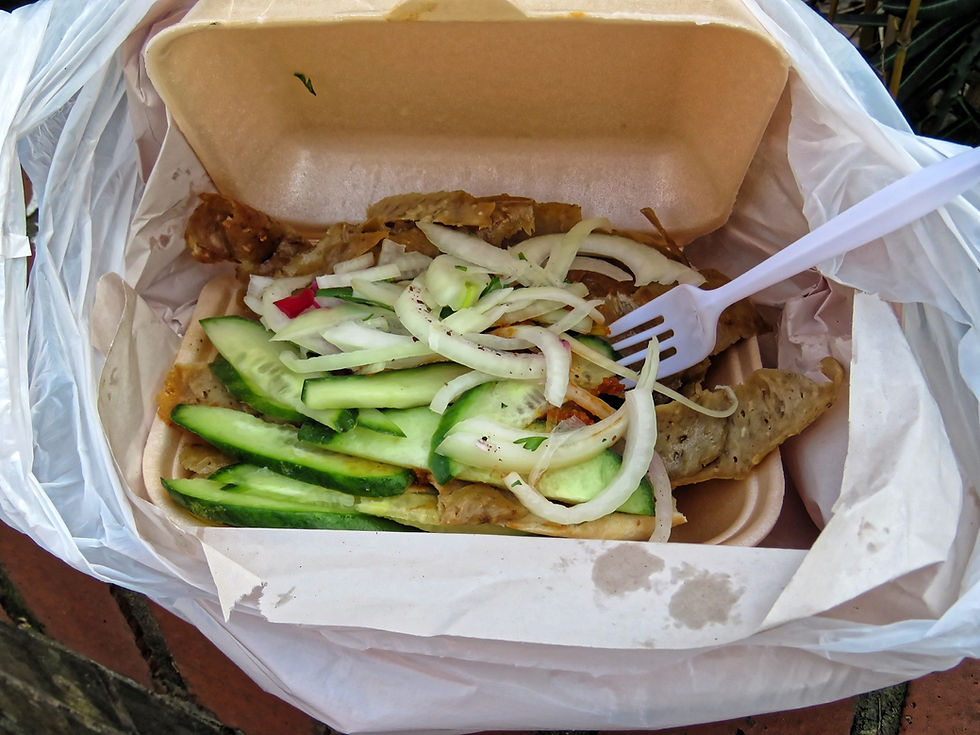
Döner im Brot, the folded flatbread version, is what you get by default if you do not ask for a wrap or plate.
My honest advice: if it is your first one, get a Dürüm. The wrap is tidier, the meat-to-bread ratio is better, and you are less likely to wear half of it. If you are properly hungry and want to sit, the Teller is the better value.

A Dürüm is the same filling rolled in a thin wrap. Ask for it by name, or you will get bread by default.
How to order döner in Berlin, line by line
Here is the whole thing in one sentence you can actually say. A useful pattern at almost any counter is:
"Einmal [form] mit [meat], mit alles, mit [sauce], bitte."
"Einmal" just means "one," and it dodges the German article guessing game, so it works for every form. Break it down:
The meat. "mit Kalbfleisch" is veal, the traditional Berlin choice. "mit Hähnchen" is chicken, lighter and very common at Gemüse kiosks. Say "vegetarisch" for no meat, or "mit Falafel" for the chickpea option.
The salad. "mit alles" means with everything: lettuce, tomato, cucumber, cabbage and onions. If raw onion is not your thing, say "mit alles, ohne Zwiebeln." That one phrase, ohne Zwiebeln, saves a lot of people.
The sauce. You usually get a choice of three: Knoblauch (creamy garlic-yogurt), Kräuter (mild herb-yogurt) and scharf (hot chili). Cocktailsoße is a milder, slightly sweet option. Just name the ones you want: "mit Knoblauch und scharf." If you want none, "ohne Soße."
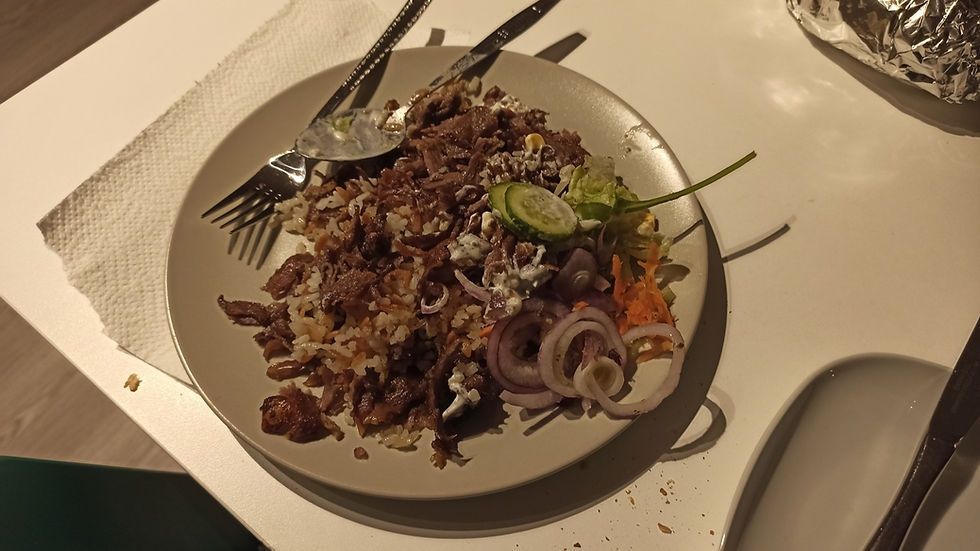
"Mit alles" means the full salad, onions included. "Ohne Zwiebeln" quietly removes the raw onion.
Two more words worth having ready: "zum Mitnehmen" for takeaway and "zum Hieressen" if you want to eat in. And if you truly draw a blank, "Einen Döner, bitte" on its own will still get you a perfectly good chicken or mixed-meat döner with the works. Use the builder below to assemble your exact order and get the German line to copy.
What it costs now, and why it feels like more
Here is the part that surprises returning visitors. A Berlin döner that cost around three to four euros before the pandemic now typically runs about seven to eight euros, and a loaded Gemüse Kebap or Dürüm at a hyped spot can top that. Germans even coined a word for it, "Dönerflation," and in 2024 the price climbed high enough to reach politics: the Left party floated a "Dönerpreisbremse," a proposed cap of 4.90 euros (2.90 for schoolchildren), which the government ruled out. You can read the background in Euronews' report on the debate.
So budget realistically. A döner is still one of the best-value hot meals in the city, but it is no longer pocket change. Most kiosks are cash-friendly and plenty now take cards, though it is worth having a few euros on you just in case. If you are mapping out daily spending, my realistic Berlin daily budget guide puts food costs like this in context.
Vegetarian and vegan döner
Berlin is an easy city to eat a meat-free döner in. The simplest route is to order any Gemüse Kebap "vegetarisch," which drops the meat and leans on the fried vegetables, salad and cheese. For a vegan version, ask for Falafel im Brot with no cheese, or head to one of the dedicated vegan döner shops that have multiplied across the city. VöNer in Friedrichshain was the early pioneer, and newer spots do convincing seitan or soy versions with the same sauces and salad. If you are decoding menus more broadly, my guide on how to read a German menu without panicking covers the words that come up most.
Where to actually eat it
The honest truth: you do not need to queue for an hour to eat a great döner in Berlin. Mustafa's Gemüse Kebap at Mehringdamm is genuinely good and genuinely famous, but the line can swallow a chunk of your afternoon, and half the queue is other tourists.

The queue at Mustafa's is real. Plenty of kiosks a few streets over do a comparable job with no wait.
There are excellent kiosks in every neighbourhood doing the same thing without the wait. For specific names and areas, I keep a separate list of the best döner kebab spots in Berlin, and the city's own tourism board has a solid Berlin döner roundup too. My simple move: if you walk past a busy kiosk full of locals on their lunch break, that is your answer. Skip the tourist queue.
Fitting it into your day
Döner is the perfect after-walking food, because it is fast, it travels, and it is everywhere near the transport hubs. On my free Berlin walking tour around the historic centre, I often get asked where to eat once we finish near Alexanderplatz, and the answer is usually the nearest honest-looking kiosk rather than anything fancy. Grab a Dürüm, find a bench, and you have the most Berlin lunch there is. If you want more of these small practical calls before you arrive, the what to eat in Berlin guide runs through the other local staples worth trying.
Image credits
Gemüse Kebap close-up: Bodhisattwa, CC BY-SA 4.0, via Wikimedia Commons.
Döner im Brot: Acabashi, CC BY-SA 4.0, via Wikimedia Commons.
Dürüm wrap: E4024, CC BY-SA 4.0, via Wikimedia Commons.
Döner components with onions: Almanta, CC BY-SA 4.0, via Wikimedia Commons.
Queue at Mustafa's Gemüse Kebap: JoachimKohler-HB, CC BY-SA 4.0, via Wikimedia Commons.