Halal Food in Berlin: A Local's Guide to Eating Well
Updated: Jul 22
One of the questions I hear while a group is gathering at the World Clock on Alexanderplatz is simple: where can I eat halal in Berlin? The visitor has just landed in the capital of currywurst, pork knuckle and beer, and does not want every meal to become a guessing game.
My answer starts with an important distinction. Berlin has plenty of restaurants that offer halal dishes, and streets such as Sonnenallee give you far more choice than the historic centre. But a neighbourhood, cuisine, owner, customer group, alcohol-free menu or lack of pork does not prove that a restaurant is halal. Use the area to find options, then verify the place itself.
Halal food in Berlin: the short honest answer
VisitBerlin lists almost 80 restaurants that serve halal food across Arab, Turkish, Indonesian and Indian kitchens. That makes Berlin a practical city for a halal-observant visitor, but the wording matters: serving a halal dish does not automatically mean that every dish, ingredient or preparation area meets the same standard.

A chicken döner photographed in Berlin. The dish and the neighbourhood do not reveal whether its meat is halal, so ask the shop before ordering.
For the widest choice, start around Sonnenallee in Neukölln, Kottbusser Tor and Kottbusser Damm, or parts of Wedding around Gesundbrunnen. These areas have many Turkish, Arab and other Muslim-friendly food businesses. They are useful places to look, not a guarantee about any individual kitchen. My guide to what to eat in Berlin covers the classic dishes; this guide explains how to check the halal question carefully.
Is döner kebab halal in Berlin?
Some Berlin döner shops use halal meat and say so clearly. Others do not, or may use halal meat for only part of the menu. Berlin has more than 1,000 kebab outlets, according to visitBerlin's döner kebab overview, but there is no reliable city-wide figure showing what share is halal. The safe answer is therefore not “most” or “all.” It is: check the shop you are standing in.
Germany does not have one uniform halal standard. The German Verbraucherzentrale explains that the term is not protected under EU food law and that different labels can use different criteria. A Halal or حلال sign is the restaurant's own statement unless it is backed by a current certificate whose issuer and scope you can check.
Start with Ist das Fleisch halal? (Is the meat halal?). Then ask which meat or dishes are covered. If certification matters to you, ask Ist das zertifiziert? Von wem? (Is it certified? By whom?). If shared preparation matters, ask whether the same grill, fryer or utensils are used. My how to order döner in Berlin guide gives you the useful ordering words once you have made that check.
Sonnenallee: Berlin's Arab Street
If you remember one food street, make it Sonnenallee in northern Neukölln. VisitBerlin describes it as Arab Street, and the stretch south from Hermannplatz has Lebanese, Syrian and Palestinian restaurants, bakeries, juice bars, sweet shops and supermarkets. Go there for the range of choices, then ask each restaurant directly about the dish you want.
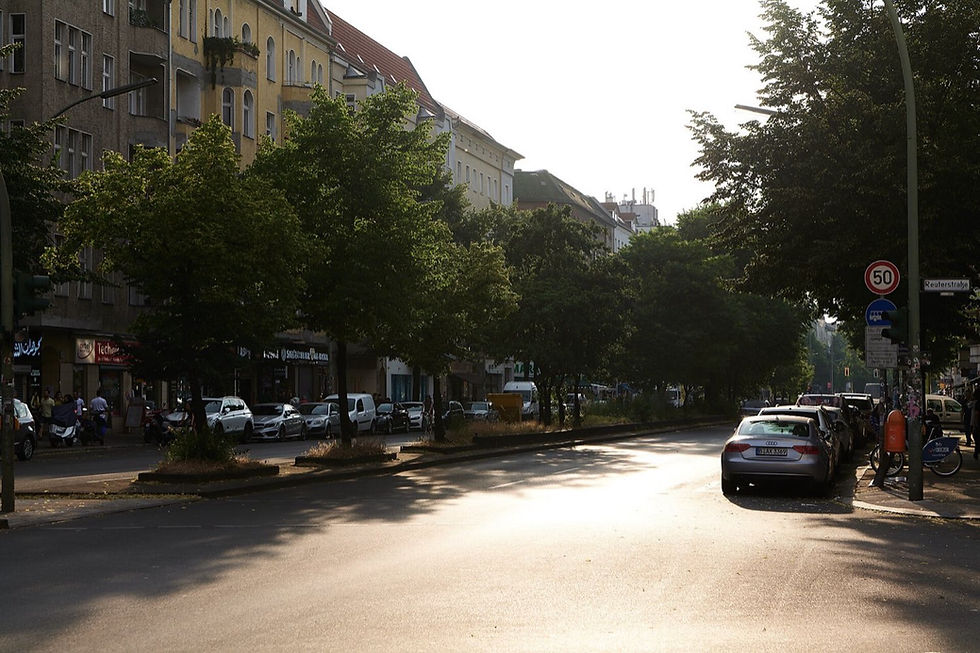
Sonnenallee in Neukölln, often called Arab Street, is a useful starting point for Levantine restaurants, bakeries and supermarkets.
This is also where I send people who want an Arab breakfast. Hummus, foul, labneh, olives, fresh bread and sweet tea make a good start before a long day of walking. Sonnenallee sits beside the area covered in my Neukölln guide, so you can combine breakfast with a real neighbourhood visit rather than travelling there for one restaurant alone.
How to verify a halal claim in Berlin
There is no honest visual shortcut, so I use a short verification sequence:
Ask about the exact dish. Welche Gerichte sind halal? means “Which dishes are halal?”
Ask which meat is covered. A yes for chicken does not necessarily answer the question for beef or lamb.
Check the certificate if that matters to you. Ask whether it is current, who issued it and what it covers.
Ask about shared preparation if that matters to you. The same grill, fryer, utensils or storage may be used for other food.
Treat a window sign as a starting point. It records the venue's claim; it is not automatically independent certification.
The right answer depends on the standard you follow. The tool below does not award a percentage or certify a restaurant. It helps you remember the questions and shows what you still need to confirm.
Sweets, bakeries and self-catering
Halal eating in Berlin is not only about grilled meat. Sonnenallee and Karl-Marx-Straße have counters stacked with baklava, knafeh, maamoul and Turkish delight, often sold by weight. For sweets that contain gelatine, flavourings or other ingredients you avoid, ask about the specific product rather than assuming that the whole bakery follows one standard.
If you have a kitchen, the Turkish Market on Maybachufer is useful for produce, bread, cheese, olives and picnic supplies. The official market runs on Tuesdays and Fridays from 11:00 to 18:30. The public market information does not establish that its meat is halal, so use a butcher or shop that explicitly confirms its current sourcing if you want halal meat. My Turkish Market guide has the full timing and practical route.

The Maybachufer market runs on Tuesdays and Fridays and is useful for produce, bread, cheese and other picnic supplies.
Where to pray, and a few practical notes
Berlin has mosques and prayer rooms across the city. The Şehitlik Mosque on Columbiadamm stands beside Germany's first Islamic cemetery, established in 1866. Its current website is being renewed, so check the mosque's visitor or tour information before going and remember that prayer times take priority. The Omar Ibn al-Khattab Mosque near Kottbusser Tor is one of Berlin's larger mosques. At BER airport, the official Room of Silence is open for prayer and reflection in Terminal 1.

The Şehitlik Mosque on Columbiadamm stands beside Berlin's historic Islamic cemetery. Check current visitor information before going.
VisitBerlin's guide for Muslim travellers also notes that hotels including the Grand Hyatt, Waldorf Astoria, Ritz-Carlton and Titanic can provide halal food on request. Ask ahead and confirm what the hotel can prepare for your stay.
My take
Use neighbourhoods to find choice, not to make a religious or food-safety decision for you. Sonnenallee is the strongest place-first recommendation because it puts many restaurants, bakeries and supermarkets on one real street. Once you choose a venue, ask about the exact dish, certification and shared preparation according to your own standard.
My free walking tour starts at Alexanderplatz and explores the historic centre of former East Berlin. It does not visit these food neighbourhoods, but after the tour I can point you toward the right U-Bahn connection for Sonnenallee, Kottbusser Tor or Wedding.
Photo attribution is available from the compact Image credits disclosure inside the Berlin Halal Verification Checklist above.