Neukölln Berlin: Which Part Is Worth Your Time
Updated: Jul 22
Every week someone on my free walking tour asks me the same thing: "I have one free afternoon, and everyone says go to Neukölln. Where exactly do I go?" It is a fair question, and it is harder to answer than it sounds. Neukölln is not a single street or a single sight. It is a big, uneven district in the south-east of Berlin that swings from loud kebab-and-club chaos to a silent sunken garden within a ten-minute walk. Walk into the wrong part and you will wonder what the fuss was about.
So this is the honest version I give in person. Neukölln Berlin is worth an afternoon, but only if you aim at the right corner of it. Here is how to read the district so you do not waste your one free block of time on a traffic-choked shopping street.
Why Neukölln confuses first-time visitors
There is a clue to the whole district hidden in its name. Until 1912 this place was called Rixdorf, and Rixdorf had a reputation. It was where working Berliners came to drink and dance, so famous for it that a hit song of the time went "In Rixdorf ist Musike." In January 1912 the town officially renamed itself Neukölln to shed the boozy image and sound more respectable. It did not really work. More than a hundred years later the district is still pulled between the same two poles: the party and the quiet, the noise and the hidden green.
That split is exactly why visitors get confused. Neukölln is not one mood, it is at least five, and they sit right next to each other. The trick is not to "do Neukölln." The trick is to pick the version you actually came for, then let the rest happen around it.

Körnerpark, a sunken neo-baroque garden five metres below street level, is the Neukölln that most visitors never find.
Start at Hermannplatz, but do not stop there
Most people arrive at Hermannplatz, the big square on the border with Kreuzberg where the U7 and U8 lines cross. It is a useful gateway and a terrible first impression. The square is loud, grey and dominated by the huge Karstadt department store, whose much-discussed rebuild has been stalled for years. If you judge Neukölln by the ten metres around the U-Bahn exit, you will turn around and leave.
Do not. Hermannplatz is a hinge, not a destination. Everything good is a short walk from here in three different directions: north into the canal-side bar district, south down the food streets, and east into the quiet village corners. Get your bearings, then move.
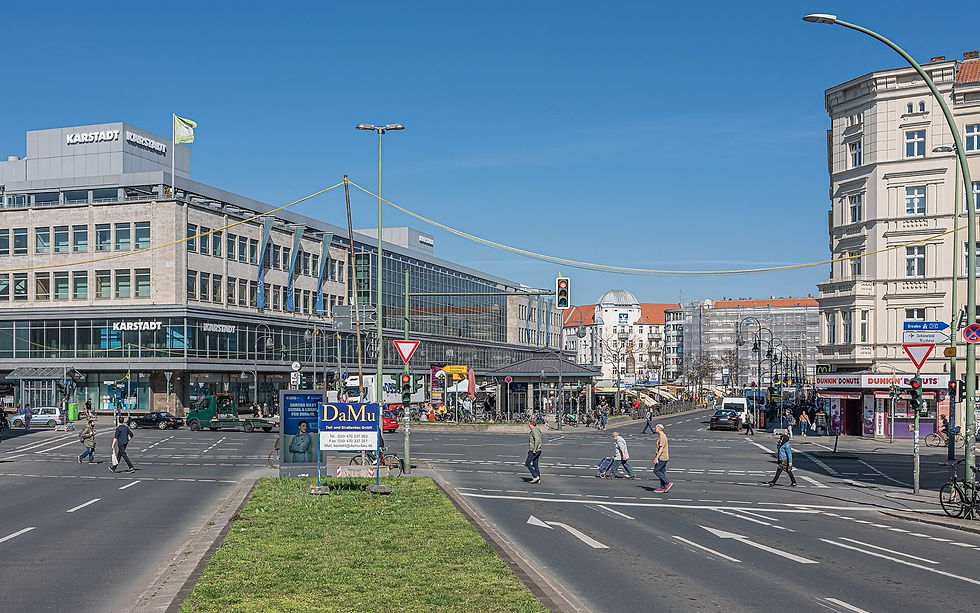
Hermannplatz is the noisy front door to Neukölln, not the room you came to see.
North Neukölln and the Reuterkiez: the canal and the market
The part of Neukölln that most travel articles actually mean is the strip just north of Hermannplatz, between Sonnenallee and the water. Locals half-jokingly call it Kreuzkölln, because it blends straight into Kreuzberg across the Landwehrkanal. This is the Reuterkiez: small bars, natural-wine spots, cafes, record shops and a young international crowd on every corner.
Its anchor is the canal itself. On Tuesdays and Fridays the Maybachufer hosts the Turkish market, a long line of stalls selling cheap vegetables, olives, fresh bread, fabric and hot food along the water. It is one of my favourite easy recommendations, and I wrote a full guide on how to visit the Maybachufer market if you want to time it right. On any warm evening, people simply sit on the canal bank with a drink from a nearby Späti and watch the light go down. That, more than any single sight, is the North Neukölln experience.

The Maybachufer market runs along the Landwehrkanal on Tuesdays and Fridays.
Körnerpark and Rixdorf: the two quiet corners most visitors miss
Now the opposite side of Neukölln, and the part I most want you to see. A few U-Bahn stops from the noise, the district hides two of the calmest, strangest places in Berlin.
Körnerpark is a formal sunken garden dropped five to seven metres below the surrounding streets, built between 1912 and 1916 on a former gravel pit. You come around an ordinary corner and suddenly look down over balustrades, a fountain, clipped hedges and a neo-baroque orangery that now holds a free gallery and a cafe. It is free, it is almost always calm, and it feels like it belongs to a different city. If you have seen Babylon Berlin, you have already seen it on screen.
A short walk away is Rixdorf, the old village core that gave the district its first name. At its heart, around Richardplatz, is the Böhmisches Dorf, the Bohemian Village. From 1737 the Prussian king Friedrich Wilhelm I let Protestant refugees from Bohemia settle here, and their little grid of low houses, cobbles and gardens survived everything the twentieth century threw at it. A working blacksmith's forge, the Rixdorfer Schmiede, still stands on the square. Standing there, with no traffic and no crowd, it is genuinely hard to believe you are inside a city of nearly four million people.

The old Rixdorf smithy on Richardplatz, the heart of Neukölln's surviving Bohemian Village.
Karl-Marx-Straße, Rathaus Neukölln and the rooftop trick
Running through the middle of all this is Karl-Marx-Straße, the district's long, busy shopping artery, with the handsome tower of Rathaus Neukölln, the town hall, about halfway along. On its own the street is more practical than pretty: phone shops, bakeries, discount stores, the everyday Neukölln that people actually live in.
But it hides the district's best-known sunset trick. On top of the multi-storey car park at the Neukölln Arcaden shopping centre sits Klunkerkranich, a rooftop bar and garden with a wide view over the Neukölln rooftops. You reach it by going up through the mall to the top parking level, which feels wrong right up until you step out into the plants, deckchairs and music. It usually opens daily from around 16:00 between spring and autumn, and it is weather-dependent and sometimes booked for events, so check before you climb up. Come for the sunset, not for a specific band.
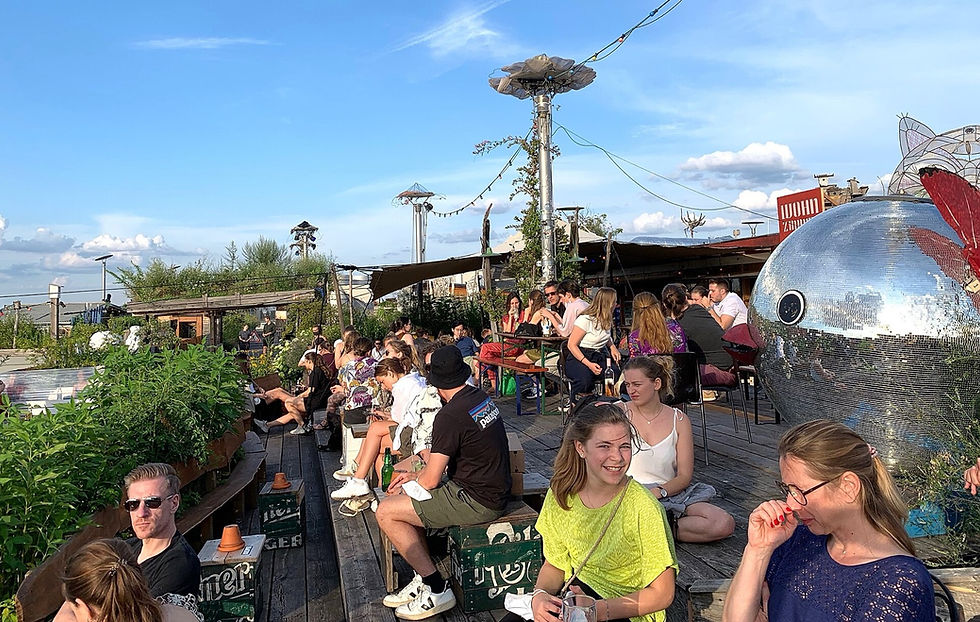
Klunkerkranich sits on top of a shopping-centre car park on Karl-Marx-Straße.
Sonnenallee: the late-night food mile
If you are hungry, and especially if you are hungry late, walk Sonnenallee. The stretch running south-east from Hermannplatz is one of the best and cheapest eating streets in the city, lined with Lebanese, Syrian and Palestinian bakeries, shawarma counters and sweet shops. This is where to come for fresh flatbread, hummus, grilled meat and knafeh long after normal Berlin kitchens have closed. It is busy, unglamorous and completely genuine, and it is a real part of what modern Neukölln is. For more on where Berlin's food actually comes from, my guide to what to eat in Berlin has the wider picture.

Sonnenallee is Neukölln's Middle Eastern food street, best walked hungry and late.
How to get to Neukölln
Neukölln is well connected, and the station you choose should match the corner you want first:
Hermannplatz (U7, U8) is the central gateway and the best all-round starting point, on the Kreuzberg border.
Schönleinstraße (U8) drops you closest to the Reuterkiez and the Maybachufer canal.
Rathaus Neukölln and Karl-Marx-Straße (U7) put you on the main artery, near Klunkerkranich.
S+U Neukölln and Hermannstraße (U8, plus the Ringbahn) are handy for Körnerpark and Rixdorf.
Sonnenallee (Ringbahn S41 and S42) sits at the far end of the food street.
If you are still working out the ticket zones and lines, my Berlin public transport guide explains how it all fits together. As with any busy city district, keep an eye on your phone and bag around the crowded squares and late-night streets, but Neukölln is a normal, lived-in part of Berlin, not a no-go zone.
Is Neukölln worth it? My honest take
Yes, with one condition: go in with a plan for which Neukölln you want. If you have a single relaxed afternoon, my favourite loop is Körnerpark for the calm, Rixdorf for the history, then north to the canal for the evening. If you only have an hour and it is warm, go straight to the Maybachufer or up to Klunkerkranich for the view. If you are here to eat, Sonnenallee never lets you down.
The tour I run with guests stays in the historic core, around Alexanderplatz and Berlin's medieval and imperial centre, because that is where the city was built and broken. Neukölln is the other half of the story: the messy, immigrant, creative Berlin that grew up afterwards and never smoothed itself out. See the centre to understand where Berlin came from, then come out here to see what it turned into. If you are still choosing a base, my guide to where to stay in Berlin covers who each district suits.
Image credits
Körnerpark, photo by Frank Schubert, CC BY-SA 4.0, via Wikimedia Commons.
Hermannplatz, photo by A.Savin, Free Art License, via Wikimedia Commons.
Böhmisches Dorf smithy, Rixdorf, photo by Rainer Halama, CC BY-SA 4.0, via Wikimedia Commons.
Maybachufer market, photo by Reinhold Möller, CC BY-SA 4.0, via Wikimedia Commons.
Klunkerkranich rooftop, photo by Lear 21, CC BY-SA 4.0, via Wikimedia Commons.
Sonnenallee, photo by Leonhard Lenz, CC0, via Wikimedia Commons.