What Is a Späti? Berlin's Late-Night Shop Culture, Sunday Rules and Tourist Tips

Updated: 6 days ago
Most tourists learn the word Späti at exactly the moment they need one.
It is late. The supermarket is closed. You forgot water. You want a cheap beer before meeting friends. You arrived on a Sunday and suddenly Berlin feels like someone turned the retail system off.
Then someone says: "Just go to a Späti."
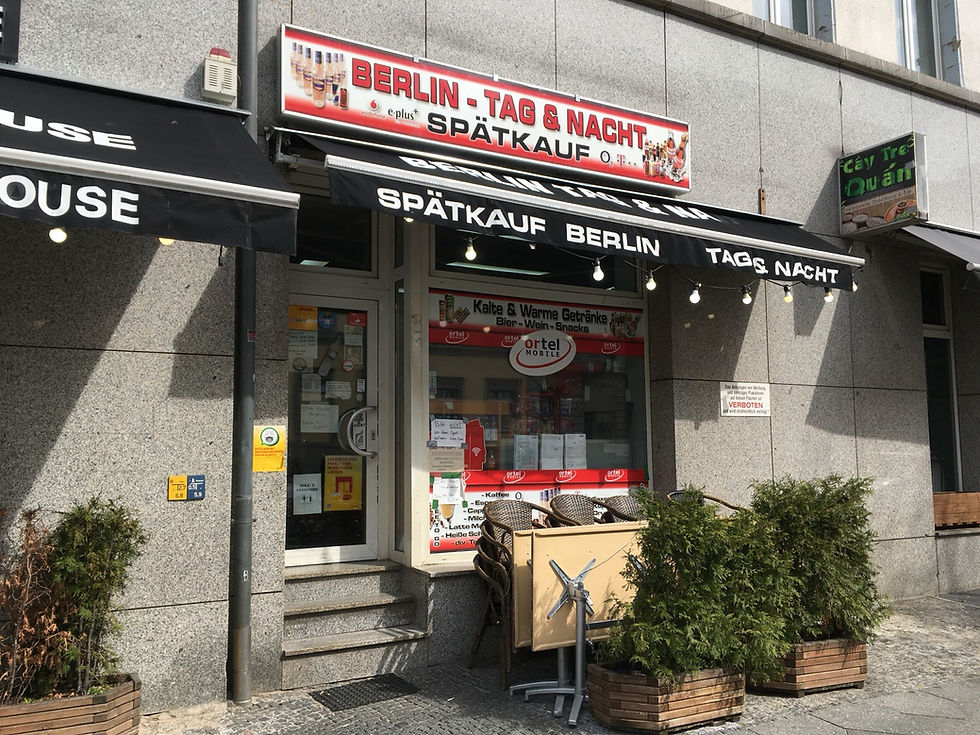
A Späti is Berlin's late-night corner shop. But if you only translate it as "convenience store", you miss the point. In Berlin, a Späti is part emergency shop, part neighborhood signal, part cultural shortcut.
It tells you something about how the city works after normal opening hours.

What Does Späti Mean?
Späti is short for Spätkauf. Literally, that means something like "late purchase".
You may also see the longer word Spätkauf on signs, especially on older shops. Some signs say Spätverkauf, Late Shop, Night Shop, Internet Cafe, Kiosk, or something wonderfully improvised in between. In daily Berlin speech, people usually just say Späti.
Say it like this:
Späti: roughly "shpeh-tee"
Spätkauf: roughly "shpeht-kowf"
You do not need perfect pronunciation. If you say "Späti" with a tourist accent, Berlin will survive.
The Short Answer
A Späti is a small late-opening shop that usually sells:
bottled water
beer and soft drinks
snacks and sweets
cigarettes and vapes
basic groceries
milk, bread, pastries, or fruit, depending on the shop
phone cables, lighters, tissues, toilet paper, and other small emergency items
magazines or newspapers in some older shops
That is the practical answer.
The cultural answer is better: a Späti is one of the places where Berlin keeps running when the official city has gone quiet.
Späti Survival Checker
Not every late-night problem is a Späti problem. Use this quick checker before you rely on one.
Why Berlin Has So Many Spätis
The official Berlin.de Späti overview describes Spätis as a Berlin speciality, with around 1000 of them in the city, mostly in central areas. The roots go back to Spätverkaufsstellen, late shops associated with the former GDR, where workers needed basic supplies after normal shop hours.
After reunification, the word and the habit spread across the whole city.
That history matters because the Späti does not feel like a polished chain-store concept. It feels more improvised. One shop may be clean, bright, and card-friendly. Another may look like it has been holding the neighborhood together since 1998. A third may sell coffee, DHL parcel service, club flyers, incense, lottery tickets, and a suspiciously large number of phone chargers.
This is Berlin. Systems exist, but they often come with improvisation attached.
Why Locals Stand Outside Spätis
In many cities, you buy something from a convenience store and leave.
In Berlin, people often buy a drink from a Späti and stay outside for a while. This is especially common in Kreuzberg, Friedrichshain, Neukölln, Prenzlauer Berg, and busy central pockets around Mitte.
Sometimes the Späti has benches. Sometimes people lean against a wall. Sometimes the whole pavement becomes a loose social space.
For tourists, this can look like a bar without a bar. That is partly right, but the rules are softer and more local:
You buy something from the shop.
You keep the noise reasonable, especially late at night.
You do not block the doorway.
You do not treat the pavement like a private party area.
You remember that people live above and around you.
The Späti can be wonderfully relaxed. It can also become annoying for neighbors when people turn it into a loud outdoor club. Be the first kind of visitor.
What Tourists Usually Buy at a Späti
The classic tourist Späti purchases are simple:
water for the hotel room
a cheap beer
a soft drink
crisps or chocolate
cigarettes
chewing gum
a lighter
a phone charging cable
a late-night snack after bars or clubs
emergency basics on a Sunday
If you are arriving in Berlin late, a Späti can save your first night. If your hotel room has no water, no kettle, and no nearby supermarket, look for one before you give up.
If you are joining my Berlin Free Walking Tour the next morning, the practical move is very simple: buy water before you arrive at the World Clock meeting point. Berlin is walkable, but two hours feel better when you are not thirsty.
Is a Späti Cheaper Than a Supermarket?
Usually no.
A Späti is often cheaper than a bar, especially for beer or soft drinks, but more expensive than a supermarket. You are paying for convenience, late hours, location, and the fact that someone is still behind the counter when most retail has closed. For the bigger money picture, my Berlin daily budget guide is a better place to compare food, drinks, transport, and museum costs.
For a tourist, that is still often worth it.
Think of it this way:
Supermarket: cheapest, best for planned shopping
Späti: best for late, small, practical purchases
Bar: best if you want to sit, use a toilet, and be served
The mistake is using a Späti like a full grocery shop. It is not built for that.
If the goal is atmosphere rather than a quick bottle, use a beer garden or bar instead. My Berlin beer gardens guide is a better fit for that kind of evening.
How Late Are Spätis Open?
There is no single Späti closing time.
Some close around midnight. Some stay open until 2 AM or 3 AM. Some are 24 hours. Some change their hours depending on the neighborhood, the owner, the season, staffing, local pressure, or enforcement.
From Monday to Saturday, Berlin has very flexible shop opening rules compared with many parts of Germany. In practice, normal supermarkets usually close somewhere around 8 PM to 10 PM, while Spätis often stay open later. visitBerlin's shopping and business-hours overview is a useful official starting point for the general pattern.
The best tourist rule is:
Use Google Maps as a hint, not a promise.
If the first Späti is closed, another one may be two blocks away.
In residential streets, do not assume late-night noise is welcome just because the shop is open.
Berlin is not a city where every opening hour online is sacred. Especially at small shops, the real answer is often on the door.
Are Spätis Open on Sundays?
This is the part tourists get wrong.
Normal shops and supermarkets in Berlin are generally closed on Sundays and public holidays. That is why Spätis feel so important. But "Späti" does not automatically mean "legally open all Sunday selling everything".
Berlin's shop opening rules make distinctions between product types and exceptions. The official Berlin.de Späti page explains that shops selling certain tourist supplies and goods for immediate consumption may open on Sundays and public holidays from 1 PM to 8 PM. It also notes a separate 7 AM to 4 PM window for shops with special product ranges such as flowers, newspapers, bakery products, and milk. For the official legal exception framework, see the Berlin service page on shop-opening exceptions for Sundays and public holidays.
The uncomfortable detail is that many Spätis sell mixed assortments. If a shop mixes different product categories, Sunday opening can become legally complicated.
For visitors, the practical version is:
Do not rely on a specific Späti being open on Sunday.
Train-station and airport shops are safer for real grocery needs.
If you only need water, snacks, or a drink, you will often find a Späti in central neighborhoods.
If you need proper supermarket shopping, plan it Monday to Saturday.
I wrote a full guide to this because it catches visitors every week: Are shops open on Sunday in Berlin?. For official station-supermarket examples, Berlin.de also keeps a page on supermarkets open on Sundays.
What About Public Holidays?
Public holidays usually feel like Sundays in Berlin retail life.
Supermarkets and normal shops are generally closed. Restaurants, cafes, museums, stations, airports, and some small shops may still operate. Spätis can help, but they are not a guaranteed replacement for planning.
If your arrival day is Easter, Christmas, New Year's Day, May 1, or another German public holiday, do your serious shopping before the holiday or use a major station. For the general tourist overview, Berlin.de's Sunday shopping page is worth checking before you travel.
A Späti is a backup. It is not a strategy for feeding a family for two days.
Cash, Cards, and the Small-Purchase Problem
Berlin has become more card-friendly, but cash still matters.
Spätis are exactly the kind of place where tourists should not assume a foreign credit card will work for a small purchase at midnight. Some accept cards. Some accept card only above a minimum amount. Some accept Girocard but not every international card. Some are cash-first. This sits inside the wider pattern I explain in my Berlin cash and card guide.
My honest advice:
Carry at least 20 to 40 euros in cash in small notes.
Keep a few coins for small purchases.
Ask before opening a drink if you plan to pay by card.
Do not be surprised if a small shop prefers cash.
This is not only a Späti issue. It is part of the wider Berlin money pattern.
The Pfand Rule: Your Bottle Is Not Just Trash
If you buy a beer, water, soft drink, or can at a Späti, you may pay Pfand, the German bottle deposit.

That deposit is usually:
25 cents for many single-use plastic bottles and cans
around 8 to 15 cents for many reusable glass bottles
The exact amount depends on the container.
You get the deposit back when you return the bottle or can to a place that accepts it, usually a supermarket machine or sometimes the Späti itself. Not every small shop accepts every bottle, especially if they do not sell that brand or container type.
The tourist etiquette is simple:
Do not smash bottles.
Do not throw deposit bottles deep into public bins.
If you do not want to return one, place it neatly beside a bin so a collector can take it.
If you are sitting outside a Späti, ask whether they want empties returned to the counter or a crate.
In Berlin, an empty bottle can still be worth money to someone. Treat it that way.
Can You Drink a Späti Beer Outside?
You will see people drinking beer bought from Spätis in public.
That does not mean every place, every situation, and every hour is a good idea. Berlin is relaxed compared with many cities, but you still need judgment.
Good Späti behavior:
one quiet drink with friends
stepping away from the entrance
keeping glass bottles under control
leaving when the shop or neighbors clearly want the pavement calmer
Bad Späti behavior:
loud group chanting
blocking the sidewalk
treating the street like a stag-party bar
leaving bottles behind
using doorways, courtyards, or apartment entrances as toilets
Berlin gives visitors a lot of freedom. The least you can do is not make the city regret it.
Is a Späti the Same as a Kiosk?
Not exactly, but the line is blurry.
In Berlin, a Späti usually means a late-opening shop inside a storefront. A kiosk may be smaller, more like a stand or booth, and may focus on newspapers, cigarettes, drinks, and snacks.
In practice, signs and local language overlap. If a Berlin friend says "Späti", they usually mean any small late shop where you can buy drinks or basics after regular shops close.
You do not need to police the difference. Just know what kind of place you are looking for.
Where Are Spätis Most Useful?
Spätis are most useful in neighborhoods where people live, go out, and move around late.
Tourists usually notice them most in:
Kreuzberg
Friedrichshain
Neukölln
Prenzlauer Berg
Wedding
Moabit
parts of Mitte
around busy S-Bahn and U-Bahn areas
Near big tourist sights, the Späti density can vary. Around Alexanderplatz, Hackescher Markt, Friedrichstrasse, and Warschauer Strasse, you usually have options nearby. Around museum-heavy or government-heavy areas, the evening retail life can feel thinner than tourists expect.
This is one reason I tell visitors not to judge Berlin only by landmark zones. The city makes more sense when you understand the Kiez, the lived-in neighborhood. Spätis are a small but very clear part of that.

If you are choosing where to walk, eat, or stay, this overlaps with broader neighborhood planning. My Berlin shopping guide explains the difference between polished retail areas and more everyday Kiez streets, while the Berlin public transport guide helps you understand why Spätis cluster around busy U-Bahn and S-Bahn movement.
What Not to Expect From a Späti
A Späti is useful, but it is not magic.
Do not expect:
full supermarket prices
fresh produce selection
public toilets
guaranteed card payment
perfect posted opening hours
English-speaking staff in every shop
a calm place to sit in bad weather
official tourist information
medicine or pharmacy products
For medicine, look for an Apotheke, and outside normal hours search for Notapotheke, the emergency pharmacy system. Berlin.de has an English overview of emergency services and pharmacies, and the Apothekerkammer Berlin runs a Notdienstfinder for emergency pharmacies.
For toilets, use stations, malls, museums, cafes, or the Berliner Toilette system. My public toilets in Berlin guide and the Berlin public toilet finder are more useful than hoping a Späti has a bathroom. For proper groceries, use a supermarket before Sunday.
A Späti solves small problems. It does not replace the rest of the city.
A First-Night Späti Plan for Tourists
If you arrive in Berlin in the evening and do not know the neighborhood yet, do this:
Check your hotel room for water, plugs, and anything you actually need.
Search "Späti near me" or walk toward the nearest lit commercial street.
Bring cash, not only a card.
Buy water first, then snacks or a drink.
If you buy beer, check whether there is Pfand.
Walk back quietly if it is late and residential.
This sounds almost too simple, but it saves a surprising number of first nights.
Berlin can feel hard on arrival because the city does not over-explain itself. Once you learn a few patterns, it becomes much easier. If you want a wider first-day checklist, use my Berlin First-Day Planner before you arrive.
Späti Etiquette in One Minute
Here is the fast version:
Say hello when you enter. A simple "Hallo" is enough.
Do not open a drink before paying.
Ask before paying by card for a tiny purchase.
Keep the doorway clear.
Do not make the pavement loud at midnight.
Return bottles if the shop wants them back.
Do not photograph staff or customers like they are part of a Berlin exhibit.
If a shop is closing, leave.
The most important rule is not complicated: remember that the Späti is someone else's workplace and someone else's neighborhood.
Should Tourists Seek Out a Famous Späti?
Not really.
Some Spätis are locally loved. Some have character. Some are attached to a particular street, square, or nightlife route. But for most visitors, the best Späti is the one near where you actually are when you need it.
This is not like choosing a museum or a restaurant. A Späti is part of everyday Berlin. If you over-plan it, you slightly miss the point.
The better goal is to understand what you are seeing when you pass one:
why it exists
why people gather outside
why Sunday is complicated
why cash still matters
why the empty bottle is not just rubbish
That knowledge changes how Berlin reads.
My Honest Advice
Use Spätis lightly.
Buy water. Buy a snack. Buy a late beer if that is your night. Enjoy the small feeling that Berlin is still awake around you. But do not turn the pavement into your private bar, and do not rely on Spätis to fix every Sunday planning mistake.
The Späti is one of those small Berlin details that explains a lot: strict rules and relaxed habits, neighborhood life and late-night improvisation, cash culture and bottle deposits, practicality and character in the same tiny shop.
That is exactly the kind of Berlin I like showing people on foot. The famous sights matter, but the city becomes much easier when you understand the everyday systems around them.
If you want Berlin to click faster, start with my Berlin Free Walking Tour. The route begins at the World Clock at Alexanderplatz, lasts about 2 hours, and helps you connect the official city with the real one people live in.
FAQ
For the next step, my practical Berlin guides to common German signs in Berlin, public drinking rules in Berlin, and grocery shopping in Berlin can help with the next practical detail.
Image Credits
Images via Wikimedia Commons:
Spätkauf in Berlin by Nicolas Bouliane, CC BY-SA 4.0, cropped and resized.
Berlin Tag Nacht Spätkauf by ChickSR, CC BY-SA 4.0, resized.
Spätkauf Berlin 2011 by Lukas Uhde, CC BY-SA 4.0, resized.
Spätkauf Late Night Shop by ChickSR, CC BY-SA 4.0, resized and orientation-normalized.