Kreuzberg Berlin: A Local Guide to the District's Two Very Different Halves
Updated: Jul 22
Ask ten people what Kreuzberg is like and you get two completely different answers. One tells you about squats, punk, kebab shops and bars that do not really start until midnight. The other talks about leafy streets, cobblestones, a Sunday farmers market and a hill with a waterfall. Both are right. Kreuzberg is really two districts that happen to share one name, and knowing which half you are walking into is the single most useful thing to understand before you go.
I send visitors here all the time, because Kreuzberg is where Berlin stops performing for tourists and just gets on with being itself. But I always ask the same question first: how much time do you have, and what time of day. That decides everything.
The two Kreuzbergs: SO36 and Kreuzberg 61
The split comes from the old West Berlin postal codes, and locals still use them as shorthand for two moods.
SO36 is the eastern half, around Kottbusser Tor, Oranienstraße and Görlitzer Park. It was the corner of West Berlin that pressed right up against the Wall, cheap and half-forgotten, which is exactly why artists, punks, draft-dodgers and Turkish families moved in during the 1970s and 80s. That mix never left. This is the loud, Turkish, political, stay-out-late Kreuzberg you see on postcards and in films.
Kreuzberg 61 is the western half, around Bergmannstraße. It kept more of its old apartment buildings, so today it feels calmer and more middle-class: tree-lined streets, cafés, a covered market hall, and the actual Kreuzberg hill that gave the whole district its name. Same district on the map, a completely different afternoon.
You do not have to choose one forever. The U1 line links both halves in a few minutes, so the smart plan is usually the quiet west in daylight and the busy east after dark.
East Kreuzberg (SO36): loud, Turkish, awake late
This is the half most people mean when they say "Kreuzberg." It is busier, grittier and more alive, and it is genuinely best from late afternoon onwards.

Oranienstraße is the spine of SO36: murals, kebab shops, bars and late-night noise.
Start at Kottbusser Tor, which everyone calls "Kotti." It is chaotic, a little rough around the edges, and completely real: Turkish grocers, döner counters, and one of the most photographed U-Bahn junctions in the city. From there, Oranienstraße runs east through the heart of the district, lined with bars, cheap eats, and the kind of street art that Kreuzberg is famous for. If you like murals, this is a good place to just wander and look up. For a wider tour of the city's walls and paint, see my guide to Berlin street art.

The U1 and U3 run on a viaduct above the street in east Kreuzberg, which makes hopping between stops easy.
Keep going and you reach Wrangelkiez and Schlesisches Tor, a tighter grid of bars and small restaurants that fills up in the evening. The reward at the end is the Oberbaumbrücke, the double-deck brick bridge over the Spree, with the U1 rattling across the top. Cross it and you are in Friedrichshain, a two-minute walk from the East Side Gallery and the longest surviving stretch of the Berlin Wall. That short walk, from a Turkish market square to a painted Wall, tells you a lot about how this city fits together. To walk the same ground in the other direction, the Kreuzberg Street Art Audio Tour starts at the East Side Gallery and finishes at Kottbusser Tor.
West Kreuzberg (Bergmannkiez): calm, cobbled, daytime
Cross to the western half and the volume drops. This is the Kreuzberg for a slow morning, a coffee, and a walk that does not demand anything of you.

Bergmannstraße in the Bergmannkiez: cafés, cobblestones and the Marheineke market hall.
Bergmannstraße is the main artery here, a long café strip that ends at the Marheineke Markthalle, a covered market hall good for lunch, cheese, coffee and a sit-down when your feet give out. Slip a block south to Chamissoplatz, a cobbled square ringed by nineteenth-century facades that survived the war largely intact, with a small farmers market on Saturdays. It is one of the prettiest quiet corners in inner Berlin, and almost no first-time visitor finds it.
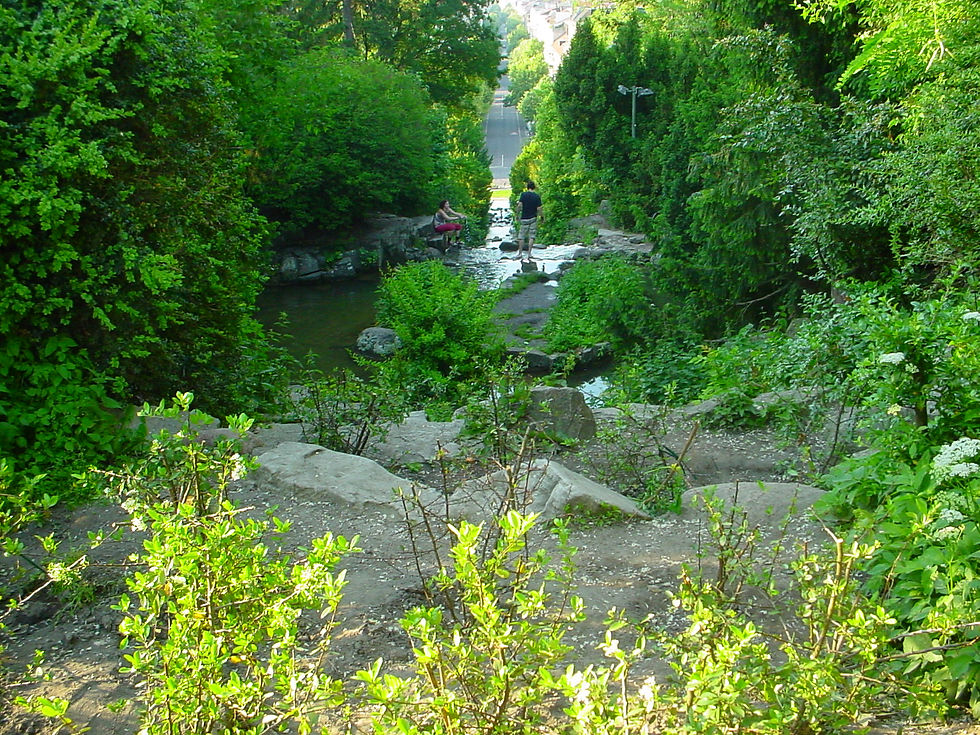
The Viktoriapark waterfall runs down the Kreuzberg hill, the 66 m rise the whole district is named after.
Then there is the hill itself. Viktoriapark climbs to the Kreuzberg, at 66 metres the highest natural point in the inner city, topped by a Schinkel-designed monument to the wars against Napoleon and with an artificial waterfall tumbling down the front in the warmer months. The district, the cross on its coat of arms, and the monument all take their name from this small hill. It is an easy climb and a genuinely good view for zero euros. If you are chasing high views across the city, I compare the paid options in my guide to Berlin observation decks, but this one is free.
Where to eat in Kreuzberg
Food is half the reason to come, and Kreuzberg does it better than almost anywhere else in Berlin.

Markthalle Neun on Eisenbahnstraße runs its popular Street Food Thursday from 17:00 to 22:00.
The Mehringdamm corner, on the line between the two halves, has the two most-queued snacks in the city: Curry 36 for currywurst and Mustafa's Gemüse Kebap for a grilled-vegetable kebab. The Mustafa's queue can be absurd, so I usually point people to Curry 36 next door if they are hungry now rather than committed to the legend. For the wider currywurst question, I have a whole guide to the best currywurst in Berlin.
For a proper meal-as-an-event, Markthalle Neun on Eisenbahnstraße is a restored 1890s market hall that runs Street Food Thursday every Thursday from 17:00 to 22:00, plus weekend markets. And a short walk south along the canal, the Maybachufer Turkish Market runs on Tuesdays and Fridays, technically on the Neukölln bank but very much part of the same world. Fruit, cheese, fabric, and the best street snacks in the area.
Which half should you start with?
If you only have an afternoon or an evening, do not try to do all of Kreuzberg. Pick the half that matches your mood and the time on the clock. This is exactly the decision the tool below is built for: answer a few quick questions and it points you to the right side, with the U-Bahn stop to start from.
Is Kreuzberg safe?
Yes, for normal visits. Kreuzberg is busy, lived-in and walkable, and the vast majority of it is completely fine by day and by evening. It looks scruffier than the polished centre, but scruffy is not the same as dangerous.
The one honest caveat is Görlitzer Park, in the east. It has a long-standing, very visible open drug-dealing scene, and that is not a tourist myth. By day it is a normal, busy park full of families and dog-walkers, and you can cross it without any trouble. I just would not treat it as a place to sit around alone late at night. The city built a fence and gates around "Görli" and started closing it after dark in spring 2026, but as of July 2026 a court has paused that nighttime closure while it is challenged, so the gates are currently being kept open again and the situation is still unsettled.
Around Kottbusser Tor you will also see visible poverty and some drug use. It looks intense the first time, but ordinary street sense is enough: keep your phone and bag close in crowds, as you would in any big city. For the wider picture, I keep an honest overview in is Berlin safe to visit.
Getting to Kreuzberg, and where it fits your trip
For the eastern SO36 side, take the U1 or U3 to Kottbusser Tor, Görlitzer Bahnhof or Schlesisches Tor; the U8 also stops at Kotti. For the western Bergmannkiez side, use the U7 to Gneisenaustraße, or the U6/U7 to Mehringdamm for the food corner and the hill. The elevated U1 viaduct through the east is a small sight in itself.
Kreuzberg is not part of my free walking tour, and I would not pretend otherwise. My route stays in the historic centre of the old East, starting at Alexanderplatz, where the layers of divided-city history sit close together. Kreuzberg is the other side of that story: the West Berlin edge that turned scruffiness into a whole culture. Do the centre with me to understand the history, then give Kreuzberg its own afternoon to feel how the city actually lives now. If you are still deciding where to base yourself, my guide to where to stay in Berlin covers whether Kreuzberg is the right neighbourhood for you.
Image credits
Images via Wikimedia Commons: Oberbaumbrücke by Ansgar Koreng (CC BY-SA 4.0); Kottbusser Tor by GillyBerlin (CC BY 2.0); Bergmannstraße and Marheineke by Fridolin freudenfett (CC BY-SA 4.0); Viktoriapark waterfall by Angr (CC BY-SA 2.5); Markthalle Neun by Dirk Ingo Franke (CC BY-SA 4.0). The Oranienstraße mural photograph is released under CC0.