East Side Gallery: Berlin's Open-Air Wall Guide
- Yusuf Ucuz
- Jun 7
- 6 min read
Updated: Jul 22
If you have seen one image of the Berlin Wall that is not grey and grim, it was probably from the East Side Gallery: a Trabant smashing through the concrete, or two old communist leaders kissing on the mouth. This painted stretch of Wall in Friedrichshain is one of the most photographed places in Berlin, and one of the most misunderstood.
So here is the honest guide from someone who walks this city every week: what the East Side Gallery actually is, the murals worth looking for, how to visit it without the crowds, and how it fits into the much larger story of the Wall that I tell on tour.
What is the East Side Gallery?
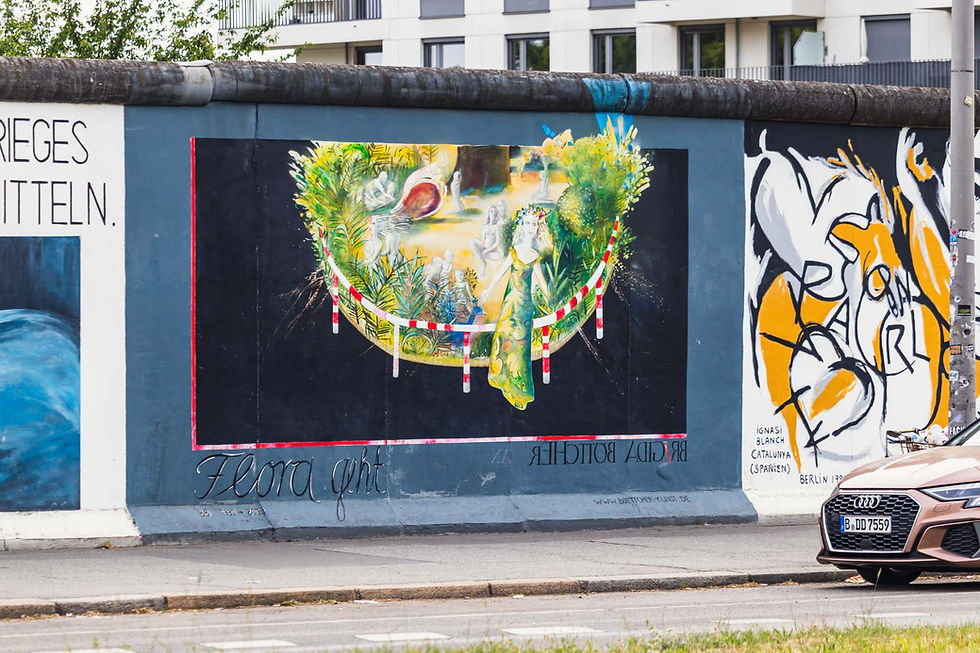
The East Side Gallery is a 1,316 metre section of the Berlin Wall, running along Mühlenstraße in Friedrichshain beside the river Spree. After the Wall fell, 118 artists from 21 countries painted this stretch in the spring of 1990, turning a symbol of division into the longest open-air gallery in the world.

It is free, outdoors, and open around the clock. You do not need a ticket and there is nothing to book. The official caretaker today is the Berlin Wall Foundation, which also runs the memorial sites across the city.
One thing that surprises people: this was not the famous "front" of the Wall that the West saw. This is the eastern, inner side of the border, the part ordinary East Berliners could never get near. The artists painted it only after the border was already open.
A short history: from death strip to open-air gallery
For 28 years this concrete was part of a deadly border. The stretch survived because of where it stood, hard against the Spree, just out of the way of the first wave of demolition.
In 1990, with the country reunifying, artists were invited to paint the inner side. They were not painting in protest behind anyone's back; they were painting a celebration, a goodbye to the border, and a hope for what came next. The result was protected as a listed monument in 1991.

There is a catch that honest visitors should know. The original 1990 paintings weathered badly and were covered in tags and signatures within a few years. In 2009, most of the wall was stripped and the artists were invited back to repaint their works from scratch. So what you photograph today is, in most cases, a 2009 version of a 1990 idea.
The gallery has also had to fight to survive. In 2013 a section was removed to make way for riverside luxury flats, which set off loud protests, including a famous appearance by the actor David Hasselhoff. It is a reminder that even a protected monument in Berlin is never entirely safe from the property market.
The murals to look for
There are over a hundred paintings, and you do not need to study all of them. A handful carry most of the meaning, and they are the ones worth slowing down for. The guide below lays out the most famous murals, who painted them, and what each one is actually saying, so you know what you are looking at as you walk.
The two everyone comes for are Dmitri Vrubel's "My God, Help Me to Survive This Deadly Love", the socialist "fraternal kiss" between Brezhnev and Honecker, and Birgit Kinder's "Test the Rest", the Trabant breaking through the Wall (only a tiny edge of it remains in my photos, but you will see it in the interactive guide above).
Give the rest a few minutes too. Here are the other famous murals from our guide that you should look for on your walk:
"Es geschah im November" (It Happened in November) by Kani Alavi
This mural shows a wave of faces flowing through a gap in the Wall, capturing the intense emotions—joy, fear, and uncertainty—of the East Berliners crossing the border on November 9, 1989.

"Umleitung in den japanischen Sektor" (Detour to the Japanese Sector) by Thomas Klingenstein
A dreamlike, orange-toned painting featuring Japanese elements and silhouettes, expressing a longing for love, peace, and distant lands during the division.

"Berlin bei Nacht" (Berlin at Night) by Yvonne Onischke
A colorful, stylized cityscape that depicts Berlin after dark, featuring the Spree river and the historic brick towers of the nearby Oberbaumbrücke.

"Doin' it cool for the East Side" by Jim Avignon
A vivid, cartoon-like painting that represents the optimistic energy, music, and underground club culture that erupted in East Berlin right after the Wall fell.

"Parlo d'Amor" (I Speak of Love) by Ignasi Blanch
A Catalan artist's tribute to hope and tolerance, featuring soft yellow and grey figures, created as a memory of the international solidarity that followed the reunification.
The honest take: gallery versus memorial
This is where I have to be straight with you, because it changes how you plan your day.
The East Side Gallery is wonderful, but it is art and symbol, not a history lesson. It is busy, the paintings are repaints, and there is very little on site to explain what the border actually was. People sometimes leave thinking they have "seen the Berlin Wall", when really they have seen a mural project on one piece of it.
If you want to understand the Wall, the death strip, the watchtowers, the tunnels, and the people who died trying to cross, go to the Berlin Wall Memorial on Bernauer Straße. I cover the difference in my guide to the Berlin Wall and what is left in 2026. Do both if you can: the East Side Gallery for the feeling, Bernauer Straße for the facts.
One more thing. It is a memorial, not a canvas. Adding your own marker tag to it, which people do, is vandalism of a protected monument, and it is part of why the 2009 repaint was needed in the first place.
How to visit
A few practical notes:
Cost and hours. Free, outdoors, and open 24 hours. There is nothing to book.
Where it is. Mühlenstraße in Friedrichshain, on the north bank of the Spree.
Getting there. Take the S-Bahn to Ostbahnhof for the quieter northern end, or the S-Bahn and U-Bahn to Warschauer Straße for the Oberbaumbrücke end. Both are a short walk. If trains still confuse you, here is my Berlin public transport guide.
How long. Allow about 45 minutes to walk the full 1.3 kilometres and stop at the famous murals. Longer if it is busy.
When to go. Early morning is far quieter and far better for photos. By midday it is shoulder to shoulder around the famous pieces. For more timing ideas, see Berlin's best photo spots.
Visitor center and info steles. While the gallery is entirely open-air and open 24/7, the Berlin Wall Foundation runs a small visitor center at Mühlenstraße 73 (open daily 10:00 AM – 5:00 PM) for questions and guided tours. They have also installed 15 glass information panels (steles) and large aluminum "wall angles" along the path with witness interviews and historical context.
What is nearby
The East Side Gallery sits in one of Berlin's most enjoyable corners, so do not just walk it and leave:
Oberbaumbrücke, the photogenic double-deck brick bridge at the Warschauer Straße end, crosses the Spree into Kreuzberg and was itself a border crossing during the division.
The Spree riverbank and its bars are a good place to sit after the walk.
Friedrichshain and Kreuzberg, the neighbourhoods on either side, are the heart of Berlin's nightlife and street-art scene.

The East Side Gallery and the rest of the Wall
The gallery is one chapter of a much bigger story that is written right across the city. If the Wall is what brought you to Berlin, follow the thread:
Where was the Berlin Wall? An interactive map shows the full line through the modern city.
The Berlin Wall: where it stood and what is left in 2026 is the practical guide to every surviving piece.
Cold War Berlin in 5 key locations connects the gallery with Checkpoint Charlie, the Brandenburg Gate, and more.
For the background, start with how Berlin was divided.
How it connects to our walking tour
The East Side Gallery is in the east of the city, away from where my tour runs, but it is part of the same story. The Wall did not stay out at the edges; it cut straight through the historic centre, right past the Brandenburg Gate and along the route I walk every day.
That route, from the World Clock on Alexanderplatz through Museum Island to Hackescher Markt, is where Berlin's whole history layers up: medieval, Prussian, wartime, divided, and reunified. See the East Side Gallery for yourself in the morning, then join our free walking tour to understand how all the pieces, including the Wall, actually fit together. You can see the full plan on our tour route page.
For the next step, my practical Berlin guides to Sachsenhausen from Berlin and Tranenpalast and the Palace of Tears can help with the next practical detail.
Image credits
All photographs by Yusuf Ucuz. Murals: “My God, Help Me to Survive This Deadly Love” (Fraternal Kiss) mural by Dmitri Vrubel. “Worlds People” mural by Schamil Gimajew. “Vaterland” mural by Günther Schaefer. “It Happened in November” mural by Kani Alavi. “Umleitung in den japanischen Sektor” mural by Thomas Klingenstein. “Berlin bei Nacht” mural by Yvonne Onischke. “Doin’ it cool for the East Side” mural by Jim Avignon. “Parlo d’Amor” mural by Ignasi Blanch. Uber Arena and Uber Platz. Mural photographs are published under German freedom of panorama; the mural artists are credited above.