Berlin Street Art: Where to Find the Best Murals and Graffiti
Updated: Aug 24
You have seen the photos before you even land: a painted stretch of the Berlin Wall, two politicians kissing, a Trabant bursting through concrete. So you arrive expecting street art everywhere, and then you spend your first day around Museum Island and the Brandenburg Gate and barely see a single spray can. The famous stuff, it turns out, is not where most visitors start.
I run a history walking tour through the old centre, so I am not a street art guide. But guests ask me about it constantly, and the honest answer is that Berlin street art is real, it is largely free, and most of it sits a short train ride out of the polished middle. Here is where to actually find it, and which spots are worth the journey.

Victor Ash's "Astronaut Cosmonaut" in Kreuzberg. It is not on any main tourist route, which is exactly why so many visitors miss Berlin's best murals.
What counts as Berlin street art?
People use "graffiti" and "street art" as if they are the same thing, and in Berlin you will see the full range on one wall. It helps to know what you are looking at.
Tags and throw-ups are the fast, letter-based signatures sprayed everywhere, from trains to shutters. This is the oldest, rawest layer.
Murals are the large, planned wall paintings, often commissioned, like the Cosmonaut above.
Paste-ups and stencils are the paper and cut-out works layered onto doorways and corners, cheaper and quicker than a full mural.
Berlin became a street art capital for a simple reason. After the Wall fell in 1989, whole districts sat half-empty with cheap rent, unclear ownership and plenty of blank concrete. Artists moved in and painted. A lot of that raw energy has since been renovated away, but the city still has more open, legal and tolerated wall space than almost anywhere in Europe.
One thing to hold loosely: outdoor street art changes. A piece you saw in a photo may already be painted over. That is not a loss, it is the point. The wall is a conversation, not a museum.
Start close: Haus Schwarzenberg, five minutes off the tourist trail
If you only have the appetite for one spot and you are already in the centre, make it this one. Haus Schwarzenberg is a scruffy courtyard at Rosenthaler Straße 39, right next to the smart Hackesche Höfe by Hackescher Markt. Most people walk straight past the entrance without noticing it.
Inside, the walls are a living collage of paste-ups, stencils and murals that changes almost weekly, with a famous portrait of Anne Frank by the artist Jimmy C that stays put. It is one of the last genuinely independent art spaces left in the increasingly polished middle of the city. It is free and open at any hour.

Haus Schwarzenberg, also known as Dead Chicken Alley, sits one minute from Hackescher Markt and is repainted constantly. This is the easiest street art to reach in Berlin.
The reason I send guests here is distance. It is about five minutes on foot from where my walking tour finishes at Hackescher Markt, so it costs you nothing and no extra journey. Use the map below to see how the rest of the spots compare on effort against how much there is to see, so you can decide what is actually worth a train ride.
The famous one: the East Side Gallery
The image in your head is almost certainly the East Side Gallery. It is a 1.3 kilometre stretch of the Berlin Wall that artists painted in 1990, home to the Brezhnev and Honecker kiss and the Trabant breaking through the concrete. It is the longest open-air gallery in the world and, fairly, the most famous street art in the city.
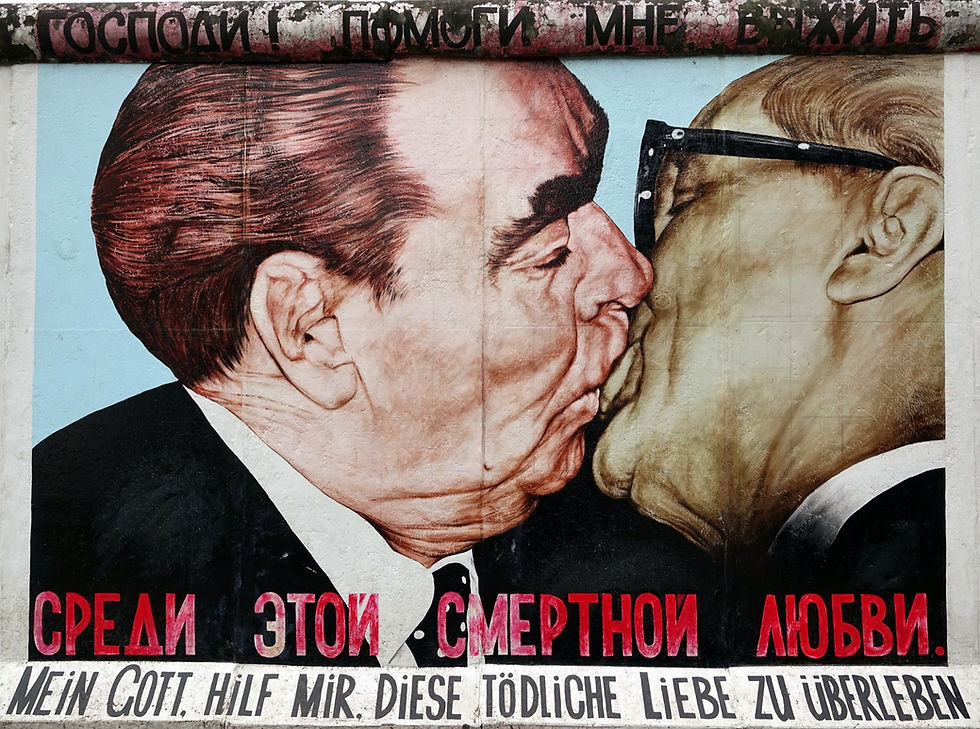
The kiss between Brezhnev and Honecker is the East Side Gallery's signature image. Come early, because by midday people queue to photograph it.
My one piece of advice is to go early. By late morning it is crowded and you will wait your turn at the best-known panels. It is really Wall history as much as street art, which is why I gave it its own full guide rather than squeezing it in here. To reach it, take the U-Bahn or S-Bahn to Warschauer Straße; if you are unsure which train is which, my explainer on the U-Bahn versus the S-Bahn untangles it.
The living scene: RAW-Gelände and Kreuzberg's big walls
This is where Berlin street art stops being a monument and starts being alive. Two areas do it best, and they sit close together on the same side of town.
RAW-Gelände is a former railway repair yard on Revaler Straße in Friedrichshain, now a raw compound of clubs, a skate hall and walls buried under constantly shifting graffiti. It is unglossy and a little rough, which is the appeal. Go in daylight to actually see the art, and keep the usual city sense about you after dark.
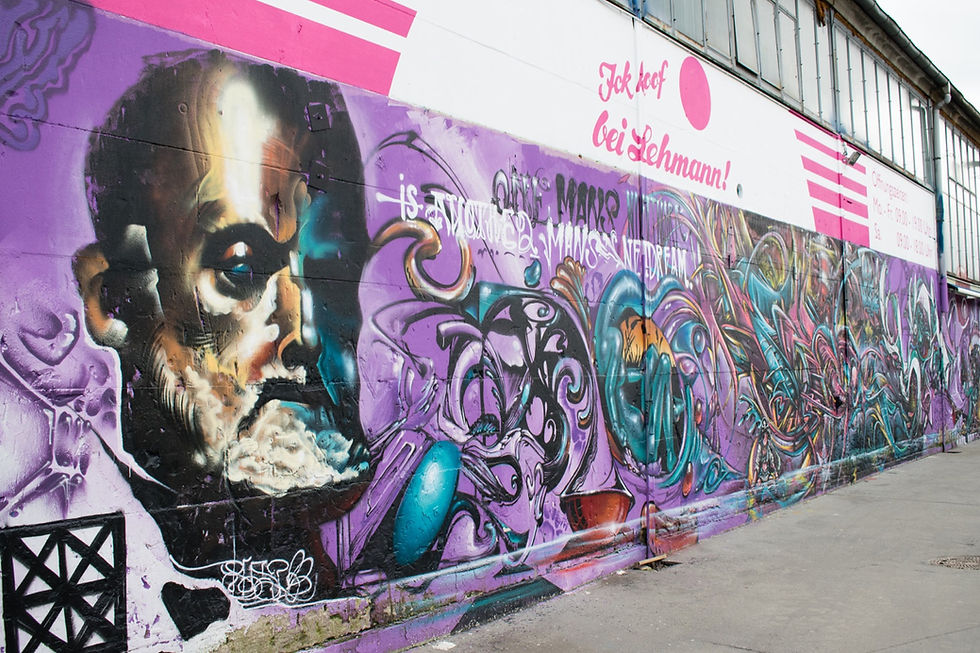
RAW-Gelände in Friedrichshain is repainted so often that no two visits look the same. This is the working, spray-can end of the scene.
Across the water in Kreuzberg, the streets around Kottbusser Tor hold some of the best big-wall murals in the city. The star is the one on the cover of this post: Victor Ash's giant "Astronaut Cosmonaut" on the corner of Mariannenstraße and Oranienstraße, a stencilled spaceman painted in 2007 that has become a neighbourhood landmark. My favourite way to see Kreuzberg is not to hunt one wall but to just walk Oranienstraße with your head up and let the art, the falafel and the bars come to you.
One indoor stop: the free Urban Nation museum
If it is raining, or you want names and context rather than just walls, Berlin has a museum for exactly this. Urban Nation, on Bülowstraße in Schöneberg, is a free museum dedicated to urban and street art. Inside it rotates exhibitions by big international artists; outside, the surrounding street is itself a run of commissioned murals.

Urban Nation in Schöneberg is free to enter and the one indoor option here. It is closed on Mondays, so plan around that.
Two practical notes. It is closed on Mondays and opens later in the day from Thursday to Sunday, so check the current hours before a special trip. And because it is exhibition-led rather than huge, it pairs well with the free-culture side of the city; it is worth reading alongside my guide to which Berlin museums are free.
The big expedition: Teufelsberg
Everything so far is free and reachable in a normal afternoon. Teufelsberg is the exception, and the one true adventure. It is an abandoned Cold War listening station on a hill in the Grunewald forest, its domes and towers now covered inside and out in what is often called Europe's largest open-air street art gallery.

Teufelsberg mixes Cold War ruin with street art on a hill in the forest. It is the only spot here with an entry fee and a real walk to reach it.
Be clear-eyed about it. It charges an entry fee of around 10 euros, it sits a genuine walk uphill from the nearest S-Bahn stations at Grunewald or Heerstraße, and there is no easy parking. It is a wonderful half-day if you love street art or Cold War ruins, and honestly skippable if you are on a tight first visit with a long list. Go on a dry weekday morning for the clearest views over the city from the top.
How to fit street art into a Berlin day
Here is the plan I would actually give a guest, ordered by effort:
Almost no effort: step into Haus Schwarzenberg by Hackescher Markt while you are already in the centre.
Half a day, free: pair the East Side Gallery with RAW-Gelände, since both are around Warschauer Straße, then cross to Kreuzberg for the Cosmonaut.
A rainy slot: the free Urban Nation museum in Schöneberg.
A full half-day trip: Teufelsberg, if street art is genuinely your thing.
A couple of the free walls double as something else entirely. The Mauerpark graffiti wall is best folded into a lazy Sunday with the flea market and open-air karaoke, rather than chased on a quiet weekday. And if you want all of this slotted into a realistic day rather than a scramble across the map, my Ultimate Berlin Trip Planner builds it around where you are staying.
None of it is on my tour route, which stays in the medieval core. But the city I show you and the city on these walls are the same place, a hundred years apart, and Haus Schwarzenberg is only five minutes from where we finish. Look up on your way there.
Images: "Astronaut Cosmonaut" mural by Victor Ash, photo by Rae Allen (CC BY 2.0); Haus Schwarzenberg courtyard, Babewyn (CC BY-SA 4.0); East Side Gallery "My God, Help Me to Survive This Deadly Love" by Dmitri Vrubel, photo by Gzen92 (CC BY-SA 4.0); RAW-Gelände, Thomas Kühling (CC BY 3.0); Urban Nation Museum, Fridolin freudenfett (CC BY-SA 4.0); Teufelsberg, KK nationsonline (CC BY-SA 4.0). All via Wikimedia Commons.