Kurfürstendamm Berlin: A Local Guide to City West
Ask a Berliner where the Kurfürstendamm is and you will get a shrug and a direction. Ask a visitor and you get a plan for the whole afternoon. That gap is worth understanding before you go, because the Kurfürstendamm is 3.5 kilometres long and only the first stretch of it does what people expect.
I send guests west all the time, but I send them to a specific 300 metres of it, not to the street as a project. This is what is actually there, where the good part ends, and how to get in and out without wasting an afternoon on shop windows.
Where the Kurfürstendamm actually starts
Here is the first thing almost everyone gets wrong. KaDeWe is not on the Kurfürstendamm. The department store sits on Tauentzienstraße, the shorter street that runs from Wittenbergplatz to Breitscheidplatz. The Kurfürstendamm only begins at Breitscheidplatz, at the broken church, and runs southwest from there to Rathenauplatz.
Together the two streets make one continuous walking axis of about 4.1 kilometres. Locals treat the whole thing as "Ku'damm" in conversation, which is why the confusion survives. It matters for one practical reason: if someone tells you to meet them "on the Ku'damm" near KaDeWe, they are describing a spot on a different street.

Tauentzienstraße seen from KaDeWe, looking west toward Breitscheidplatz. The Kurfürstendamm starts at the church in the distance.
The street itself is older than it looks. It began as a causeway out to the Grunewald hunting lodge, and from the 1870s it was widened into a 53 metre boulevard with four rows of plane trees on Bismarck's initiative. The date locals cite as its birthday is 5 May 1886, when the steam tram from Zoologischer Garten to Halensee started running.
Wittenbergplatz to Uhlandstraße is the part worth walking
The useful visitor walk runs from Wittenbergplatz to Uhlandstraße, about 1.3 to 1.4 kilometres and roughly 18 minutes at a normal pace. The first part is Tauentzienstraße; the Kurfürstendamm section begins at Breitscheidplatz and continues west from the church. Nearly everything a visitor comes to City West for is inside that combined stretch. Here is what sits in it.
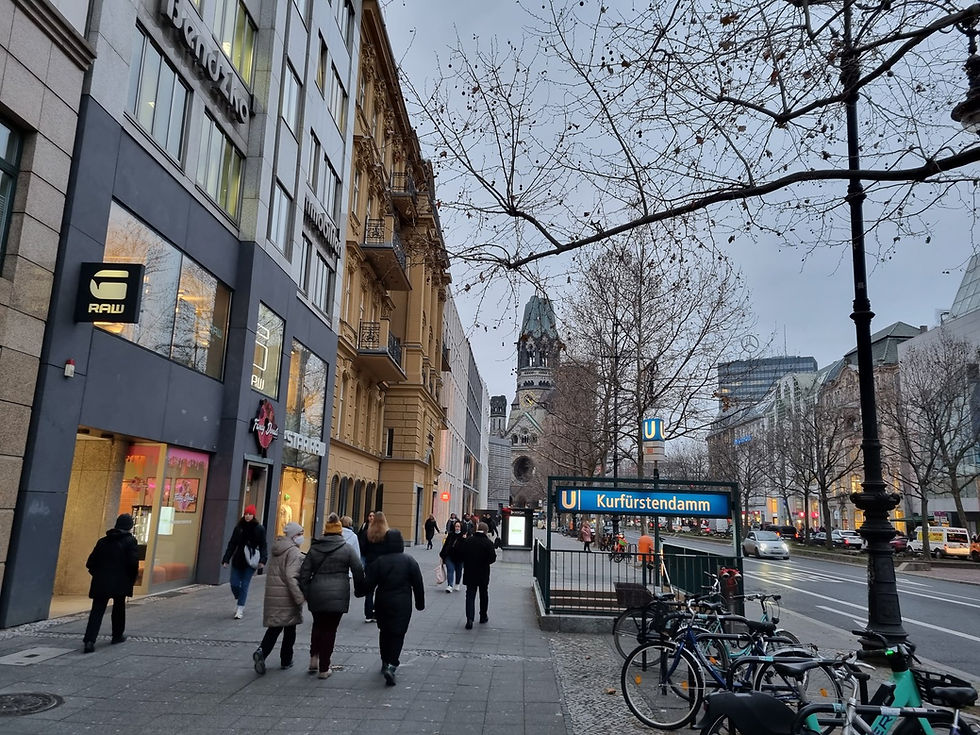
The busy stretch between Breitscheidplatz and Uhlandstraße. The U1 entrance here is your easy way back east.
The Kaiser Wilhelm Memorial Church
The broken tower on Breitscheidplatz is the single most important thing on this street. The church was hit in November 1943 and the ruin was deliberately left standing when the new blue-glass church went up beside it. Entry is free. The new church is normally open daily from 10:00 to 18:00. The Memorial Hall inside the ruined tower lists separate opening days, commonly Monday to Saturday from 10:00 to 18:00, but current closure notices can override them. Check the church's official visitor page on the day you go.
Ten minutes inside that hall explains West Berlin better than an hour of walking does. I have written a longer piece on how to visit the Memorial Church if you want the detail.
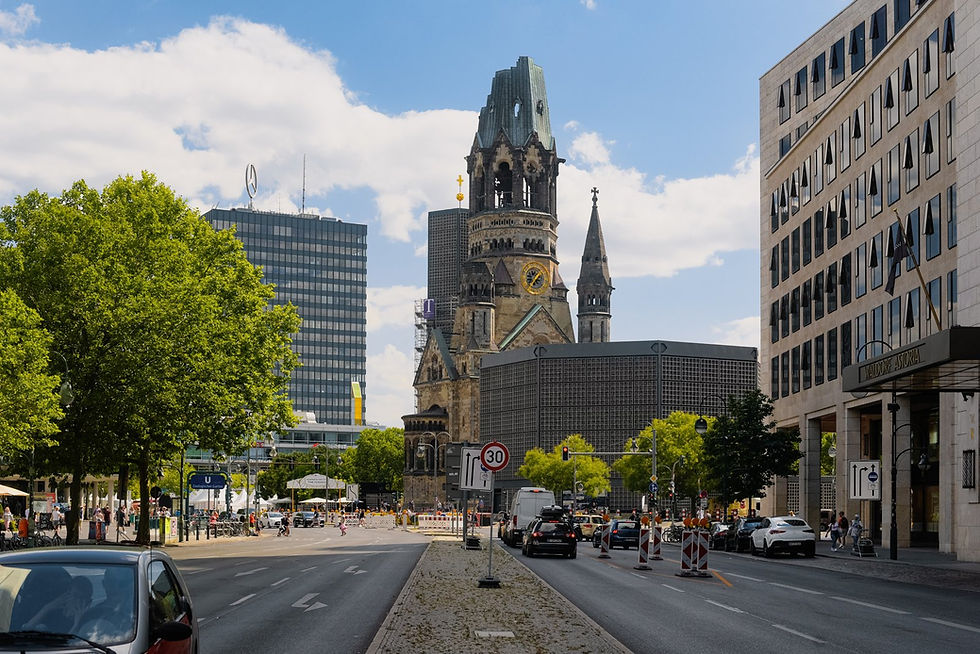
Breitscheidplatz on a normal summer afternoon. The Kurfürstendamm officially begins here.
Bikini Berlin and a free view into the zoo
Directly behind the church is Bikini Berlin, a 1950s block turned into a concept mall. The free roof terrace is listed as open daily from 9:00 to 21:00 and looks across into Zoo Berlin. For the direct view of the monkey enclosure, use the panoramic Monkey Window inside the lower mall rather than the roof. The shops run Monday to Saturday from 10:00 to 20:00, so on Sunday check which indoor areas are accessible before relying on the window.
The Monkey Bar upstairs in the 25hours hotel next door has the same view with a drink in your hand, and it appears in my list of Berlin rooftop bars.
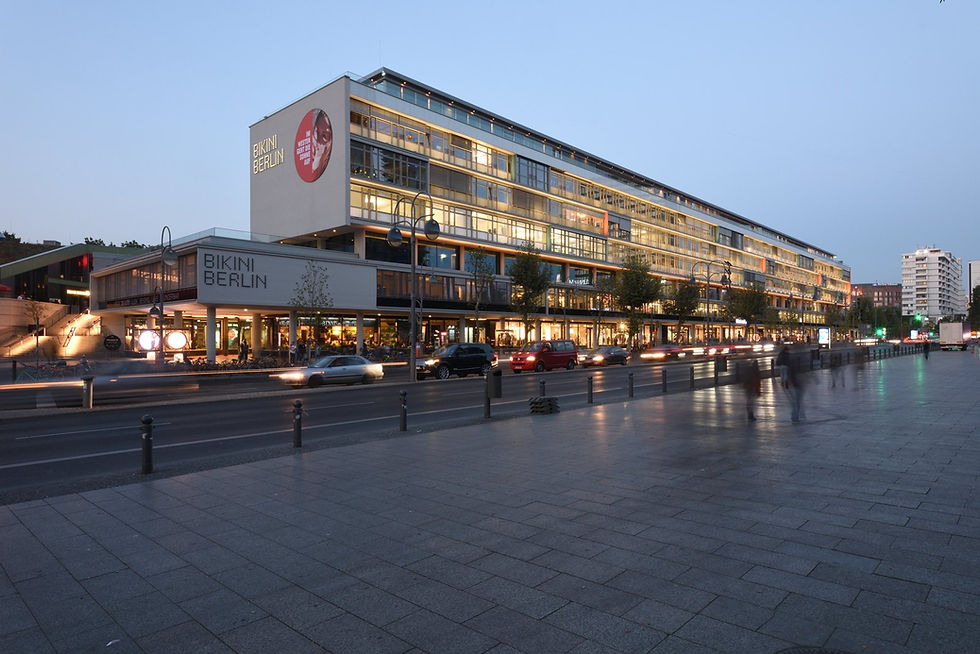
Bikini Berlin on Budapester Straße at blue hour. Its free roof terrace looks across into the zoo.
C/O Berlin
Across from Zoologischer Garten station, in the old Amerika Haus, is C/O Berlin, a photography museum that is consistently one of the better exhibition spaces in the city. It is open daily from 11:00 to 20:00. Admission is 15 euros, 8 euros reduced, and free for visitors aged 18 and under. Whether you go depends on the current show, but the building alone is a genuine piece of Cold War history: it was the American cultural centre in West Berlin.
One practical note about this cluster: the church, Bikini Berlin, the zoo entrance, C/O Berlin and Zoologischer Garten station are all within about 300 metres of each other. If you only have an hour in the west of the city, spend all of it here and do not walk further.
Savignyplatz is the turn most people should make
About 400 metres north of the Kurfürstendamm, between Uhlandstraße and Adenauerplatz, is Savignyplatz. Two leafy squares split by Kantstraße, restaurants tucked under the S-Bahn arches, and the Bücherbogen bookshops built into the railway vaults.
This is where I go and it is where I send people. On a warm evening, Savignyplatz beats another kilometre of Kurfürstendamm every time. The area is old West Berlin in the way that actually survives: no landmark, no ticket, just a neighbourhood that kept its restaurants. Walk up Fasanenstraße or Knesebeckstraße from the boulevard and you are there in five minutes.

Savignyplatz, four hundred metres north of the boulevard. The better end of a Ku'damm afternoon.
What is west of Adenauerplatz, and who it is for
Past Adenauerplatz the Kurfürstendamm keeps its width and loses its reasons. Offices, hotels, car showrooms, tall apartment blocks. It is real Berlin and people live good lives on it, but there is nothing there that justifies the walk from Breitscheidplatz.
Two exceptions are worth naming, because both are genuinely good and both deserve a dedicated trip rather than tired feet at the end of a shopping walk.
The Schaubühne at Lehniner Platz is one of the most important theatres in Germany. Selected performances carry English surtitles, so check the current programme before you plan an evening around one. The theatre occupies Erich Mendelsohn's Universum cinema from 1928, part of the WOGA complex. Its long curved form was designed like a ship's keel, and the building has housed the Schaubühne since 1981.

The Schaubühne occupies Mendelsohn's 1928 Universum cinema. Come for a play, not as the end of a long walk.
Rathenauplatz, where the street ends, has two concrete Cadillacs standing on end in the middle of a traffic circle. Wolf Vostell put them there in 1987 for West Berlin's 750th anniversary as part of the Skulpturenboulevard. The Cadillacs are one of three surviving works from that project, and people still argue about them. It is a good story and a bad plan: you are about 4.1 kilometres from Wittenbergplatz, and the Ringbahn at Halensee is roughly 400 metres away.
Why West Berlin needed a second city centre
City West did not begin from nothing. The Kurfürstendamm was already a fashionable shopping, theatre and cinema address before the Second World War. When Berlin was divided, much of the historic core around Unter den Linden and Museum Island lay in East Berlin. The western half then concentrated its principal commercial and cultural centre around Zoologischer Garten, the Memorial Church, Tauentzienstraße and the Kurfürstendamm.
Department stores, cinemas, the zoo, a major station and theatres made this axis the public showcase of West Berlin. The Kurfürstendamm was not just a shopping street; it was one of the places where the western half presented itself to residents and visitors.

Tauentzienstraße in 1978, when this axis was West Berlin's principal commercial and showcase centre.
After reunification, Mitte again became a major visitor and business centre, but City West did not disappear. The city simply had more than one strong centre again. If you want the background, I have written about how Berlin was divided and why Berlin has no old town in more detail.
Getting there and getting out
The Kurfürstendamm is closer than most visitors think. From Alexanderplatz it is about 15 to 20 minutes.
U-Bahn: U1 and U9 stop at Kurfürstendamm station, about 200 metres west of Breitscheidplatz. U2 and U9 reach Zoologischer Garten, around 300 metres from the square. U1, U2 and U3 all stop at Wittenbergplatz.
S-Bahn: the Stadtbahn lines S3, S5, S7 and S9 stop at Zoologischer Garten, which is the easiest arrival if you are coming from Hauptbahnhof, Friedrichstraße or Alexanderplatz.
Zones: all of it is inside zone AB, so a normal Berlin ticket covers it.
Getting out: the useful exits are U1/U9 Kurfürstendamm, U1 Uhlandstraße and U7 Adenauerplatz. West of Adenauerplatz there is no U-Bahn on the street at all, which is the real reason to turn back there.
If you are still deciding where to base yourself, my guide to where to stay in Berlin covers whether the west makes sense for your trip.
So is the Kurfürstendamm worth it?
Yes, with a strict limit on how much of it you walk.
Go for Breitscheidplatz: the broken church, the free roof terrace, the zoo, C/O Berlin, and the way this square became the centre of public life in West Berlin during the division. Give it an hour or two. Then either turn north to Savignyplatz for the evening, or take the U-Bahn back east.
Do not walk the full 3.5 kilometres expecting it to keep getting better. It does not, and I have made that mistake myself on a hot afternoon that I do not recommend repeating. The Kurfürstendamm rewards a short, deliberate visit and punishes completionism.
My free walking tour stays in the historic centre in the east, so the two do not overlap. If anything they work well as a pair: the tour explains the city that was destroyed and divided, and an afternoon on the Kurfürstendamm shows you what one half of it built instead.
Photo credits are available from the closed Image credits control inside the interactive route above.