Wittenberg Day Trip from Berlin: Trains, the Theses Door and What Is Actually Open

Stand on a platform at Berlin Hauptbahnhof, board an ICE heading south, and 41 minutes later you step out in the small town where the modern world cracked open in 1517. A Wittenberg day trip from Berlin is one of the easiest history trips Germany offers: one train, one street, and the actual door where Martin Luther posted his 95 theses.
I recommend Wittenberg to guests who have already walked Berlin's centre and want one calm day outside the city. The town is compact in a way Berlin never is. Almost everything sits on a single 1.9 kilometre line between the station and the Castle Church, so you can see the whole story on foot without planning anything complicated.

Wittenberg from above: the Town Church, the market square and, at the far end of the same street, the Castle Church tower.
The trains: ICE in 41 minutes or RE3 on the Deutschlandticket
Two trains matter, and they leave from the same station. Times below were checked on 4 September 2026.
The ICE runs roughly hourly from Berlin Hauptbahnhof, usually at 27 or 29 minutes past the hour, and reaches Lutherstadt Wittenberg Hbf in 41 to 42 minutes.
The RE3 regional train runs about every two hours, at 40 past the hour in the morning (08:40, 10:40, 12:40 on a typical weekday), and takes 1 hour 27 minutes. It also stops at Potsdamer Platz and Südkreuz, which saves you crossing the city to Hauptbahnhof.
Coming back is relaxed: ICE trains leave Wittenberg at 48 past the hour into the evening, with RE3 departures spread between them, including one just before 21:00.
The ticket question has a trap in it. Wittenberg sits in Saxony-Anhalt, not Brandenburg, and that changes which of the usual Berlin day trip tickets work:
The 63 euro Deutschlandticket covers the RE3 door to door. If you already hold one, this day trip costs you nothing extra in transport.
The Brandenburg-Berlin-Ticket does not reach Wittenberg. The flat group ticket that wins for Potsdam or the Spreewald ends at the state border, and the Sachsen-Anhalt-Ticket does not include Berlin either.
The Quer-durchs-Land-Ticket (51 euros plus 12 per extra person) covers the trip on regional trains, but on weekdays it is only valid from 09:00, so the first RE3 you can actually use with it is the 10:40.
For the ICE you need a normal DB ticket. Booked a few days ahead, advance fares for this short hop are often cheap; Super Sparpreis fares start at 6.99 euros. Group and Deutschland tickets are never valid on ICE trains.
If you want the full comparison logic for group tickets versus advance fares, I broke it down in my guide to train tickets for day trips from Berlin.

Lutherstadt Wittenberg Hauptbahnhof: the ICE from Berlin arrives here in about 41 minutes.
One street runs the whole town
From the station, the old town works like a single line. You walk about 12 minutes into Collegienstraße, and from there the street changes its name twice while carrying you past every major sight: Collegienstraße to the market square, then Schlossstraße to the Castle Church. End to end it is about 1.9 kilometres of flat, cobbled, mostly pedestrian town.
On the way in you pass the Luthereiche, an oak standing where Luther burned the papal bull that threatened him with excommunication in December 1520. The tree you see today was planted in the 19th century, but the spot is the real one, and it makes a fitting first stop: this is where the argument stopped being academic.
My advice: walk the street in one direction and let the stops come to you in order. The tool below shows the whole line with real photographs, walking times from the station, and what each stop costs and when it opens, so you can decide in advance which ones deserve your time.
The Theses Door and the two churches
The Castle Church (Schlosskirche) holds the famous door and Luther's grave. The wooden door of 1517 is long gone, destroyed by fire in 1760; what you touch today is the bronze door from 1858 with the full Latin text of the 95 theses cast into it, under a golden mosaic. Inside, Luther and his ally Philipp Melanchthon lie buried a few steps from where the argument started.
Open Monday to Saturday 10:00 to 17:00, Sundays and holidays from 11:30, with a 3 euro preservation fee (1 euro reduced).
The tower climb costs 3 euros extra, and the last ascent is at 16:00. On a clear day you see how small the town that changed Europe actually is.

The bronze Theses Door of 1858 carries the full Latin text of the 95 theses.
The Town Church of St. Mary (Stadtkirche), a short walk back along the street, is where Luther actually preached and had his children baptised. The prize inside is the Reformation altar painted by Lucas Cranach the Elder and his son, with Luther sitting in the Last Supper like a Wittenberg local. From April to October it is open Monday to Saturday 11:00 to 17:00 and Sundays from 12:30; hours shorten in winter. A combined ticket for both churches costs 5 euros, and under 18s enter free.
Between the two churches lies the market square with its white Renaissance town hall and the statues of Luther and Melanchthon. The whole ensemble, together with the Luther and Melanchthon houses, has been UNESCO World Heritage since 1996.

The market square with the Renaissance town hall, halfway along the walk.
The Lutherhaus is closed, so here is what to see instead
This is the part most visitors find out too late, standing in front of a construction fence. The Lutherhaus, the monastery where Luther lived and taught, is closed for renovation until spring 2027.
The museum moved its best pieces next door instead:
"Literally Luther. Facets of a Reformer" runs in the Augusteum (Collegienstraße 54) daily from 10:00 to 18:00, 6 euros, reduced 4. You still see the things worth the trip: Luther's monk's habit, Cranach portraits, and the first Wittenberg complete edition of the German Bible. The exhibition is scheduled to run until early January 2027.
The Melanchthonhaus (5 euros, closed Mondays) is the elegant Renaissance house of the movement's quiet organiser, with a garden out back that most people miss.
The Cranach courtyards at Markt 4 and Schlossstraße 1 show where Lucas Cranach ran his workshop, pharmacy and print business; there is a working historical print room, and the courtyards themselves are free to step into.
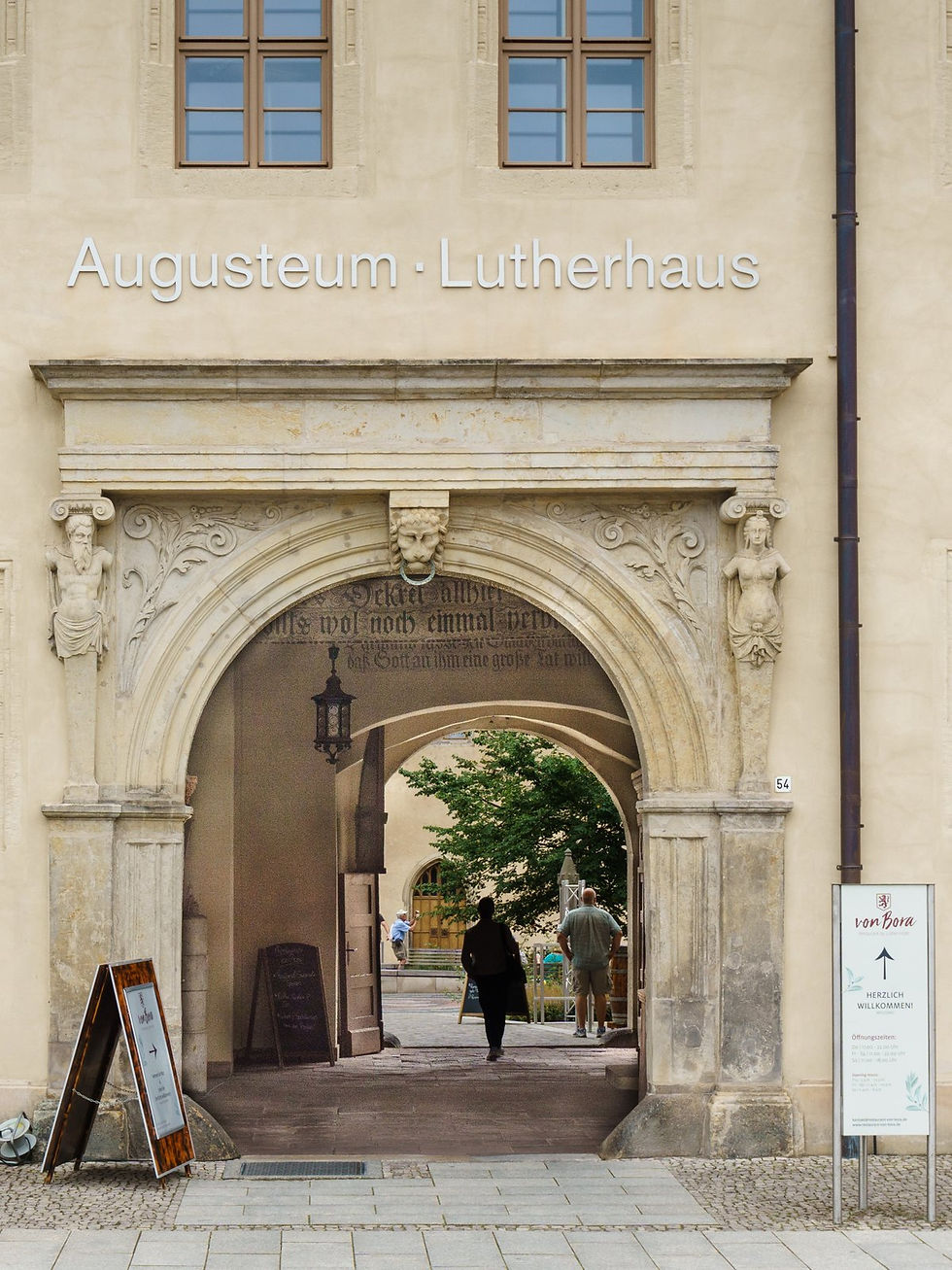
Through the Augusteum portal: the Lutherhaus behind it is closed until spring 2027.
If the weather turns or you travel with kids, the asisi panorama LUTHER 1517 near the station (Lutherstraße 42, daily 10:00 to 17:00, last entry 16:30, 14 euros, children 6 to 16 pay 7) wraps you in a 360 degree image of Wittenberg on the day the theses went up. I would not build the trip around it at that price, but as a one-hour rain plan it works, and children read the scene faster than any museum label.

Inside the LUTHER 1517 panorama near the station: Wittenberg as it looked in 1517.
How I would time a Wittenberg day trip from Berlin
My advice: take a morning train, but not the earliest one. Wittenberg opens slowly; the churches unlock at 10:00 or 11:00, so arriving at 08:30 mostly buys you closed doors and an empty street. I have made that mistake before, in this exact town.
A day that works, using times valid on weekdays:
09:27 ICE from Hauptbahnhof, arriving 10:09, or the 10:40 RE3 if you travel on a Deutschlandticket or Quer-durchs-Land-Ticket.
Walk in past the Luthereiche, then do the Augusteum exhibition before the midday groups arrive.
Lunch on the market square, then the Stadtkirche altar, the Castle Church and the Theses Door, and the tower before the 16:00 last ascent.
Train back around 17:48 or 18:48; you are in Berlin in time for dinner.
Two calendar notes. On Mondays both churches and the Augusteum stay open, but the Melanchthonhaus closes, so museum lovers should pick another day. And on 31 October, Reformation Day, Wittenberg throws its festival and fills completely; it is a public holiday in Saxony-Anhalt and Brandenburg, though not in Berlin, so shops back in the capital stay open while Wittenberg parties.
If you enjoy this kind of one-train escape, my guides to Leipzig, Dresden and Potsdam follow the same logic.
And the story connects back to Berlin more directly than most visitors expect. Berlin adopted the Reformation in 1539, twenty-two years after the door, and a bronze Luther still stands beside St. Mary's Church at Alexanderplatz, one of the stops on my free Berlin walking tour. Walk Wittenberg one day, then come and see where the same story landed in Berlin.
Image credits
Source and licence details for the 6 photographs used in this article.
Aerial view of Wittenberg with the Town Church, market square and Castle Church tower: Toni Klemm, CC BY-SA 4.0, via Wikimedia Commons.
The modern station building of Lutherstadt Wittenberg Hauptbahnhof: Andre_de, CC BY-SA 4.0, via Wikimedia Commons.
The bronze Theses Door of the Castle Church in Wittenberg: Dguendel, CC BY 4.0, via Wikimedia Commons.
The market square of Wittenberg with the Renaissance town hall: Dguendel, CC BY 4.0, via Wikimedia Commons.
The stone portal of the Augusteum on Collegienstrasse in Wittenberg: Radler59, CC BY-SA 4.0, via Wikimedia Commons.
Visitors inside the asisi panorama LUTHER 1517 in Wittenberg: asisi F&E GmbH, CC BY-SA 4.0, via Wikimedia Commons.