Dresden Day Trip From Berlin: What It Really Costs You in Hours

Updated: Jul 22
Dresden is the day trip Berlin visitors are told is easy. Under two hours on the train, a baroque old town you can walk across in ten minutes, and back in time for dinner. Most of that is true. What nobody tells you is that the whole thing is decided by two numbers: the train you leave on and the train you come back on.
My advice: do not plan a Dresden day trip from Berlin around what you want to see. Plan it around the two trains, then fill the gap between them. Do it the other way and the afternoon becomes a clock-watching exercise instead of a visit to the city.

The Neumarkt and the Frauenkirche. Almost everything worth seeing on a day trip sits within about 500 metres of this square.
Why a Dresden day trip from Berlin is an hours problem, not a distance problem
Dresden is close. That is exactly what makes people careless with it.
The fast train takes about 1 hour 40 minutes each way. That sounds like nothing until you add the two ends. You have to get to Berlin Hauptbahnhof, and once you land in Dresden you still have a 20 minute walk into the old town, and the same walk back. On a normal day trip that is roughly three and a half hours of moving before you have looked at a single building.
The good news is that the arithmetic still works, and it works better here than on most German day trips. Leave Berlin at 07:28, take the 18:53 back, and you have nine and a half hours on the ground. That is a real day, not a raid.
The bad news is that the trains are every two hours, not every hour. Older guides still describe an hourly service. That is out of date. If you miss the 18:53, the next departure is a late evening train that does not run on every date, and suddenly your cheap day trip is a hotel booking.
The train you take is the whole decision
There are four ways to get from Berlin to Dresden, and they are genuinely different products rather than four speeds of the same thing.
The direct fast train. This is the one to take. It runs from Berlin Hauptbahnhof to Dresden Hauptbahnhof in about 1 hour 40, roughly every two hours. Since the December 2025 timetable change these are Railjet services on the Berlin to Prague line, not the EC trains that older articles describe. The name matters, and I will come back to why.
The IC. There is a second long-distance train, and here is the trap: it does not stop at Berlin Hauptbahnhof at all. It runs via Berlin Ostkreuz and the airport, reverses direction at BER, and takes about two hours from Ostkreuz. If you are staying in Friedrichshain it can be convenient. If you are standing at Hauptbahnhof waiting for it, it is not coming.
The regional route. Two trains with a change at Elsterwerda, about three hours each way. This is the Deutschlandticket option, and it has a 2026 complication I cover below.
The bus. Around 35 departures a day and a shortest journey of about 1 hour 54, which is barely slower than the IC. It drops you near Dresden Hauptbahnhof. It is a fair backup if the trains are full or expensive, but it is not covered by any rail ticket.
For the current pattern and prices, check Deutsche Bahn's Berlin to Dresden page before you commit to a date.

Dresden Hauptbahnhof. The translucent roof is worth thirty seconds of your attention before you start walking.
The Deutschlandticket trap
This is the single most expensive misunderstanding on this route, so I want to be blunt about it.
The Deutschlandticket does not cover the fast direct train to Dresden. It is a Railjet, and Railjet is named on the official exclusion list alongside ICE, IC and EC. Boarding it with a Deutschlandticket means buying a full ticket on board.
It gets worse if you are reading older advice. Until 13 December 2025, regional tickets from the Berlin and Brandenburg transport association were accepted on the IC between Berlin and Elsterwerda. Deutsche Bahn ended that arrangement. Every blog post and forum answer written before that date telling you to use your Deutschlandticket on the IC to Dresden is now simply wrong.
What the Deutschlandticket does cover is the slow route: the regional train to Elsterwerda, the connecting train onward, and then every tram and bus in Dresden once you arrive. At 63 euros a month in 2026 that is excellent value if you already hold one. It just costs you about two and a half hours of daylight compared with the fast train.
If you are still working out whether the ticket makes sense for your trip at all, my Deutschlandticket guide for tourists goes through the maths properly.
One more thing worth knowing: the two regional day tickets, the Brandenburg-Berlin-Ticket and the Sachsen-Ticket, each stop at their own state border. Neither one covers the whole journey. You would need both, and neither is valid before 09:00 on a weekday, which kills the early start.
The 2026 detail that changes where you arrive
While engineering work at Dresden Hauptbahnhof runs through 15 November 2026, the connecting regional train from Elsterwerda terminates at Dresden-Neustadt, on the other side of the river, not at the main station.
That is not a disaster. It is a different day. You arrive on the Neustadt side, cross the Augustusbrücke into the old town, and the scruffier, younger half of Dresden is on your doorstep instead of being a 2 kilometre detour. If the Neustadt is what you came for, the slow train is quietly the better one.
The walk nobody budgets for
Here is a claim you will see everywhere: the Frauenkirche is a ten minute walk from Dresden Hauptbahnhof.
It is not. It is about 1.6 kilometres, straight up Prager Straße, and it takes a normal person twenty minutes. Add the same walk back and you have spent forty minutes of your day getting between the station and the thing you came to see. Trams run it in a few minutes if the weather is against you.
I am labouring this because it is exactly the kind of small error that turns a comfortable plan into a rushed one. Build the forty minutes in.
The Altstadt is smaller than you expect, and that is the good news
Once you are there, Dresden repays you fast. The core is genuinely tiny.
Zwinger to Semperoper: about 130 metres
Hofkirche to Zwinger: about 180 metres
Frauenkirche to the Brühlsche Terrasse: about 200 metres
Frauenkirche to the Zwinger, the longest hop in the loop: about 500 metres
The whole circuit of Neumarkt, the Fürstenzug, Schlossplatz, the Hofkirche, Theaterplatz, the Zwinger and the Brühlsche Terrasse is well under two kilometres of walking. You can see the outside of everything famous in Dresden in about ninety minutes, without hurrying and without paying for anything.
That is why Dresden works as a day trip. The sights are not spread out. They are stacked.

The Fürstenzug, about 102 metres of Meissen porcelain along the Stallhof wall. Free, outdoors, and there whatever day you turn up.
The Monday and Tuesday trap
If you take one thing from this guide, take this one.
Dresden's two headline museums close on different days.
The Zwinger picture gallery, the Gemäldegalerie Alte Meister, is closed on Mondays.
The Residenzschloss and the Green Vault are closed on Tuesdays.
There is no single day of the week when both are shut, and there is no day when you are safe without checking. Plan "the museums" for a Monday without checking and you lose half the reason you came.
The upside is that this is easy to work with once you know. Monday is a Green Vault day. Tuesday is a Zwinger day. Any other weekday gives you both.
And on either day the outdoor city still works: the Zwinger courtyard, the Fürstenzug, the Brühlsche Terrasse and the Neumarkt cost nothing and do not depend on the museum closing day. The Zwinger courtyard itself has opening hours, currently 06:00 to 22:00 through August 2026.

The Zwinger courtyard. Walking in costs nothing. Only the museums around it are ticketed.
What is actually worth paying for
You will not do all of these in a day. Pick one or two.
The Frauenkirche interior is free, and it is the surprise of the trip. From outside it is a heavy stone dome. Inside it is pale pink, green and gold, and much lighter than the exterior prepares you for. A donation is asked for, not required. Opening hours shift daily around services and rehearsals, so check the Frauenkirche site rather than assuming.
The dome climb costs 12 euros and gives you the best view over the old town roofs. From March to October it runs Monday to Saturday from 10:00 and Sunday from 13:00, with the entrance at stair tower G.
The Gemäldegalerie Alte Meister costs 18 euros, and the same ticket gets you into three more museums in the Zwinger. Allow ninety minutes minimum. Closed Mondays.
The Historic Green Vault costs 18 euros and needs a timed ticket. Capacity is limited and slots sell out. Book it before you leave Berlin or accept you may not get in. Closed Tuesdays. This is the room the 2019 jewel theft emptied; the recovered pieces went back on display in 2024.
The Semperoper guided tour costs 16 euros and lasts 45 minutes, running nearly every day, though rehearsals can cancel it. Numbers are limited, so book ahead through Semperoper Erleben.
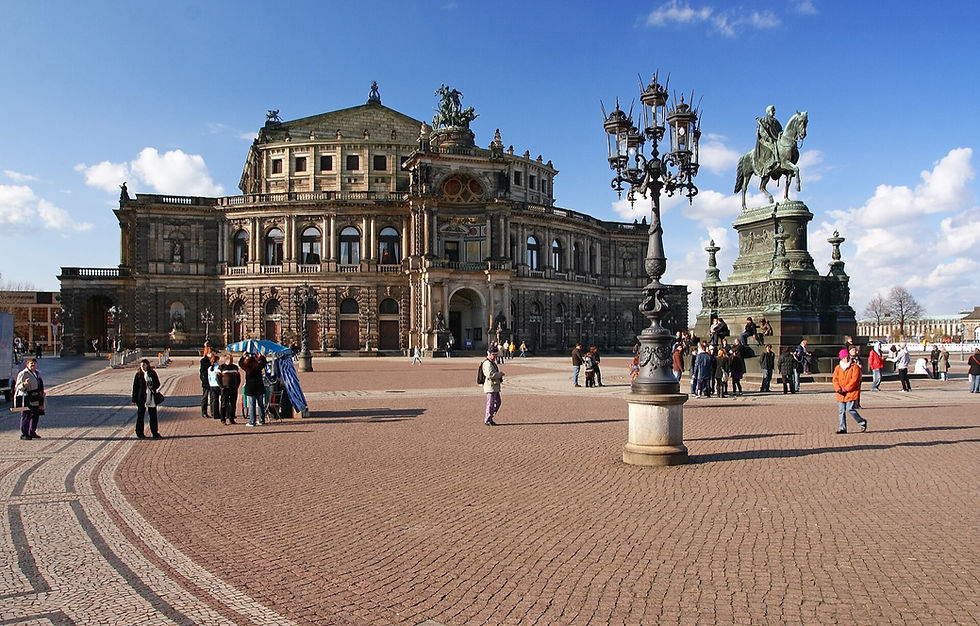
Theaterplatz. The Semperoper is two minutes from the Zwinger, so seeing the outside costs you nothing but the detour.
Book the train early, and book it on a fixed departure
Walk-up long-distance fares in Germany are punishing. Advance fares are not.
Deutsche Bahn's cheapest advance tier starts at 6.99 euros one way and the standard advance tier at 21.99 euros, both second class. On a route this short you will usually find something in the low teens if you book a week or two out. The flexible walk-up fare is several times that.
The catch is that cheap fares are tied to a specific train. On a two-hourly service that is a real commitment, so decide your return before you book, not after lunch in Dresden.

The steps up to the Brühlsche Terrasse. Once you are on the terrace the Elbe opens out, and this is the view most people remember.
Is Dresden actually worth a day trip, or should you stay over?
Honestly: the day trip is the right call for most people.
Because the Altstadt is a five hundred metre cluster, ten hours on the ground is genuinely enough for the outdoor loop, one or two museums, the dome climb and a long lunch. You are not skimming. You are seeing the thing.
Stay overnight only if one of these is true: you want the Neustadt in the evening rather than the afternoon, you are continuing into Saxon Switzerland or towards Prague, or you want three or more museums. Otherwise you are paying for a hotel to do the same day slightly slower.
One honest warning about the river view. The Carolabrücke partly collapsed in 2024 and was demolished by late 2025, so the Elbe panorama is not the one in older photographs and will not be rebuilt for years. The classic view from the Brühlsche Terrasse is still there. The bridge in the postcards is not.
If you are weighing Dresden against the alternatives, my guide to the best day trips from Berlin puts it next to Potsdam, the Spreewald and Sachsenhausen. Potsdam is the easy half day; Dresden is the one worth a full one.
Where this fits in a Berlin trip
My rule is simple: do not spend a day out of Berlin until you have understood Berlin.
Dresden is a beautiful, rebuilt, baroque city, and the contrast with Berlin is the point of going. But that contrast only lands if you already know what Berlin is and why it looks the way it does. If Dresden is on day two of a four day trip, you will spend it comparing a city you have not met yet.
That is the same reasoning behind my free walking tour through the historic centre. Two hours around Alexanderplatz, the Marienkirche, the Rotes Rathaus and Museum Island gives you the frame. Dresden makes far more sense on day three than on day one. If you are still deciding how to spread your days, how many days you need in Berlin is the honest version.

Inside the Frauenkirche. The exterior gives no hint of this, which is exactly why it is worth the twenty minutes.