Leipzig Day Trip from Berlin: The Fast Train, the Cheap Route and What Fits in One Day

Stand on the lower level of Berlin Hauptbahnhof on any weekday morning and watch the departure board for a few minutes. Dresden gets a queue of tourists with day bags. Potsdam gets everyone else. And the train to Leipzig, which is faster than both of those trips, leaves with businesspeople and almost no visitors on it.
I think that is one of the quiet mistakes of Berlin tourism. Leipzig is a little over an hour away, the whole city centre is walkable from the station, and it holds the other half of a story I tell constantly in Berlin: how East Germany ended. Berlin has the Wall. Leipzig has the church where the pressure that broke it started.

The Markt and the Altes Rathaus in evening light. Almost everything in this article is within ten minutes of this square on foot.
The two ways to make a Leipzig day trip from Berlin work
There are two honest versions of this trip, and they are built on two different tickets.
The fast version: ICE or IC, about 70 minutes. Direct long-distance trains run frequently between Berlin and Leipzig Hauptbahnhof, and the quickest take a little over an hour. During Berlin's 2026 Stadtbahn closure this route is one of the lucky ones: Leipzig trains use the north-south tunnel, so they leave from the lower level of Hauptbahnhof, the platforms Germans call *tief*, and from Südkreuz. If you have read my guide to leaving Berlin by train in 2026, this is the easy case. As a bonus, the Berlin to Leipzig line came out of a full renovation at the end of 2025, so 2026 is a good year for it.
Super Sparpreis is train-specific, and DB advertises it from 6.99 euros nationwide, but that is not a promise for every Berlin–Leipzig departure. Sparpreis starts at 21.99 euros nationwide and can be cancelled before travel for a 10 euro fee. Flexpreis costs the most and lets you take any train that day, which on a day trip is worth real money the moment a museum runs long. Seat reservations are optional at 5.50 euros. Check the exact train and live fare on bahn.de.

A regional train under the iron roof of Leipzig Hauptbahnhof. The city centre starts directly across the ring road.
The slow version: the Deutschlandticket route, about three hours. The Deutschlandticket is not valid on ICE or IC trains, full stop. But regional trains go to Leipzig too: take the RE3 from Berlin Hauptbahnhof, lower level, to Lutherstadt Wittenberg, then the S-Bahn line S2 on to Leipzig. Budget about three hours each way with the change, and check the exact connection in the DB Navigator app, because not every RE3 runs the full distance. If you already hold the ticket, the extra cost of this whole day trip is zero euros of transport, and the same ticket covers Leipzig's trams when you arrive. Two things worth knowing: Wittenberg itself, Luther's town, makes a genuinely good stop on the way if you leave early, and this direct Wittenberg to Leipzig S-Bahn link disappears with the December 2026 timetable change. This is the year to use it.
My advice: take the fast train out and decide the return leg by how sure you are of your evening. I book the cheap locked fare for the morning, because I know when I want to arrive, and keep the way back flexible, because I never actually leave a city when I planned to. I have made that mistake before, and watching a departure board from the wrong side of a closing museum door is not how you want to remember Leipzig.
What actually fits: the walkable core
Leipzig Hauptbahnhof is enormous, one of the largest stations in Europe, with a shopping arcade built into it. Do not linger. Cross the ring road in front of it and you are two streets from the Markt. Everything in this section sits inside a circle you can walk across in about fifteen minutes.
Nikolaikirche. From the outside it is easy to walk past. Inside, the columns open into pale green palm fronds, and it is one of the most surprising church interiors in Germany. Entry is free and it is open daily. This is also where the story of 1989 begins, which I come back to below.
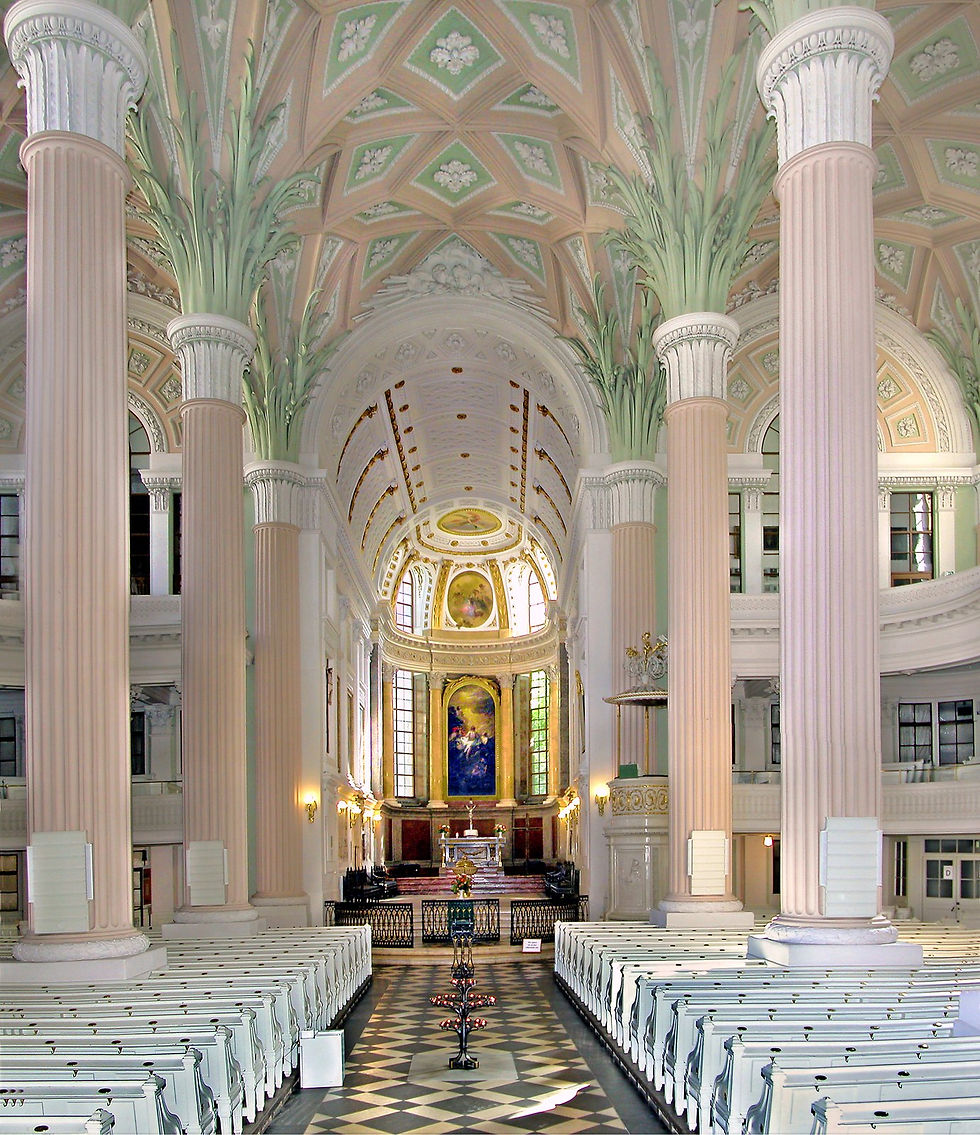
The palm columns of the Nikolaikirche. The Monday peace prayers that grew into the 1989 demonstrations started under this ceiling.
Thomaskirche. Ten minutes across the centre. Johann Sebastian Bach ran the music here for 27 years, and his grave lies in the chancel floor. Entry is free. If your trip lands on a Friday or Saturday, the Thomanerchor's motet services, Fridays at 18:00 and Saturdays at 15:00 for a small admission of around 3 euros, are the cheapest world-class concert you will ever attend; confirm the week's schedule on thomaskirche.org because the choir travels and the regular motets pause during Saxony's summer holidays. The Bach Museum opposite the church is closed Mondays and costs 14 euros; under-18s and visitors on the first Tuesday of each month enter free.

The Thomaskirche from the west. Bach worked here from 1723 until his death in 1750.

The Bach monument on the Thomaskirchhof, on your way in to his grave.
The passages. Leipzig was a trade-fair city for centuries, and the centre is threaded with covered arcades. The famous one is the Mädlerpassage, where a staircase leads down to Auerbachs Keller, the restaurant Goethe wrote into Faust. Eating there is touristy and I do not care; some clichés earn their status. If you want the quicker, cheaper version of lunch, the Markt and the streets around it are full of bakeries and Imbiss options.
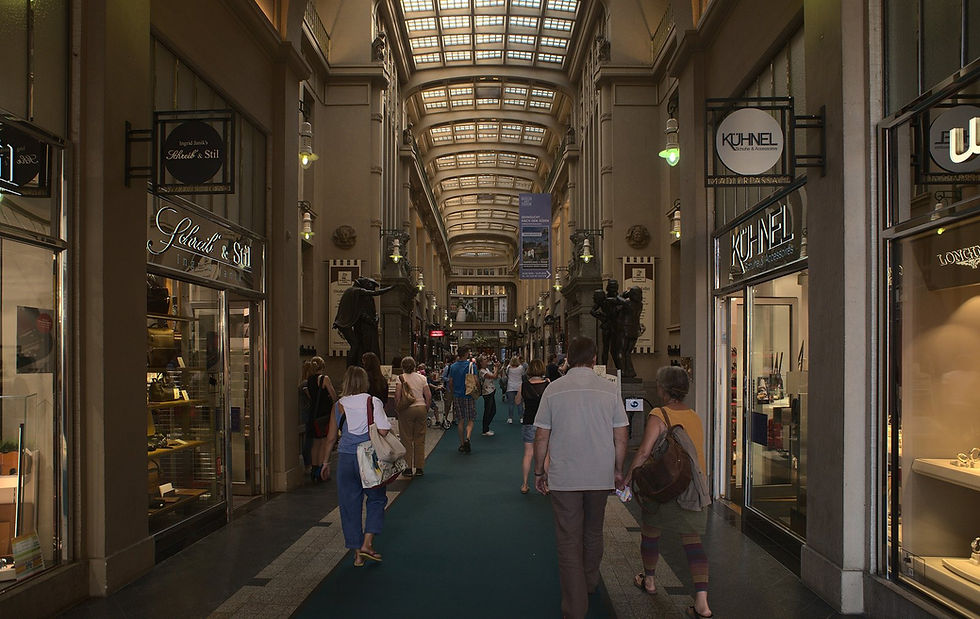
Mädlerpassage, the arcade above Auerbachs Keller. Goethe set a scene of Faust in the cellar below it.
The 1989 story most visitors miss
Here is why I send people to Leipzig from Berlin specifically. In Berlin you see where the Wall stood and where it fell. What you cannot see in Berlin is why it fell when it did, and a large part of that answer is Leipzig.
Through the 1980s, the Nikolaikirche held Monday evening peace prayers. In September 1989 those prayers spilled into the streets as the Monday demonstrations. On 9 October 1989, around 70,000 people marched around Leipzig's ring road past the Stasi headquarters, carrying candles, expecting the state to shoot. It did not, and after that night the East German government never regained control of its own streets. The Wall opened exactly one month later.
Two stops make that story concrete, and they are both light on the wallet. The Zeitgeschichtliches Forum on Grimmaische Strasse covers everyday life, dictatorship and resistance in East Germany, is completely free, and is closed on Mondays. The Runde Ecke, the old Stasi headquarters on the ring road, keeps its original offices as a museum, open daily with a 5 euro entry that includes an audio guide. Standing in those corridors a day or two after walking Berlin's East Side Gallery joins the two cities into one story better than any book I can recommend.
If this is the part of history that pulls you, my free Berlin walking tour spends about 2 hours in the former East Berlin centre around Alexanderplatz telling the Berlin half of it. The tour and booking details are here, and a Leipzig day slots neatly beside it on another day of the same trip.
The one tram ride worth taking
Leipzig's centre is so compact that you may not touch public transport at all. I would still make one exception: tram 15 from the station forecourt, about 15 minutes, to the Völkerschlachtdenkmal, the Monument to the Battle of the Nations. It commemorates the 1813 battle in which Napoleon was decisively beaten outside Leipzig, it is 91 metres of granite brutal enough to make the Reichstag look delicate, and you can climb to a viewing platform on top. Open daily 10:00 to 18:00 from April to October, 12 euros for the monument and its museum; details on the official museum page. A Deutschlandticket covers the tram; otherwise buy a normal LVB ticket.

The Völkerschlachtdenkmal across its reflecting pool. Tram 15 runs here from the station in about a quarter of an hour.
A day that works, and the Monday problem
A shape I would actually use, on the fast train:
09:00 leave Berlin Hauptbahnhof, lower level. Coffee on the train.
10:15 walk from Leipzig Hbf to the Nikolaikirche, then the Markt.
12:00 Thomaskirche and the Bach grave; motet at 15:00 if it is Saturday.
13:00 lunch at Auerbachs Keller if you booked, otherwise the Markt area.
14:30 Zeitgeschichtliches Forum or the Runde Ecke, depending on your appetite for museum versus original place.
16:00 tram 15 to the Völkerschlachtdenkmal, up the platform, tram back.
18:30 train home, in Berlin before 20:00.
Watch the Monday problem. The Zeitgeschichtliches Forum, the Bach Museum and the Museum der bildenden Künste all close on Mondays, the same habit I have written about for Berlin on a Monday. A Monday Leipzig trip still works, because the churches, the Runde Ecke and the Völkerschlachtdenkmal stay open, but if the free GDR museum is a priority, go any other day. The Museum der bildenden Künste is the right upgrade for a second visit or a rainy afternoon: its permanent collection is free, while the current combined special-exhibition ticket costs 12 euros.
Leipzig against the other classic escapes: Dresden is more beautiful, Leipzig is more alive and asks less of your feet. Potsdam is closer and gentler. The Spreewald is nature. If you want the full menu, my day trips from Berlin overview compares all of them, and the Berlin Hauptbahnhof guide helps you survive the departure end of the day.
Image credits
Source and licence details for the 7 photographs used in this article.
Markt and Altes Rathaus in evening light: Frank Vincentz, CC BY-SA 3.0, via Wikimedia Commons.
Regional train at Leipzig Hauptbahnhof: Falk2, CC BY-SA 4.0, via Wikimedia Commons.
Nikolaikirche interior: Jörg Blobelt, CC BY-SA 4.0, via Wikimedia Commons.
Thomaskirche west front: Tuxyso, CC BY-SA 3.0, via Wikimedia Commons.
Bach monument at the Thomaskirchhof: Romzig, CC0 1.0, via Wikimedia Commons.
Mädlerpassage arcade: Flocci Nivis, CC BY 4.0, via Wikimedia Commons.
Völkerschlachtdenkmal and reflecting pool: Jojoo64, CC BY-SA 4.0, via Wikimedia Commons.