The Oberbaumbrücke: Berlin's Prettiest Bridge and the Border That Ran Through It

Walk east along the river from the East Side Gallery and you reach a red-brick bridge that looks like it belongs to a different, older Berlin. Two pointed towers rise over the Spree, a yellow U-Bahn train rattles across the top, and a tour boat slides underneath. This is the Oberbaumbrücke, the crossing between Kreuzberg and Friedrichshain, and it is one of the most photographed spots in the city.
Most people take the photo and move on. The bridge deserves a minute more, because almost nothing about it is what it seems. It looks medieval but is younger than the U-Bahn. It looks purely decorative but was one of the hardest places in divided Berlin to cross. For twenty-eight years, the border between East and West ran straight across the water beneath these arches.
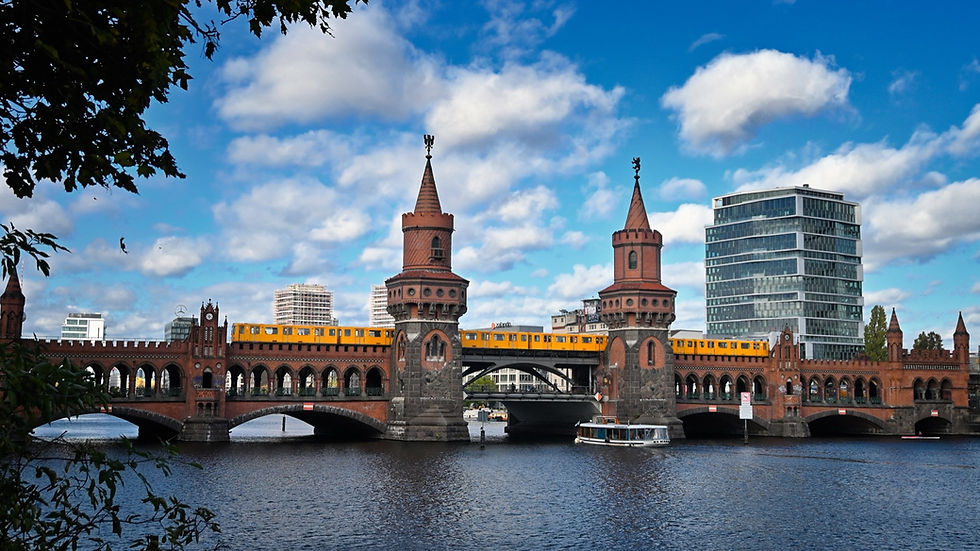
The Oberbaumbrücke carries the U1 and U3 across the Spree. The road and walkways run below, the trains run above.
A bridge that pretends to be older than it is
The towers are the trick. They look like a medieval city gate, and that is exactly the point. The Oberbaum was once a real customs barrier here: a spiked tree trunk, a Baum, was floated across the river at night to stop boats slipping past without paying. When Berlin replaced the old wooden bridge, the architect Otto Stahn finished the present one in 1896 and dressed it in North German brick-Gothic. Its two 34-metre towers echo several medieval landmarks, including the Mitteltor tower in Prenzlau and the Uenglinger Gate in Stendal.
So the "medieval" look is late-19th-century theatre. The bridge is younger than the electric tram and only a little older than the U-Bahn it carries. Once you know that, the details start to read differently: the crests, the pointed caps, the arcades are all Victorian-era brickwork doing an impression of something much older.

The brickwork looks centuries old, but the towers went up in 1896. The glass high-rise behind them is the honest age of the view.
How the double-decker actually works
The Oberbaumbrücke does two jobs at once, stacked on top of each other. The upper deck carries the U1 and U3, so the trains cross the river in the open air on a viaduct. The lower deck carries the road, a bike lane, and pedestrian walkways under a run of brick arches. That two-level plan was designed in from the start, back when the city was still planning its first elevated railway.
For a visitor, that means the best way to experience the bridge is on foot, on the lower deck. Take the walkway on the downstream (south) side. Wait a moment and a yellow train will clatter across above your head, which is the shot everyone comes for. Then look upstream, east, through the brick arches: standing in the middle of the Spree is the Molecule Man, three aluminium figures leaning into each other where Kreuzberg, Friedrichshain and Treptow meet.

Look east from the bridge and the Molecule Man stands in the river, with the TV Tower on the skyline behind it.
The border that ran through it
This is the part most photos skip. In April 1945 the retreating Wehrmacht blew up the middle span of the bridge. It was patched up after the war, but then history did something stranger to it.
When the Berlin Wall went up in 1961, the Oberbaumbrücke sat directly on the border. The Kreuzberg bank was the American sector, in the West; the Friedrichshain bank was the Soviet sector, in the East. The frontier ran along the river, so the whole bridge became part of the East Berlin border. From 21 December 1963, it worked as a pedestrian crossing, and only West Berlin residents were allowed to walk across it. For everyone else it was simply sealed.
The bridge came back to life at a very deliberate moment. Reconstruction started in 1992, and it reopened to traffic on 9 November 1994, exactly five years to the day after the Wall fell. A new steel middle section, designed by the Spanish architect Santiago Calatrava, filled the gap where the span had been blown up, and the U-Bahn returned across the top in 1995. When you stand on that steel centre today, you are standing on the old line between the two Berlins.

The bridge and the river in 1992, as the rebuild began and the border years came to an end.
How to see the Oberbaumbrücke, and when
The Oberbaumbrücke is free to walk across at any hour, and it is easy to reach from either bank. From the Kreuzberg side, take the U1 to Schlesisches Tor and walk about four minutes down Oberbaumstraße through Wrangelkiez. From the Friedrichshain side, use Warschauer Straße, served by the U1, U3, S-Bahn and the M10 tram. Crossing on foot takes roughly ten minutes if you stop for photos, which you will.
Come in the late afternoon and stay into dusk. The brick glows in low light, and after dark the bridge has a secret: set into the arch over the river is a neon artwork by Thorsten Goldberg called "Stone, Paper, Scissors", two lit circles that flash a random hand at each other from nightfall until about one in the morning. It has quietly played the game against itself over this old border line since 1997.

At blue hour the brick warms up and the whole bridge doubles in the river below.
Turn it into a short Berlin walk
The Oberbaumbrücke is best treated as the hinge of a small walk rather than a single stop. The East Side Gallery runs along the Friedrichshain bank right up to the bridge, so the longest surviving stretch of the Wall and the crossing that once sat on the border are a two-minute walk apart. Cross into Friedrichshain for the RAW yard and Warschauer Straße, or back into Kreuzberg for the canal and Wrangelkiez.
There is a lighter side too. Every summer the residents of the two districts meet on the bridge for a mock "vegetable battle", throwing flour, water and old fruit at each other in a friendly fight over which side the bridge really belongs to. It is a very Berlin way to remember that this was once a hard border and is now just a bridge between two neighbourhoods that like to argue.
The bridge is not on my free walking tour, which stays in the historic centre of the old East around Alexanderplatz. But it is one of the clearest, most walkable pieces of the divided-city story you can add on your own, and it makes far more sense once you have seen where the line ran through the middle of Berlin. If you want the water-level view instead, the river cruises pass right under the arches.
Image credits
Source and licence details for the 5 photographs used in this article.
Oberbaumbrücke with a U-Bahn train crossing: Penguin9, CC BY-SA 4.0, via Wikimedia Commons.
Molecule Man, the Oberbaumbrücke and the TV Tower from the Spree: Paul Korecky, CC BY-SA 2.0, via Wikimedia Commons.
Oberbaumbrücke tower detail with the district crest: Raimond Spekking, CC BY-SA 4.0, via Wikimedia Commons.
Oberbaumbrücke reflected in the Spree at blue hour: Michabka, CC BY-SA 4.0, via Wikimedia Commons.
The Oberbaumbrücke and the Spree in 1992: Throttle lever, CC BY-SA 4.0, via Wikimedia Commons.