Friedrichshain: A Local's Guide to Berlin's Coolest District
Updated: Jul 22
Most first-time visitors spend their whole Berlin trip in Mitte, around Brandenburg Gate, Museum Island and Alexanderplatz. That is where my free walking tour works too, because the history is packed into that small core. But if you only see the polished centre, you miss the Berlin that most people actually move to the city for. Friedrichshain is where I send anyone who asks me, "Where do I go to feel the real thing?"
It sits just east of the centre, on the north bank of the Spree, and it wears its recent history openly: painted Wall, socialist boulevards, squatted railway yards turned into clubs, and a park older than the German Empire. It is not a checklist district. It is a mood.
Where Friedrichshain is, and why it feels different
Friedrichshain was part of East Berlin, and you can still feel it. After reunification the empty buildings and cheap rents pulled in artists, students and anyone who wanted space to do something, and the district turned into one of the loudest, youngest corners of the city. Today it shares a joint borough with Kreuzberg across the river, and the two are stitched together by the Oberbaumbrücke, the double-decker brick bridge with the U-Bahn running over the top.
The centre of the tour I run is medieval and imperial Berlin. Friedrichshain is the opposite end of the story: what the city became after the Wall came down. That contrast is exactly why it is worth an afternoon and an evening.

The East Side Gallery's most famous panel, Dmitri Vrubel's "My God, Help Me to Survive This Deadly Love."
The East Side Gallery: go early or skip the photos
The one sight almost everyone comes for is the East Side Gallery. It is the longest surviving stretch of the Berlin Wall, about 1.3 kilometres of concrete along Mühlenstraße by the river, painted with more than 100 murals since 1990. The Brotherhood Kiss and the Trabant bursting through the wall are the images you already know from postcards.
Here is the honest version. The gallery is free and always open, but it is also one of the most crowded strips in Berlin by late morning, and the murals sit right next to a busy road. If you want a clean photo and space to actually read the paintings, come between 8 and 9:30 in the morning. I have made the mistake of turning up at noon with a tour group and spending the whole time waiting for a gap in front of each panel. Early light, empty pavement, the Spree next to you: that is the version worth having. If you want the full story of the Wall as a border rather than an art wall, my East Side Gallery guide goes deeper.

The Oberbaumbrücke links Friedrichshain to Kreuzberg, with the U1 line crossing on the upper deck.
When you reach the end of the gallery, walk out onto the Oberbaumbrücke. It is the prettiest way to leave the district, the river opens up on both sides, and it is the natural bridge into Kreuzberg if you want to keep going.
RAW-Gelände: Berlin at its rawest, and its most contested
A few minutes north, off Revaler Straße near Warschauer Straße, is the RAW-Gelände, a former railway repair works that became Berlin's most concentrated patch of alternative culture. Inside one grubby, graffiti-covered compound you get bars, clubs, a skate hall, a climbing wall built into an old bunker, street art on every surface, and a Sunday flea market. It is loud, messy and completely un-touristy in feel, even when it is full of tourists.
I have to be straight about 2026, because this is the kind of thing that changes between when a guidebook is written and when you arrive. RAW-Gelände is in the middle of a long redevelopment fight, and in early 2026 several venues were hit with operating bans over fire-safety concerns, with construction starting at one edge of the site. Most of it is still open and still worth wandering through, but do not travel across the city for one specific club without checking first. Look up the exact bar or club the same day, because the map here is genuinely shifting.
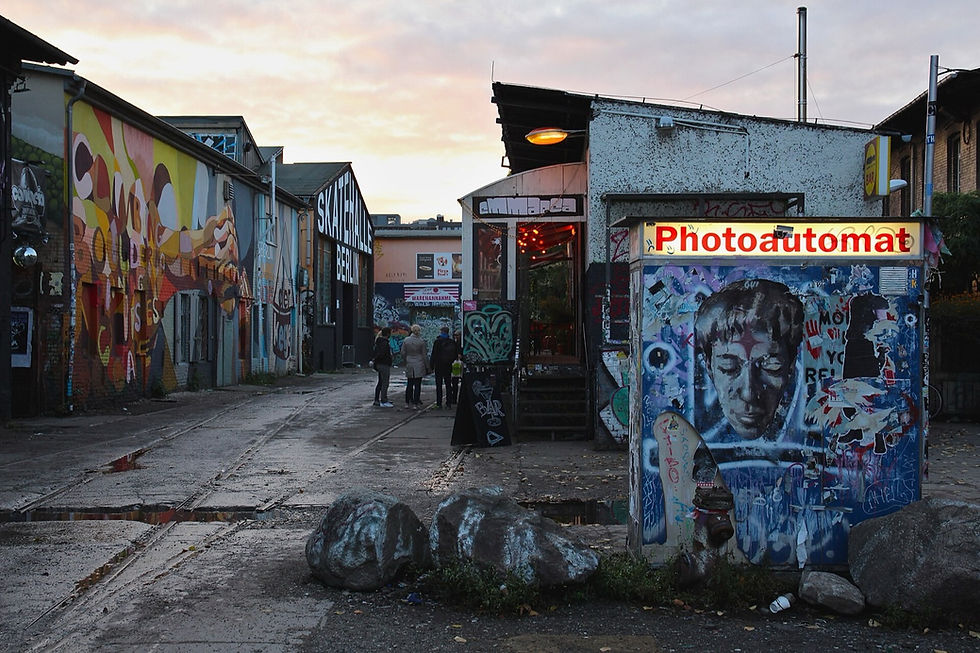
RAW-Gelände at dusk: former railway sheds turned into clubs, bars, a skate hall and open-air street art.
Boxhagener Platz and the Simon-Dach Kiez
Away from the river and the party yard, Friedrichshain has a calmer, everyday side, and this is the part I like most. The grid of streets around Boxhagener Platz, locally just "Boxi," and Simon-Dach-Straße is full of cafés, cheap restaurants, small bars and restored Art Nouveau apartment blocks. In the afternoon it is a good place to do nothing in particular: a coffee, a slow lunch, a browse.
The square itself has two weekend markets worth timing your visit around. On Saturdays there is a farmers market with regional produce, bread and cheese, and on Sundays a relaxed flea market runs from about 10:00 to 18:00. It is smaller and less hectic than the famous Mauerpark market, which is exactly why locals like it. Come to browse and sit, not to fight crowds.

The Sunday flea market on Boxhagener Platz is smaller and calmer than Mauerpark.
Volkspark Friedrichshain and Karl-Marx-Allee
For green space, head to Volkspark Friedrichshain, Berlin's oldest public park, opened in 1848. In summer it is one big picnic, and its centrepiece is the Märchenbrunnen, the Fairy Tale Fountain from 1913, a curved arcade of stone lined with characters from the Brothers Grimm. Behind it are two hills, the Bunkerberge, built from wartime rubble piled over buried flak towers, with a view back across the rooftops from the top.

The Märchenbrunnen in Volkspark Friedrichshain, a 1913 fountain lined with Brothers Grimm figures.
The other piece of history most visitors walk straight past is Karl-Marx-Allee, the enormous socialist boulevard the GDR built in the 1950s as a showcase of "workers' palaces." It is almost absurdly wide and grand, lined with tiled apartment buildings, and it runs up to the twin domed towers of Frankfurter Tor. If you have ever wondered what East Germany wanted its capital to look like, this street is the clearest answer in the city, and it is best walked in the low evening light.

Frankfurter Tor marks the end of Karl-Marx-Allee, the GDR's monumental 1950s boulevard.
How to get to Friedrichshain
Friedrichshain is easy to reach from the centre, and the station you pick depends on what you want first:
Warschauer Straße (U1, U3, S-Bahn S3/S5/S7/S9, trams M10 and M13) is the main gateway, right next to the East Side Gallery and RAW-Gelände.
Ostbahnhof (S-Bahn) sits at the western end of the East Side Gallery.
Frankfurter Tor and Weberwiese (U5) drop you straight onto Karl-Marx-Allee.
Ostkreuz is the big S-Bahn interchange on the district's eastern edge, useful if you are coming from further out.
If you are still working out how the network fits together, my Berlin public transport guide explains the tickets and lines.
Is it worth it? My honest take
If your trip is only two days and centred on the classic sights, you can skip Friedrichshain without guilt. But if you have an afternoon and an evening to spare, this is the easiest way to see the Berlin that exists outside the postcards: creative, unpolished, a bit chaotic, and very much alive. Start on the river with the Wall, drift through Boxhagener Platz, and let the evening take you wherever it goes.
The way I think about it is simple. The historic core, the part I walk with guests on the free tour, tells you how Berlin was built and broken. Friedrichshain tells you what it did next. See both, and the city finally makes sense. If you are still deciding which neighbourhood to base yourself in, my guide to where to stay in Berlin covers who each district suits.
Image credits
East Side Gallery ("My God, Help Me to Survive This Deadly Love" by Dmitri Vrubel), photo by Gzen92, CC BY-SA 4.0, via Wikimedia Commons.
Oberbaumbrücke, photo by Ank Kumar, CC BY-SA 4.0, via Wikimedia Commons.
RAW-Gelände, photo by DavideGorla, CC BY 2.0, via Wikimedia Commons.
Boxhagener Platz flea market, photo by Andrzej Otrębski, CC BY-SA 4.0, via Wikimedia Commons.
Märchenbrunnen, Volkspark Friedrichshain, photo by Lukas Beck, CC BY-SA 4.0, via Wikimedia Commons.
Frankfurter Tor, Karl-Marx-Allee, photo by Andreas Praefcke, CC BY 3.0, via Wikimedia Commons.