Karl-Marx-Allee: How to Walk East Berlin's Showpiece Boulevard
Stand at Strausberger Platz on the U5 and look east. The street in front of you is 90 metres wide, dead straight, and lined for more than a kilometre with tiled palaces that look like Moscow decided to move to Berlin. Guests on my tour ask about this street more often than you would expect, usually in the form of one confused question: what is this place, and why does nobody talk about it?
That street is Karl-Marx-Allee, East Berlin's showpiece boulevard, and it is one of the best free history walks in the city. It is also easy to do badly, because the boulevard is 2.3 km long and only part of it is the part you came for. This guide is the version I give friends: which stretch to walk, what to look for on the facades, and what is actually open along the way.

The Frankfurter Tor towers, the eastern gate of the boulevard. Everything in this guide happens on the street between here and Alexanderplatz.
What Karl-Marx-Allee is, in one honest paragraph
Before the war this was Große Frankfurter Straße, an ordinary broad street heading east out of the centre. In 1949 East Germany renamed it Stalinallee for Stalin's 70th birthday, and from 1952 it rebuilt the bombed street as the young country's showcase: monumental apartment blocks in the style Berliners call Zuckerbäckerstil, wedding-cake style, designed by a team around Hermann Henselmann. The state called them workers' palaces, and for once the propaganda was literal. These were ordinary flats dressed in ceramic tiles and columns, some awarded as prizes to model workers. In 1961, after Moscow disowned Stalin, the street quietly became Karl-Marx-Allee overnight. Today the whole ensemble is a listed monument, and Berlin has been pushing it, together with West Berlin's rival Hansaviertel, toward a UNESCO World Heritage nomination.
One orientation fact makes the whole street click: it has two halves that do not look alike. The eastern half, roughly Strausberger Platz to Frankfurter Tor, is the 1950s stone-and-tile stage set. The western half toward Alexanderplatz was finished later, in the 1960s, as glass-and-concrete modernism. Both halves are honest East Berlin, but they are two different East Berlins, built ten years and one ideology-shift apart.
Which stretch of Karl-Marx-Allee is actually worth walking
Walk the eastern half, from Strausberger Platz to Frankfurter Tor, heading east. That is about 20 minutes without stopping and a good 45 with the facades, the fountain and a coffee. The U5 runs directly underneath the entire boulevard, with stations at Schillingstraße, Strausberger Platz, Weberwiese and Frankfurter Tor, so you can shorten the walk at any moment by dropping into the next station. There is no cheaper safety net in Berlin sightseeing.
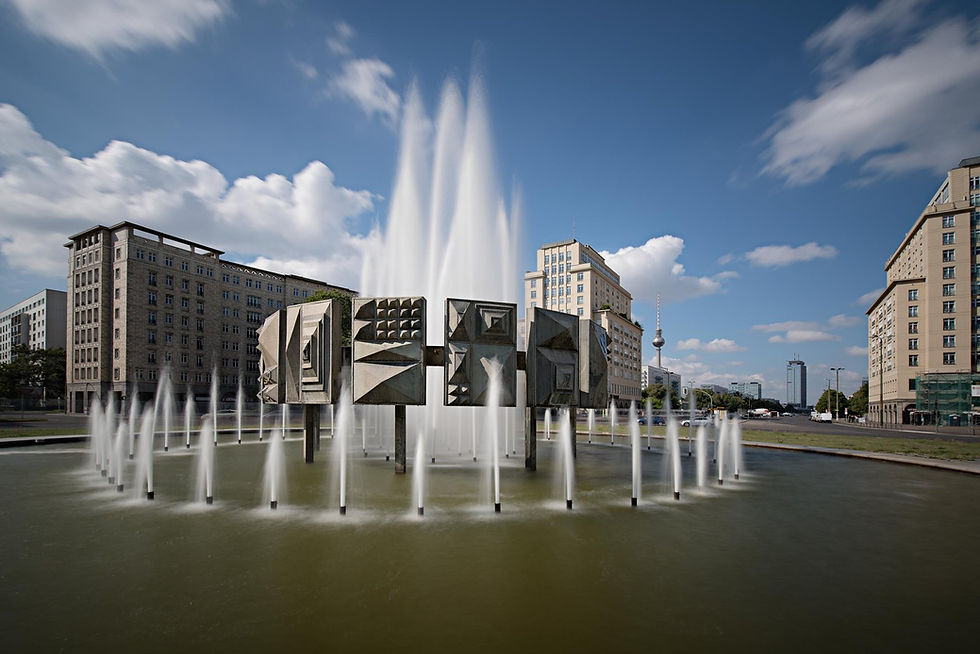
Strausberger Platz, the start of the showpiece stretch. The copper fountain is Fritz Kühn's Floating Ring, and the TV Tower lines up straight down the boulevard behind it.
Start on the fountain island at Strausberger Platz and turn around once. The stepped tower houses framing the square are Henselmann's, and they work as a gate between the two halves of the street. Look west and the TV Tower sits exactly on the axis of the boulevard, which tells you everything about how deliberately this street was drawn. Then walk east on the north side, cross over around Weberwiese for the portal at number 81, and finish between the twin towers of Frankfurter Tor.

The same stretch in 1970. The buildings have not changed; the traffic and the country have.
My advice: do not try to walk the whole 2.3 km from Alexanderplatz on foot expecting constant highlights. I have made that mistake with guests before, and the long modernist middle drains the energy the 1950s stretch deserves. Ride the U5 one stop instead and spend the saved half hour inside Café Sibylle or at the Kino International box office.
How to read the facades
The boulevard rewards slow looking, because the buildings were designed to be read. Four details carry most of the story.

The portal of Karl-Marx-Allee 81 near U Weberwiese. The relief above the cornice celebrates the 1952 national rebuilding programme that raised these blocks.
The tiles. The facades are clad in ceramic tiles from Meissen, the Saxon porcelain town. In the later GDR decades they became famous for falling off, and the safety nets became a running Berlin joke. Look closely and you can still spot the replaced patches in slightly wrong shades of cream.
The portals. House number 81, two minutes from U Weberwiese, has a full colonnade guarding an apartment door, with a relief above celebrating the Nationales Aufbauprogramm of 1952, the national rebuilding programme. Palaces for workers was the entire political message, carved in stone.
The towers. Henselmann topped the Frankfurter Tor pair with domes that quote the two cathedral towers on Gendarmenmarkt. East Berlin was claiming the Prussian skyline for itself, on a residential building with shops downstairs.
The arcades. The ground floors run as covered arcades, built for evening promenades and parade crowds. The boulevard was a stage, and the shopping was part of the set design.
I built a small tool for exactly this part of the walk. It shows the real facades with the details pinned, so you can rehearse what to look for before you go or check them off while standing there.
The workers who built it, and the day they revolted
Here is the part that turns a pretty street into a serious one. On 16 June 1953 the construction workers building Stalinallee downed tools and marched, because the government had raised their work quotas while food prices climbed. By the next day the strike had become an uprising across East Germany, with hundreds of thousands on the streets. On 17 June 1953 Soviet tanks crushed it, with deaths across the country. The model workers of the regime's own showcase project were the ones who lit the fuse, and a memorial plaque on the Allee marks it. West Berlin named the continuation of Unter den Linden, Straße des 17. Juni, after that date, which means both halves of the divided city ended up with a street name telling this same story.
The street's other vanished landmark tells the sequel. From 1951 a giant bronze Stalin stood on the Allee, and the boulevard carried his name. In the night of 13 to 14 November 1961, with destalinisation official policy, the monument was removed in secret and the street woke up as Karl-Marx-Allee. Workers ordered to destroy the statue quietly kept fragments, including an ear and a piece of the moustache, and decades later the surviving pieces surfaced in the small exhibition on the Allee's history at Café Sibylle.

An ear of the vanished Stalin monument, photographed in the Allee history exhibition at Café Sibylle. The rest of the statue was cut up and melted.
If this period grabs you, my guide to how Berlin was divided gives the wider frame, and the Stolpersteine guide covers the earlier, darker layer of memory you will also cross on these pavements.
What is actually open on the boulevard
Kino International reopened in February 2026, and that is the single best piece of news this street has had in years. The GDR's premiere cinema at Karl-Marx-Allee 33, built in 1963 with a glass foyer floating over the entrance, closed in April 2024 for a full renovation and reopened at the end of February 2026 with restored interiors, new projection and proper accessibility for the first time. On 9 November 1989 this cinema was premiering Coming Out, the GDR's first film with a gay lead, while the Wall opened a few kilometres north. Today Yorck Kinos runs the program, and many screenings are marked OmU or OmeU, original language with subtitles, so a film here is a realistic visitor evening, not just a photo stop.

Kino International at Karl-Marx-Allee 33, back in business since February 2026 after an 18 month renovation.
Café Moskau is not a café. The elegant pavilion opposite the cinema, with a Sputnik model on its mast and a mosaic of Soviet life at the entrance, opened in 1964 as the showcase restaurant for Soviet cuisine. Since 2009 it has been a rented event venue, so unless you are attending a conference you will be admiring it from the pavement. It photographs best at night, when the upper floor glows.

Café Moskau at Karl-Marx-Allee 34. Admire the Sputnik from outside; the building only opens for booked events.
Café Sibylle is the real coffee stop. At Karl-Marx-Allee 72, in a space that has served coffee since the street was Stalinallee, it keeps original 1950s details and the small free exhibition on the boulevard's history. It is the natural halfway pause on the eastern stretch. Opening hours have shifted between operators over the years, so check current times before you build your afternoon around it.
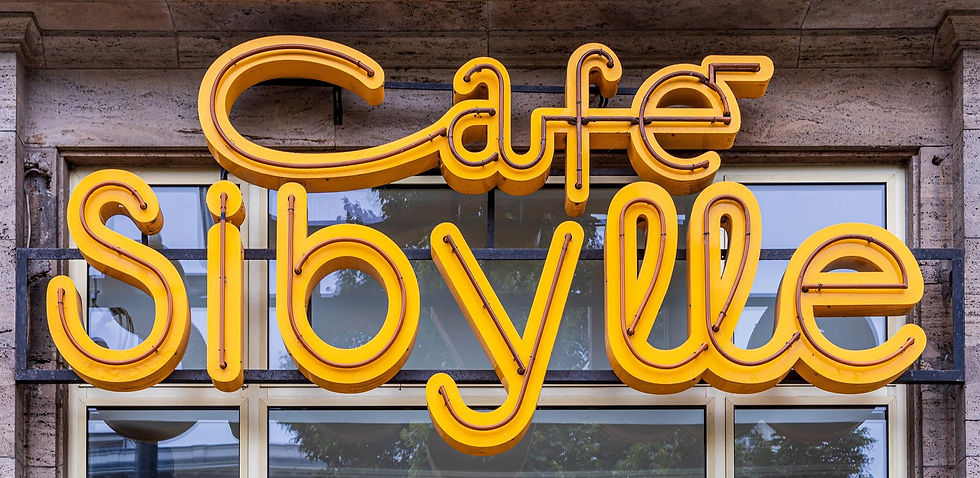
The 1950s neon of Café Sibylle at number 72, the working café of the boulevard.
How the Allee fits the rest of your Berlin
Karl-Marx-Allee starts at Alexanderplatz, which is exactly where my free Berlin walking tour starts and spends its ~2 hours in the historic centre of former East Berlin. The Allee is the cleanest add-on afterwards: one U5 stop from Alexanderplatz to Strausberger Platz and you are standing on the stage set, with the stories from the tour still fresh. It also chains neatly into the rest of East Berlin's headline sights. From Frankfurter Tor, the M10 tram runs one way to the Berlin Wall Memorial on Bernauer Straße, and a short walk down Warschauer Straße brings you to the East Side Gallery. If you are deciding how much Berlin fits in your trip, my how many days in Berlin guide slots this walk into a realistic plan.
One last honest note. Karl-Marx-Allee has almost no queue, no ticket and no gift shop, and that is precisely its value. It is the rare Berlin sight where the history is simply standing on the street, free, two U-Bahn stops from Alexanderplatz, and most visitors never see it.
Image credits
Source and licence details for the 8 photographs used in this article.
Frankfurter Tor towers from the west: Gryffindor, Public domain, via Wikimedia Commons.
Strausberger Platz fountain: Henning Grope, CC BY-SA 4.0, via Wikimedia Commons.
Karl-Marx-Allee in 1970: FOTO:Fortepan / Nagy Gyula, CC BY-SA 3.0, via Wikimedia Commons.
Portal of Karl-Marx-Allee 81: JoachimKohler-HB, CC BY-SA 4.0, via Wikimedia Commons.
Kino International: Matthias Süßen, CC BY-SA 4.0, via Wikimedia Commons.
Café Moskau at night: Matthias Süßen, CC BY-SA 4.0, via Wikimedia Commons.
Café Sibylle neon sign: Matthias Süßen, CC BY-SA 4.0, via Wikimedia Commons.
Ear of the Stalin monument: Angela M. Arnold, CC BY-SA 3.0, via Wikimedia Commons.