Gendarmenmarkt: A Local Guide to Berlin's Most Beautiful Square
Updated: 1 day ago
You are somewhere near Unter den Linden or Museum Island, and someone tells you to go and see Gendarmenmarkt because it is the most beautiful square in Berlin. So you walk two minutes south, the street opens out, and there it is: a huge open square with two almost identical domed buildings facing each other and a grand columned hall in the middle. It is genuinely striking. It is also completely unexplained. There are no big signs telling you what any of it is, whether you can go inside, or whether it costs anything.
I send a lot of guests here after my tour, so let me do what the square itself does not, and tell you plainly what you are looking at. Because the honest truth of Gendarmenmarkt is a small surprise: two of its three landmarks are called cathedrals, and neither one is a cathedral at all.
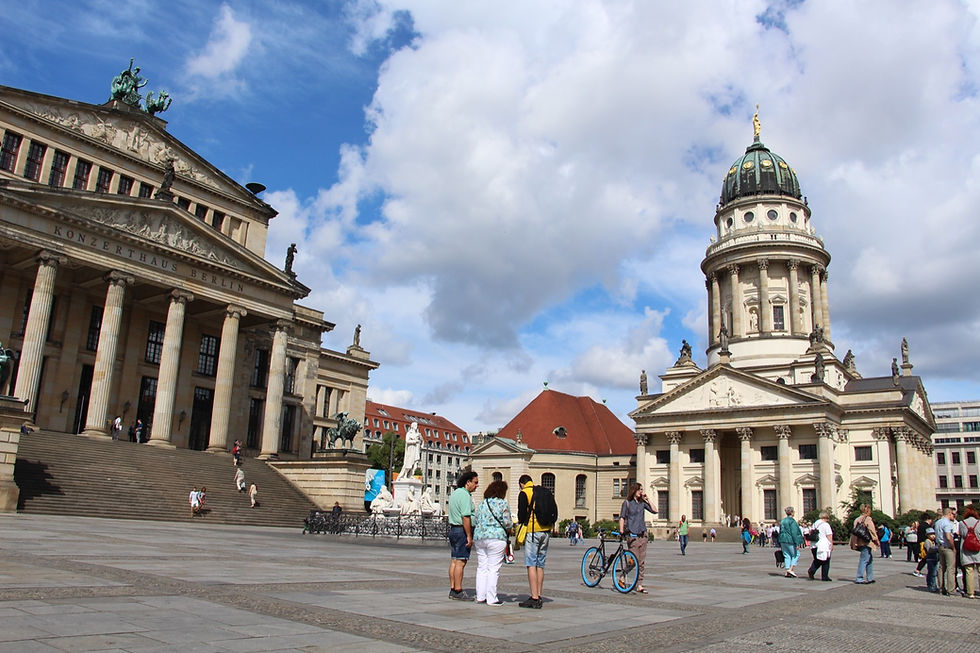
Gendarmenmarkt in one frame: the Konzerthaus on the left, the French Cathedral tower on the right, and the poet Schiller on his plinth in between.
What is Gendarmenmarkt, and why does everyone photograph it?
Gendarmenmarkt is a large rectangular square in Berlin-Mitte, laid out in the late 1600s in what was then the brand-new Friedrichstadt district. The odd name has nothing to do with a market you can shop at. It comes from the Gens d'Armes, an 18th-century cuirassier regiment that once kept its stables and guardhouse on this spot. The soldiers are long gone; the name stuck.
What draws people now is the arrangement. Three buildings frame the space: a domed building to the north, a matching domed building to the south, and the Konzerthaus concert hall between them, with a white marble poet standing on its steps. It is calm, symmetrical, and grand in a way most of central Berlin is not, which is exactly why it ends up on so many photos.
One practical note before you go. The whole square was dug up and rebuilt between 2022 and early 2025, and it reopened in March 2025 with fresh paving and, for the first time, step-free access across the whole surface. So the building site that some older guidebooks mention is finished. You will find it in Mitte, a short walk south of Unter den Linden and Museum Island, with the U-Bahn stations Stadtmitte and Französische Straße right on its doorstep.
The twist most visitors miss: neither "cathedral" is a cathedral
Here is the fact I most enjoy telling guests. The two domed buildings are known in English as the French Cathedral and the German Cathedral, and in German as the Französischer Dom and the Deutscher Dom. Except neither was ever a cathedral, because a cathedral needs a bishop, and neither of these ever had one.
The word doing the confusing is "Dom". It looks like the German word for cathedral. But here it comes from the French "dôme", meaning dome. And the two showy domed towers you are photographing were not part of the original churches at all. The actual churches underneath were modest: one built around 1700 for Berlin's French-speaking Huguenot refugees, one for the local German Protestant community. It was Frederick the Great who, in the 1780s, bolted a pair of tall decorative domed towers onto them, purely to make his new square look monumental. So the grandeur is real, but it is essentially eighteenth-century set design, not two great houses of worship.

The French Cathedral tower. This is the decorative dome Frederick the Great added in the 1780s, not the small refugee church it sits over.
Once you know that, the square gets more interesting, not less. Use the little guide below to tap each of the three buildings and see what it really is, what is free, and what is worth your time.
The French Cathedral: the paid climb and a refugee story
The Französischer Dom, on the north side, is the one to enter if you want a view. Its tower has a viewing platform about 40 metres up, reached by 254 steps, and from the top you get a clean, straight-on look at both domes, the TV Tower and a good slice of central Berlin. Tickets start from around 8 euros, and prices and opening hours shift with the season, so check the current details on the official Französischer Dom site before you make a special trip.
Inside the base is a small Huguenot Museum. The Huguenots were French Protestants who fled Catholic France, and Berlin took in thousands of them after 1685. They shaped the city more than most visitors realise, from its trades to a fair number of its surnames. If the weather is grey, I would skip the climb and cross straight to the building opposite, which is free and, to me, the better half-hour.
The German Cathedral: the free surprise inside

The German Cathedral. It looks like a twin of the French one, but inside there is no church at all, just a free exhibition on German democracy.
The Deutscher Dom, on the south side, looks like a near-perfect twin of its French counterpart. Step inside, though, and there is no church. It holds a free exhibition, run by the German Parliament, the Bundestag, on the history of German democracy from the 1848 revolution to the present day, spread over five floors.
Entry is free, it is open Tuesday to Sunday and closed on Mondays, usually from around 10:00 to 18:00 and a little later in summer. If you only have the time or energy for one building on the square, make it this one. It is free, it is calm and cool inside on a hot afternoon or a rainy one, and it is genuinely good. Most tourists walk straight past the door, which is a small shame.
The Konzerthaus, and the poet on the steps
The building in the middle, the one that reads KONZERTHAUS BERLIN across the front, is the square's third act, and it has its own quiet twist: it was not built as a concert hall. Karl Friedrich Schinkel designed it in 1821 as the royal theatre, the Schauspielhaus. It was gutted in the war, and East Germany rebuilt it, reopening it as a concert hall only in 1984. The marble figure standing out front is the poet Friedrich Schiller.

The Konzerthaus, Schinkel's old royal theatre, with Schiller on the steps. The steps themselves are the best free seat on the square.
You do not need a ticket to enjoy the best of it. The wide stone steps facing the square are, to me, the finest free seat in the house. Sit there with a coffee in the early evening and watch the two domes catch the last of the light. If you do want to go in, evening concerts are ticketed, but there are cheaper lunchtime and short-format concerts if you just want to see the hall.
The square through the year
For most of the year Gendarmenmarkt is simply open and free to wander. The one time it changes character is December, when it hosts one of Berlin's best-known Christmas markets, with wooden stalls filling the space between the buildings and a small entry fee on the busiest days. Dates move each year, so check the current listing if you are visiting around the holidays.

In December the square fills with the Gendarmenmarkt Christmas market. The rest of the year it is open, free, and quiet enough to really look at.
How to fit Gendarmenmarkt into a Berlin day
I will be honest about one thing, because it matters for your planning. Gendarmenmarkt is not on my free walking tour route, which stays in the older, medieval core of the city around Alexanderplatz, the Rotes Rathaus and Museum Island. So I do not walk guests through it. But it sits only about ten to fifteen minutes on foot from the Brandenburg Gate and Unter den Linden, which makes it an easy, low-effort add either before or after those sights.
My simple plan: come for the view, sit on the Konzerthaus steps for a few minutes, step into the free German Cathedral, and only pay for the French tower if the sky is clear. It pairs naturally with the free-culture side of Berlin, so it is worth reading alongside my guide to which Berlin museums are free. And if you are still mapping out where everything sits, my Ultimate Berlin Trip Planner can slot the square into a realistic day rather than a rushed dash between pins.
Images: Gendarmenmarkt and Konzerthaus, Fred Romero (CC BY 2.0); Französischer Dom, Jochen Sievert (CC BY-SA 4.0); Konzerthaus and Schiller monument, Ansgar Koreng (CC BY 3.0 DE); Deutscher Dom, Richard Mortel (CC BY 2.0); Christmas market, Sergey Galyonkin (CC BY-SA 2.0). All via Wikimedia Commons.