Berlin Wall Memorial (Bernauer Strasse): How to Visit the Real Wall Site

Updated: 6 days ago
Most visitors come to Berlin wanting to "see the Wall," and most of them leave without ever understanding it. They stand for a photo at Checkpoint Charlie, walk a painted stretch of the East Side Gallery, and assume that was the Berlin Wall. It was a small part of it.
My advice: if you want the Wall to make sense, go to the Berlin Wall Memorial on Bernauer Strasse. It is free, it is outdoors, and it is the one place in the city where you can see the whole border and not just a single painted wall. Give it an hour, walk it in order, and it will explain more than any museum ticket.

Seen from the viewing tower: the outer wall, the raked sand of the death strip, the patrol road and the inner wall, all kept in place on Bernauer Strasse.
Why the Berlin Wall Memorial explains the Wall better than anywhere else
The Berlin Wall was never one wall. It was a system: an outer wall on the western side, then a strip of raked sand, a patrol road, lamps, watchtowers, and an inner wall on the eastern side. The empty middle was the death strip, floodlit at night and covered by a clear line of fire.
Almost everywhere else in Berlin, that system is gone. You get one surviving slab, or a line of bricks in the pavement, and you have to imagine the rest.
Bernauer Strasse is the exception. Here an 80 metre section of the border was kept intact, held between two tall steel walls so you can see its full depth. This is the only place in Berlin where the outer wall, the death strip, the patrol road and the watchtower stand together as they did.
That is why I send people here first. If you have already seen the East Side Gallery or you are still deciding whether Checkpoint Charlie is worth your time, this is the site that ties them together. For the wider picture of how Berlin was divided, Bernauer Strasse is where the map becomes real ground under your feet.
What you actually see on Bernauer Strasse
The memorial runs for 1.4 kilometres along Bernauer Strasse, on the old line between the districts of Wedding, which was West, and Mitte, which was East. The street itself became famous in 1961 because the houses on the southern side stood in the East while their pavement was in the West. When the border went up, people jumped from those windows to escape, until the windows were bricked up and the buildings later demolished.
Today the strip is a long, open, landscaped corridor. It looks calm, and that calm is the point. The memorial does not shout at you. Its meaning is in the details: rusted steel rods marking where the wall ran, ground lines showing where houses and escape tunnels were, and the preserved section where the full border still stands.
My advice: do not walk this looking up for a big monument. Walk it looking down and across. The story here is in the sand, the ground markers and the gaps, and it is easy to walk straight over without noticing.
Getting there, and when the Berlin Wall Memorial is open
The address is Bernauer Strasse 119, and it sits right next to a train station, which makes it easy.
S-Bahn: S1, S2, S25 or S26 to Nordbahnhof, directly beside the memorial.
Tram: M10 to Nordbahnhof.
U-Bahn: U8 to Bernauer Strasse, or U6 to Naturkundemuseum, both a short walk.
Bus: 247 to S Nordbahnhof/Gartenstrasse.
The hours are the one thing worth checking before you go, because the site keeps two different schedules:
The open-air memorial and the death strip are open every day, 08:00 to 22:00. Everything is free.
The Documentation Center, the Visitor Center and the viewing tower open Tuesday to Sunday, 10:00 to 18:00. The last tower climb is 17:45, and these indoor parts are closed on Mondays.
So if you come on a Monday, or late in the evening, you can still walk the whole memorial and stand at the preserved strip. You just cannot climb the tower or see the indoor exhibitions. I have sent people here on a Monday and they still got the most important part. If you want the tower, come Tuesday to Sunday and not too late in the afternoon. You can confirm current times on the Berlin Wall Foundation site and on the visitBerlin page.
To get here smoothly from the centre, my Berlin public transport guide covers tickets and validation so a short northern trip does not turn into a fare mistake.
Start inside the station: the Nordbahnhof ghost station
Most people walk straight past the best introduction, which is inside Nordbahnhof itself.

S-Bahn Nordbahnhof was a sealed "ghost station" during the division. A free exhibition on the platform level explains how it worked.
During the years of division, Nordbahnhof was a ghost station. West Berlin trains ran on lines that dipped under East Berlin, and stations like this one were sealed and guarded. The trains rolled through slowly, past dim platforms where nobody was allowed to get on or off.
There is a free exhibition here, "Border and Ghost Stations in Divided Berlin," right where you arrive. My advice: read it before you go up to the street. It sets up everything you are about to see outside, and it takes ten minutes.
The Documentation Center and the viewing tower
A little way along the strip stands the Documentation Center, and this is where the site suddenly clicks.
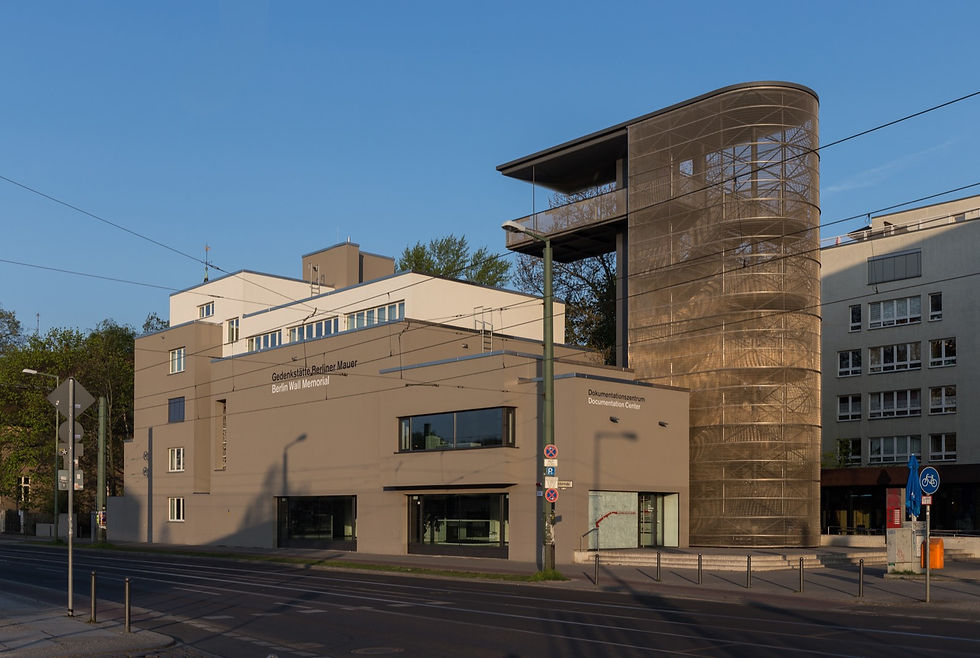
The Documentation Center holds the main exhibition and a rooftop platform that looks straight down onto the preserved border strip.
Inside is a free exhibition on the Wall and the people who lived beside it. On the roof is a viewing platform, and the climb is worth it. From the tower you look straight down onto the preserved death strip, and you finally see it as a whole: the two walls, the sand, the patrol road, the watchtower. From ground level it is a corridor. From above it is a border.
Remember the hours here. The tower follows the indoor schedule, so it is Tuesday to Sunday, last climb 17:45, closed Mondays. If the tower is the thing you most want, plan your day around that.
The Window of Remembrance
Near the centre of the memorial is the quietest and heaviest part, the Window of Remembrance.

The Window of Remembrance: a lit portrait for each person known to have died at the Berlin Wall.
It is a steel wall of small, lit photographs. Each one is a person known to have died at the Berlin Wall between 1961 and 1989. At least 140 people died at the Wall, and several of them were killed on this very street in the first months, some falling from the windows they tried to escape through.
My advice: slow down here. The faces are young, and the dates are close together. This is the emotional centre of the whole site, and it is the reason Bernauer Strasse feels different from a photo stop.
The Chapel of Reconciliation
Standing alone on the former strip is a small round chapel of rammed earth and timber.

The Chapel of Reconciliation stands where a church was trapped inside the death strip and blown up by the GDR in 1985.
There used to be a tall neo-Gothic church here, the Church of Reconciliation. When the Wall went up, the church ended up stranded inside the death strip, cut off from its own congregation. In 1985 the GDR blew it up because it blocked the guards' sightlines.
The chapel that stands here now was built in 2000 on the same spot, and its rammed-earth walls contain rubble from the church that was destroyed. Short services and readings for the victims are held here on weekdays. It is a small building with a very direct story: erased by the border, rebuilt on the same ground.
Walk it with me: the Death Strip audio guide
Bernauer Strasse is long, quiet, and easy to misread. The meaning is in small markers, ground lines and gaps, and most people walk straight past the best of it without knowing what they are looking at. That is exactly why I recorded a self-guided audio walk for this stretch.
It follows the route stop by stop, from the ghost station at Nordbahnhof to the preserved death strip, the escape tunnels, and the people who died trying to cross here. You go at your own pace, with my voice in your ears instead of a guidebook in your hand. Have a listen to the free sample below before you decide. If you are choosing between themes, compare both Berlin audio tours first.
If you would rather just wander, that works too. Walk it roughly south to north: start with the ghost station inside Nordbahnhof, get your bearings at the Visitor Center, then take the preserved strip, the viewing tower, the Window of Remembrance, the Chapel of Reconciliation, and finally the escape-tunnel and house markers toward Schwedter Strasse. If you want to see where this fits with the rest of the divided city, my guide to Cold War Berlin in five locations and the post on where the Wall actually stood pair well with a Bernauer Strasse morning.
Where it fits in a Berlin day
Bernauer Strasse is not in the old centre, so it is not on my walking route. My BerlinWalk tour starts at Alexanderplatz and lasts about 2 hours, and it covers how the divided city worked in the historic core, around the TV Tower, the river and Museum Island. Bernauer Strasse is the deeper Wall chapter you do on your own, ideally on the same trip.
My advice: treat it as its own hour, not a quick stop between other things. Come in the morning when it is quiet, walk the strip slowly, climb the tower if it is open, and let it be the visit where the Berlin Wall finally stops being an abstract idea. Then bring your questions to the tour, and the rest of the divided-city story will land much more easily.
Image Credits
Images by Pedelecs, Burkhard Muecke, Inhiber and Ansgar Koreng via Wikimedia Commons. Full license details are recorded in the local visual source notes.