German Numbers for Tourists: How to Read Berlin Prices, Platforms and Menus
Updated: Jul 22
The first time a number really catches you out in Berlin, you are usually standing at a bakery counter or a market stall. You point at a coffee and a roll, the person behind the counter says something that sounds like "drei fünfzig," and you freeze for a second because your brain was still reaching for the coins. Or you are on the platform at Hauptbahnhof, a calm voice says "Gleis sechzehn," and you have no idea whether that is your track or someone else's.
None of this is about speaking fluent German. It is about the handful of German numbers for tourists that come at you fast: prices, platforms, quantities, and the deposit on a bottle. Learn how those are built and said, and a lot of small Berlin moments stop being stressful. Here is the part that actually matters, in the order you will meet it.
The one rule that changes everything
German says the small number first.
Twenty-one is einundzwanzig, which is literally "one-and-twenty." Sixty-seven is siebenundsechzig, "seven-and-sixty." The unit digit comes first, then the word und ("and"), then the ten. English used to do this too, which is why "four and twenty blackbirds" still sounds vaguely familiar.
This is the single thing that trips visitors up. You hear "sieben..." and start writing a 7, then the "...undsechzig" arrives and the real number is 67. My advice: do not try to translate it left to right. Read or hear the German word, then flip it. Once you expect the flip, it stops fighting you.
Move the slider below to any number and watch the word build itself, with the unit and the ten marked so you can see the flip. Then press the button to hear it.
A few spelling traps hide inside the tens, and they are worth knowing because they change how the word sounds. sechs (6) quietly loses its s in sechzehn (16) and sechzig (60). sieben (7) drops its ending in siebzehn (17) and siebzig (70). And 30 is dreißig, ending in -ßig rather than the -zig you see on every other ten. Nobody expects you to get these perfect. You just want to recognise them when they fly past.
Prices: the comma is the cents, and there is no "and"
A German price tag looks slightly off to a lot of visitors because the punctuation is swapped. A comma is the decimal point, and a dot is the thousands separator. So 3,50 € is three euros fifty, and 1.000 € is one thousand euros, not one point something.
Said out loud, prices are usually just two numbers with nothing between them. "Drei fünfzig" is 3,50. "Zwei achtzig" is 2,80. A round price drops the cents and adds the word Euro: 4,00 € is simply "vier Euro." You will hear the full version too, like "drei Euro fünfzig," but the short one is more common at a busy counter. The big printed numbers on the notes and coins are the easy part; it is the spoken price at the till that catches people out.
If you want a sense of what things actually cost before you arrive, the realistic Berlin daily budget breaks down a normal day in euros, and the guide to paying with cards in Berlin explains where you still need cash.
Cents, coins and the Pfand
One hundred cents make a euro, the same as anywhere in the eurozone, and Berlin coins go from 1 cent up to a 2 euro coin. The number you will hear most as a standalone amount is the Pfand, the refundable deposit on drinks.
A single-use can or plastic bottle carries 25 cent, said "fünfundzwanzig Cent." Refillable glass and plastic bottles carry 8 or 15 cent. You pay it at the till and get it back by feeding the empty bottle or can into a return machine at any supermarket. It is not a tax and it is not a tip: it is your own money waiting in a machine. The full Pfand cheat sheet covers which containers count and how the machine pays you back.

Keep a few coins on you. Small bakeries, Spätis and market stalls are quicker with cash, and the Pfand machine only deals in exact amounts.
The numbers you actually hear out loud: platforms, lines and buses
This is where numbers stop being a menu item and start being directions.
A platform is a Gleis. "Gleis sechzehn" is track 16, and at Berlin Hauptbahnhof the number you need is printed on your ticket and shown on the yellow departure board, so you can always check it against the sign rather than trusting your ear. On busy platforms you will also hear zwo instead of zwei for 2, because over a loudspeaker zwei and drei can blur together. It means exactly the same thing.

Platform numbers are shown as digits on every sign, so you rarely have to decode a spoken one. The number on your ticket is the one to match.
Line numbers are the easy case: they are just the plain digit. U8 is "U acht," S7 is "S sieben," and the sightseeing-friendly bus is the 100, "hundert." Nothing flips, because there is no ten-and-unit to reorder. If the spoken station names are the harder part for you, the guide to pronouncing Berlin station names and the one on what the train announcements are actually saying both help.
At the counter: markets, bakeries and Spätis
The counter is where the flip and the price come together. Someone weighs your tomatoes at a market, glances at the scale, and says "macht drei fünfzig" (that comes to 3,50). The trick is that they are not testing your German. Cash makes it painless: hand over a note, and the number on the till or the change in your palm tells you everything the spoken price did.
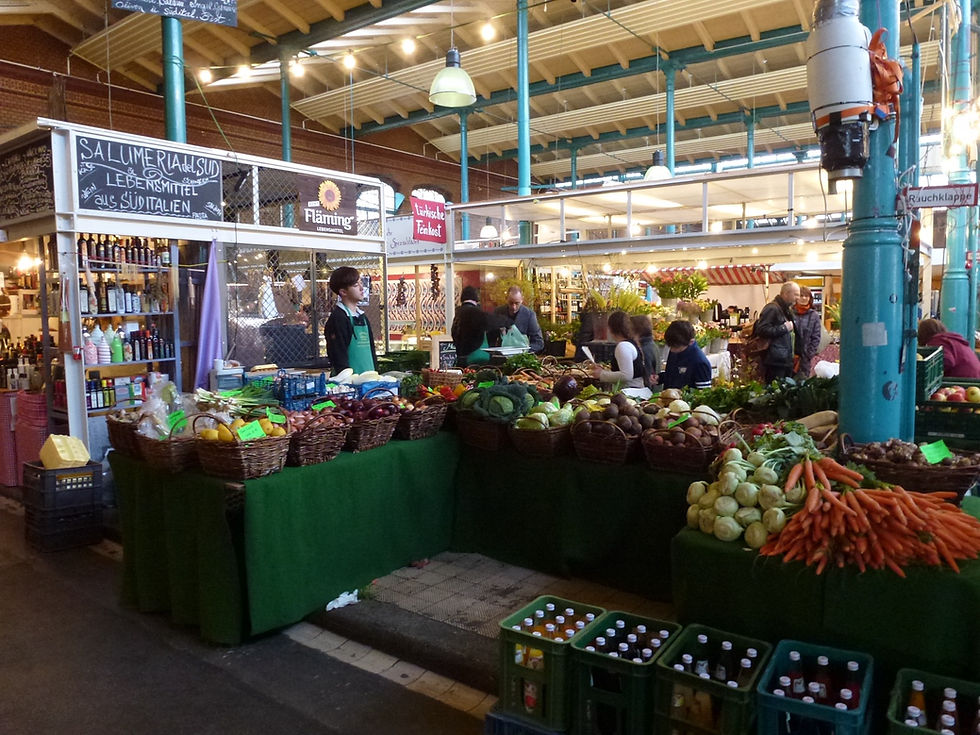
At markets like Markthalle Neun the prices are written on little cards, so you can read the number even when the seller says it fast.
If you want a couple of phrases to go with the numbers, the Berlin restaurant phrases guide covers ordering and paying, and the 50 essential German phrases set gives you the polite words that sit around the price: bitte, danke, and "zusammen" if you want to pay together.
Buying a ticket without decoding a single spoken number
Here is the reassuring part for anyone who finds all of this a lot: you do not need to understand a spoken German number to buy a transport ticket. Every BVG and S-Bahn machine has an English option, and the price is shown on the screen as digits. You pick your ticket, the total appears, and you pay by card or coins.
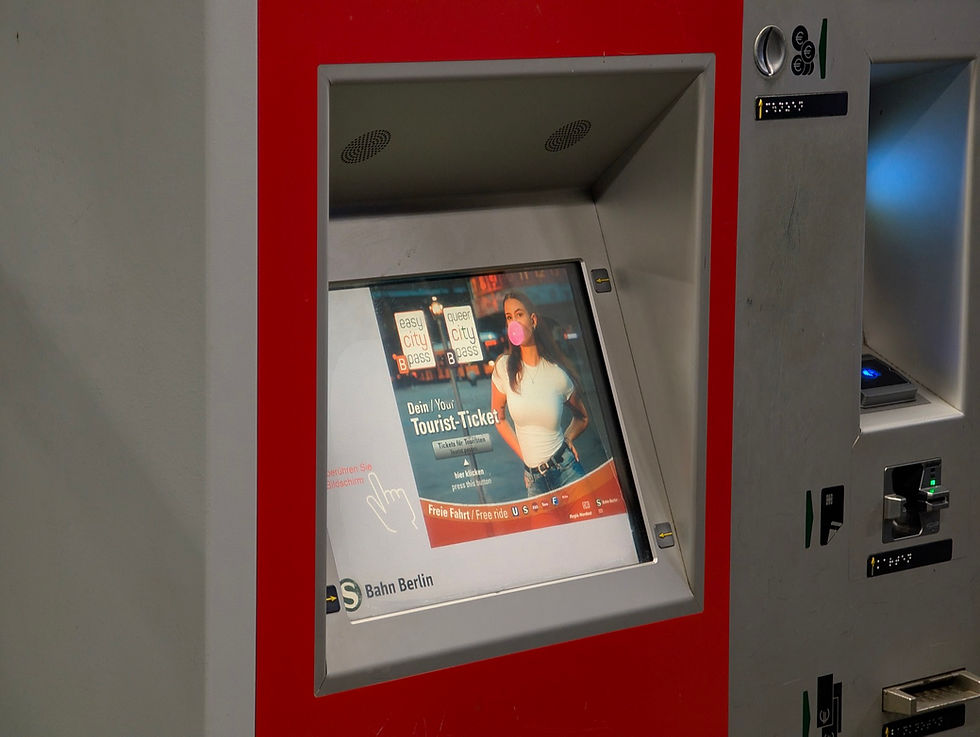
The machine shows the price as a number and switches to English, so the ticket is the one place you can ignore spoken numbers entirely.
For reference, the current fares are simple round figures: a single AB ticket is 4,00 € ("vier Euro"), a short hop (Kurzstrecke) is 2,80 €, and a 24-hour AB ticket is 11,20 €. These are the official BVG fares, the city's own Berlin public transport overview lists every ticket type, and the step-by-step ticket machine guide walks through the exact buttons.
German numbers for tourists, from one to a hundred
If you only memorise one block, make it one to twelve, because everything else is built from it:
0 null, 1 eins, 2 zwei, 3 drei, 4 vier, 5 fünf, 6 sechs
7 sieben, 8 acht, 9 neun, 10 zehn, 11 elf, 12 zwölf
The tens are their own short list: 20 zwanzig, 30 dreißig, 40 vierzig, 50 fünfzig, 60 sechzig, 70 siebzig, 80 achtzig, 90 neunzig, 100 hundert. Everything in between is a unit plus und plus a ten, in that order: 42 is zweiundvierzig, 88 is achtundachtzig. That is the whole system.
Do you even need this?
Honestly, for a short trip you can get by without saying a single German number. Machines show digits, cards work almost everywhere, and most people in central Berlin will happily switch to English. So why bother?
Because the numbers are the part of the language you meet whether you like it or not. You will see a price, hear a platform, hold a coin, and pay a deposit within your first hour in the city. Recognising them turns those small moments from mild panic into a quick nod, and that changes how a place feels. It is the same reason I start my free walking tour at Alexanderplatz with the practical stuff before the history: once the everyday details make sense, you stop bracing for the city and start looking at it.
Learn the flip, expect the comma, and keep a few coins in your pocket. That is most of what German numbers for tourists ever asks of you.
Image credits
Photos: Berlin Hauptbahnhof platform sign by Clic (CC BY-SA 4.0); euro banknotes by Markus Spiske (CC BY 2.0); euro coins by Santeri Viinamäki (CC BY-SA 4.0); Markthalle Neun produce stall by Fridolin freudenfett (CC BY-SA 4.0); Berlin S-Bahn ticket machine by Anselm Schüler (CC BY-SA 4.0). All via Wikimedia Commons.