How to Use a Berlin Ticket Machine: Buy a BVG Ticket Step by Step

Updated: Aug 31
The first thing a lot of visitors do in Berlin is stand in front of a ticket machine, look at a wall of German words, and quietly panic while a train pulls in behind them. I understand that feeling, and I have watched it happen a hundred times at Alexanderplatz. The good news is that the machine is simpler than it looks, it speaks English, and once you know the four or five taps that matter, buying a Berlin ticket machine ticket takes about thirty seconds.
This guide walks you through the whole thing: where the machines are, how to switch to English, which fare to choose in 2026, how to pay, and the one step at the end that catches out more tourists than any other.
Where the ticket machines actually are
Berlin has no ticket barriers. You will not tap in or out like in London or Paris, and nobody checks your ticket to get onto the platform. That freedom is exactly why the machine matters: it is the only place your journey becomes legal, and it is easy to walk straight past it.
You will find the machines on the platform itself, usually near the stairs or the entrance, not in a separate ticket hall. There are two kinds, and for a visitor the difference barely matters:
BVG machines stand on U-Bahn platforms. The older ones are the classic yellow and white boxes; newer ones are bigger with a large touchscreen.
Red Deutsche Bahn (DB) machines stand on S-Bahn platforms, usually labelled VBB-Fahrkarten.
Both sell the same tickets. A ticket you buy from a red S-Bahn machine is valid on the U-Bahn, the tram, and the bus, and the other way round. So use whichever machine is in front of you and do not overthink it.

A red DB machine on an S-Bahn platform. The yellow BVG machines look different but sell the same tickets.
Step one: wake the screen and choose English
Here is the small thing that confuses people first. The machine usually shows a rolling advert, not a menu, so it can look switched off or broken. It is not. Touch the screen anywhere and the menu appears.
The moment the menu loads, look for a language row, often shown as small flags, and pick English. The machines run in German, English, French, Turkish, and Spanish, so you are not stuck reading Einzelfahrausweis unless you want to. If you would like a head start on the German words you will still see printed on the ticket and the signs, my guide to reading German signs in Berlin covers the ones that matter.
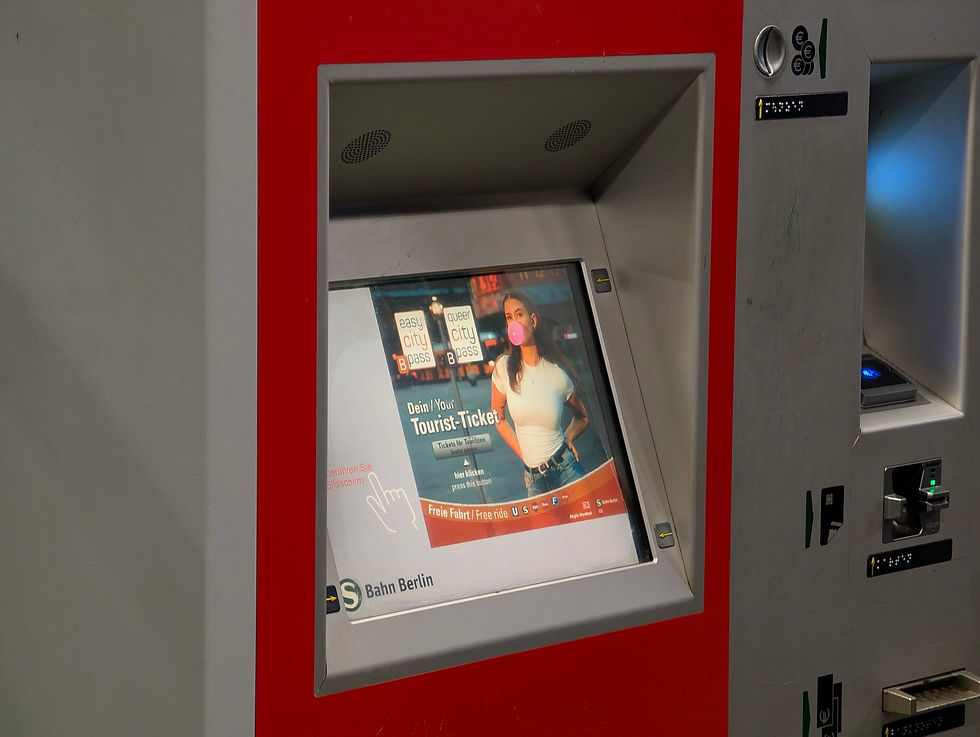
Touch the screen to start, then pick English. The card reader and coin slot sit to the right of the display.
Step two: choose the right ticket
This is where most of the real decision happens, and it is worth thirty seconds of thought because the wrong ticket is either a waste of money or a fine. These are the 2026 fares for the Berlin zones, straight from the official BVG ticket pages and berlin.de.
Single ticket AB, 4.00 euros
The standard tourist ticket. It covers one journey in one direction across zones A and B, which is the whole city centre and almost everywhere you will want to go. It is valid for 120 minutes and you can change between the U-Bahn, S-Bahn, tram, and bus as much as you like, as long as you keep moving in roughly one direction. No return trips.
Kurzstrecke (short trip), 2.80 euros
The cheap one, with a catch. A Kurzstrecke covers 3 stops on the U-Bahn or S-Bahn (one change allowed) or 6 stops on a bus or tram. If your hotel is genuinely three stops from the museum, this is the smart buy. If you might go further, buy the AB single, because a Kurzstrecke used beyond its limit counts as no ticket at all.
24-hour ticket AB
Unlimited travel in zones A and B for 24 hours from validation. At €11.20, it becomes cheaper than three €4.00 AB single tickets, and it saves you returning to the machine during a full sightseeing day.
The airport ticket: ABC
BER airport sits in Zone C, outside the normal AB city zone. So for any trip to or from the airport you need a Single ABC (5.00 euros) or a Day ticket ABC (12.90 euros). A plain AB ticket will not cover the airport run, and it is a common, expensive mistake. If you want the full airport route rather than just the fare, I wrote a separate guide on getting from Berlin airport to Alexanderplatz. For how the zones fit together in general, see my Berlin AB and ABC ticket zones explainer.
If all of this still feels like a lot to decide while a machine beeps at you, use the simulator below. Tap through the exact screens, answer two quick questions, and it will point you at the right fare before you ever stand at a real machine.
Step three: pay by card, phone, or cash
Once you confirm the ticket, the machine asks for payment. Modern Berlin machines are comfortable with cards: they take girocard, Visa, Mastercard, and Maestro, and most now accept Apple Pay and Google Pay too, so a contactless tap is usually the fastest way through. You may be asked for your PIN.
If you prefer cash, the machines take coins from 5 cents up to 2 euros and notes of 5, 10, and 20 euros. One warning worth repeating: the machines carry limited change. Feeding a 20 euro note for a 2.80 euro Kurzstrecke is a good way to get a fistful of coins back, or occasionally a machine that cannot make change at all. Pay with something close to the price when you can.

Trams have their own small machines onboard, and they usually take coins only. Buy before you sit down.
A quick note on trams and buses, because they work differently. Trams have a small machine onboard, often coin-only and button-based rather than a touchscreen, so carry some change if a tram is your plan. On buses you buy from the driver. If you would rather skip machines entirely, you can buy the same tickets in the BVG app, which I cover in how to buy Berlin transport tickets on your phone.
Step four: the one that saves you 60 euros
This is the step that turns a valid ticket into a fine if you skip it, so read this part twice.
A paper ticket from the machine is not valid until you stamp it. Buying it is not enough. Before you board, you push the ticket into a small yellow or red box on the platform, mounted on a pole or a wall near the stairs. It is marked Bitte hier entwerten / Please validate here. The box stamps the date, time, and station onto your ticket, which is what starts the clock on that 120 minutes.
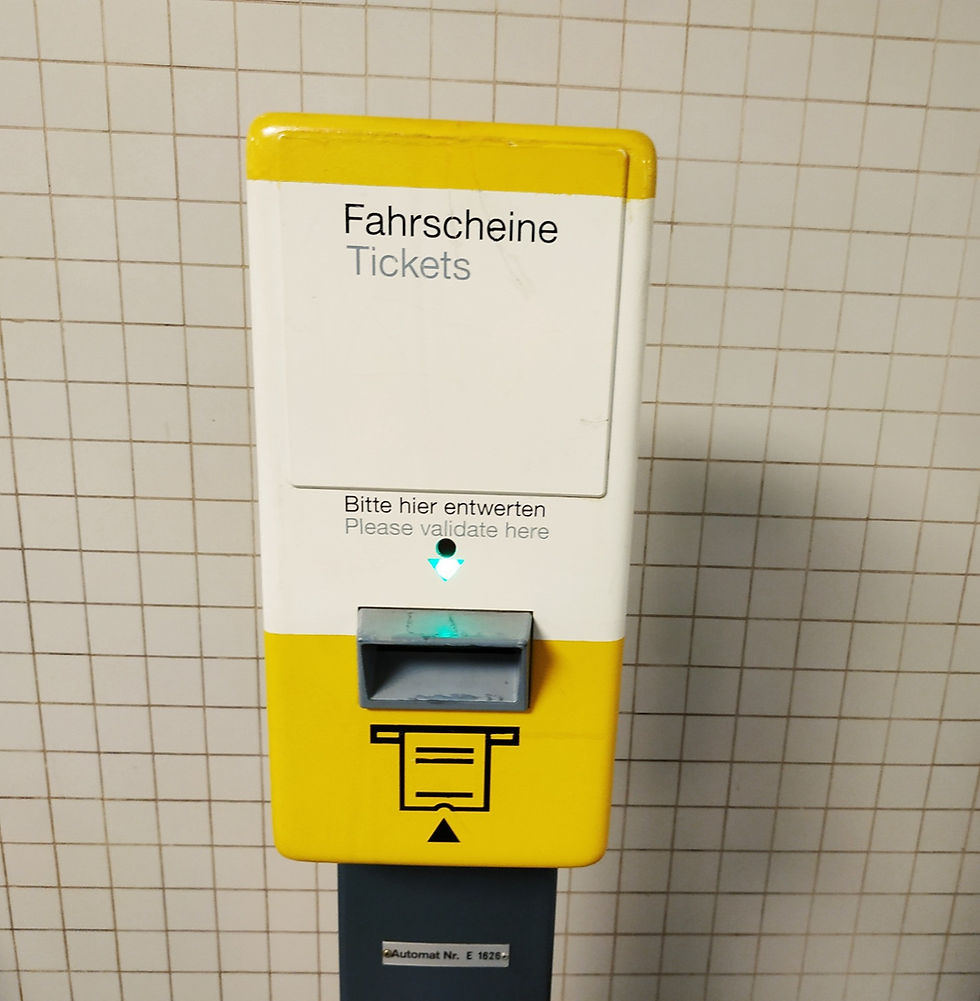
The validation box. Push your paper ticket into the slot until it clicks, before you get on the train.
Because there are no barriers, plain-clothes inspectors ride the trains and check tickets at random. An unstamped ticket counts as Fahren ohne gültigen Fahrschein, travelling without a valid ticket, and the fine is 60 euros paid on the spot. I have watched tourists get caught with a ticket in their pocket that they simply forgot to stamp, and the inspector has heard every excuse. If you want the full picture on how validation and fines work, I go deeper in do you really need to validate your ticket on Berlin trains and the Berlin U-Bahn fine explained.
The one exception: tickets bought in the BVG app are already validated the moment you buy them, so there is nothing to stamp. This only applies to paper tickets from the machine.

Machines sit right on the platform, so buy and stamp before your train arrives, not after.
The honest shortcut
If you are only in Berlin for a couple of days and you find the machines stressful, here is what I actually tell my guests: buy a day ticket in the morning, stamp it once, and forget about the machine for the rest of the day. You stop calculating fares at every station, you never ride unstamped by accident, and the cost is close to what three separate singles would be anyway. For a full-day itinerary it is the calmest option.
However you buy it, the machine is a thirty-second job once you know the four steps: touch the screen, choose your ticket, pay, stamp. Do that and Berlin's transport becomes one of the easiest big-city systems in Europe to use. If you want to understand the whole network first, my guide to Berlin public transport for tourists puts the U-Bahn, S-Bahn, tram, and bus in one place, and you can plan a whole trip with my free Berlin trip planner.
My free walking tour starts at Alexanderplatz, right next to one of the busiest ticket-machine spots in the city, and ends at Hackescher Markt. If you are nervous about your first ride, come and ask me on the day. I would rather show you the machine in person than have you learn it the hard way from an inspector.
Image credits
Yellow BVG ticket machine: Travelarz, CC BY-SA 3.0, via Wikimedia Commons.
S-Bahn machine touchscreen: Anselm Schüler, CC BY-SA 4.0, via Wikimedia Commons.
Tram onboard machine: Nicbou, CC0, via Wikimedia Commons.
Validation box: IgorCalzone1, CC BY-SA 4.0, via Wikimedia Commons.
Machine in U-Bahn station: Geoprofi Lars, CC BY-SA 4.0, via Wikimedia Commons.