Berlin Train Announcements Decoded: What the U-Bahn and S-Bahn Voice Is Saying

Updated: Jul 22
The first German most visitors actually hear in Berlin is not a friendly hello. It is a calm, clipped recorded voice on the train, saying something right as the doors are about to shut. You do not need to speak German to ride the U-Bahn and S-Bahn, but a few of these announcements carry real instructions, and missing them is how people end up on the wrong platform or two stops past where they meant to get off.
Almost none of it is translated on board. So here is a plain-English decoder for Berlin train announcements: what the recorded voice is really saying, line by line, and the one small thing each one is quietly asking you to do.
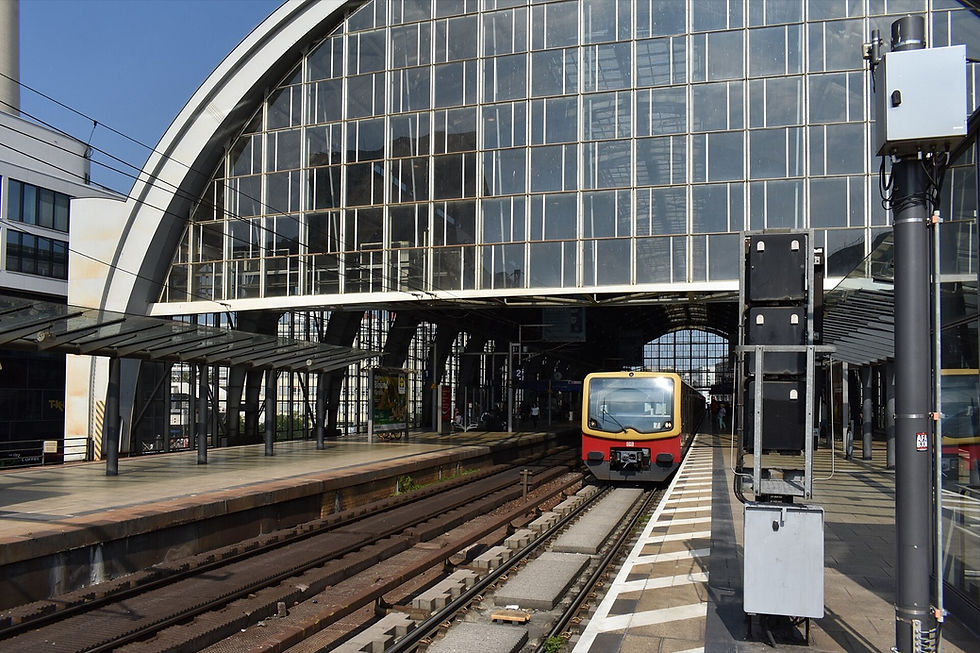
An S-Bahn pulling into Alexanderplatz, the hub where most visitors hear the recorded Berlin voice for the first time.
Berlin train announcements come in two voices
Berlin runs two separate rail networks, and they sound different because different companies operate them. The U-Bahn is the underground metro run by the BVG: yellow trains, a white U on a blue sign. The S-Bahn is the city rail run by Deutsche Bahn: red-and-yellow trains on raised and surface tracks, a white S on a green circle. If you want the full picture of how they differ, I wrote a separate guide on the U-Bahn versus the S-Bahn, and a broader one on Berlin public transport for tourists.
For announcements, the one thing to know is the personality gap. The U-Bahn barely talks. The S-Bahn talks a lot. An older U-Bahn train may give you little more than its destination and the doors-closing warning. An S-Bahn will announce the next stop, tell you which side to get off, and sometimes list your connections. Once you expect that difference, the silence on the U-Bahn stops feeling like a problem.

The overhead board does the U-Bahn's talking: Linie (line), Ziel (destination) and Abfahrt (departure), here U4 to Nollendorfplatz in 2 minutes on Gleis (track) 2.
"Zug nach ..." tells you the direction, not a platform number
The most useful habit in Berlin is to stop thinking in northbound and southbound, and start thinking in final stops. A train here is named by where it ends. "Zug nach Alexanderplatz" simply means "train to Alexanderplatz," and that destination is how you confirm you are heading the right way. Match the name you hear, or the name on the front of the train and the platform sign, to the direction you want.
You will see the same logic on the front of every S-Bahn: a line number and a place, like S7 Ahrensfelde. That place is not a stop you probably care about. It is just the end of the line, pointing you the right way down the platform.
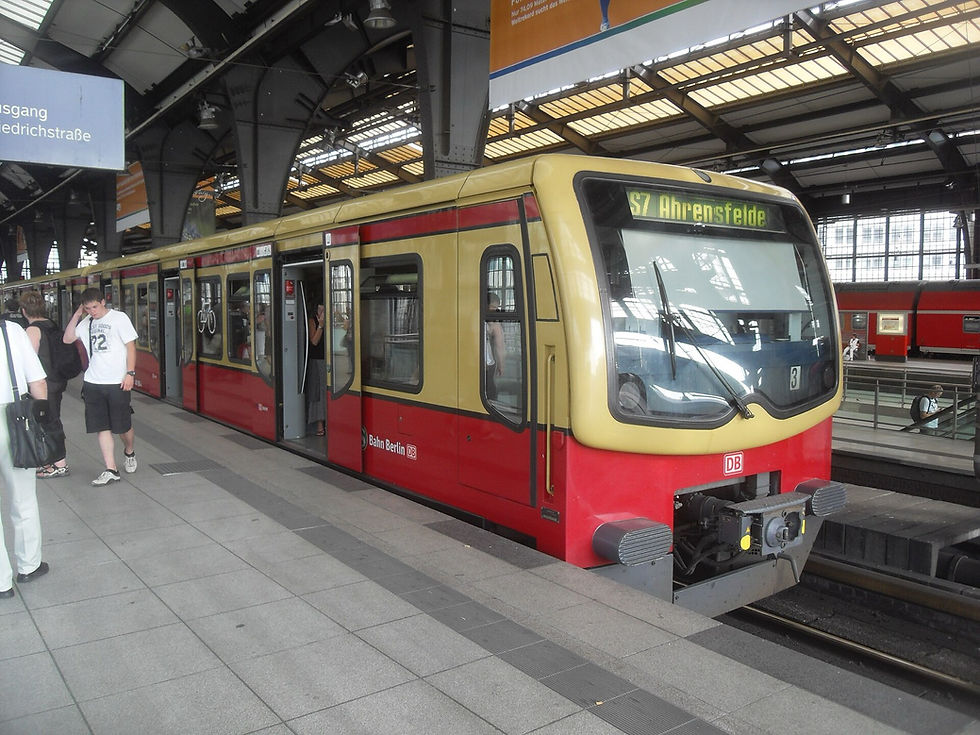
S7 Ahrensfelde on the front of the train. The line plus the final stop is your direction check, not a compass point.
"Zurückbleiben, bitte" is the one you will hear most
If you learn a single Berlin announcement, make it this one. "Zurückbleiben, bitte" means "stand back, please," and it plays as the doors are closing. It is the sound of the city: crisp, a little stern, and constant.
The instruction is exactly what it sounds like. When you hear it, step back from the doors instead of lunging through them. I have watched plenty of visitors try to beat it, get a bag caught, and hold up the whole train for the sake of ninety seconds. On the central lines the next train is usually only a few minutes away, so it is never worth the sprint.
Here is one short ride to Alexanderplatz with every announcement decoded in order. Switch between the U-Bahn and the S-Bahn voice to hear how much each one actually tells you.
"Nächster Halt" and the call that saves you a scramble
On the S-Bahn, the voice announces "Nächster Halt," meaning "next stop," followed by the station name. The small strip display above the doors shows the same thing, so you can listen or just watch the screen.
Then comes the genuinely useful part: the exit side. "Ausstieg rechts" means the doors will open on the right, "Ausstieg links" on the left, always in the direction the train is moving. It sounds minor until you are deep in a packed carriage and realise you are on the wrong side. Shift toward the correct doors before the train stops and you step off cleanly instead of apologising your way across. On some curved platforms you will also hear a reminder to mind the Lücke, the gap between the train and the platform edge.
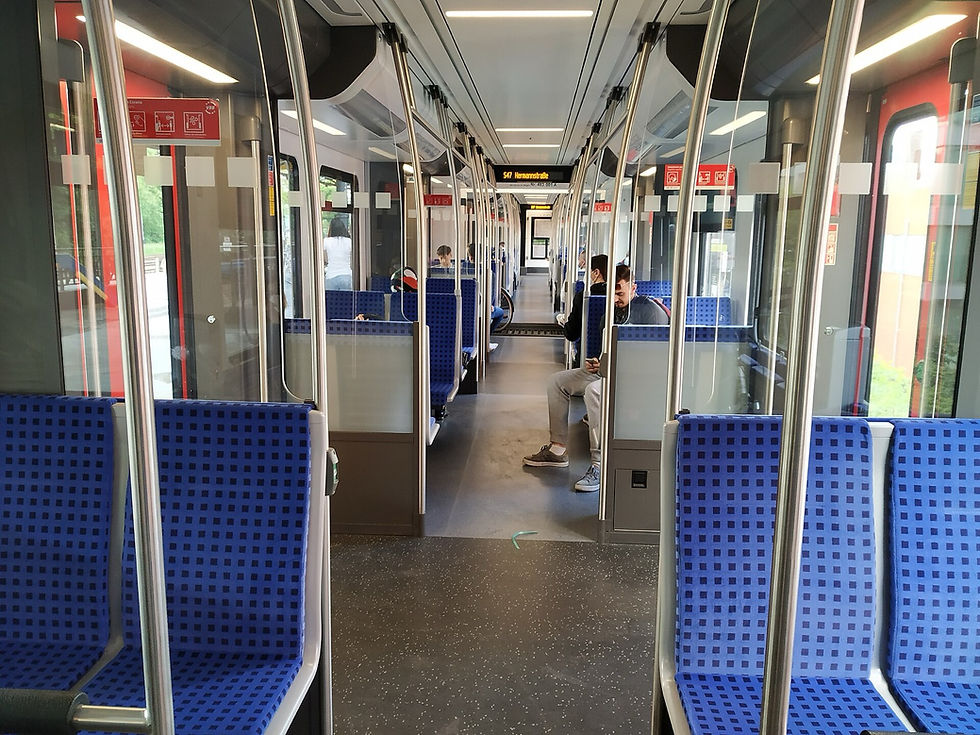
The onboard strip repeats the spoken line: S47 Hermannstrasse. If you miss the announcement, the display is saying the same thing.
That three-note S-Bahn chime, and why it is fading
Berlin has an accidental piece of music. As the S-Bahn doors close, older trains play a short "doo-DOO-doo" tone that has been part of the city since 1986. Berliners know it in their sleep.
It is slowly disappearing. A European rail-safety rule now requires a faster, pulsing warning sound, so the newest S-Bahn trains, the 483 and 484 series introduced from 2021, use a plain beep instead of the melody. The older trains that still carry the chime are being retired gradually into the 2030s, so you can still catch the famous three-note tone for now, mostly on the classic red-and-yellow carriages.
When something is wrong: Störung, Verspätung and Ersatzverkehr
Not every announcement is routine, and the disruption ones are worth recognising because they change your plan. A Störung is a fault or disruption on the line. A Verspätung is a delay. And the word that catches most visitors off guard is Ersatzverkehr, or the fuller Schienenersatzverkehr, often shortened to SEV. It means a section of the line is closed and a bus is standing in for the train.
If you hear or see Ersatzverkehr, do not panic and do not buy a new ticket. Follow the signs to the marked replacement bus, usually purple and labelled Ersatzverkehr, running every few minutes along roughly the same route. Your normal ticket still covers it. Weekend and summer engineering works are the usual reason, and I dug into how to handle a bad transport day in my guide to a Berlin transport strike or closure. The official pages at S-Bahn Berlin and the BVG list current disruptions if you want to check before you set off.
The last one to know is "Endstation, bitte alle aussteigen," end of the line, everybody off. If that is not where you meant to be, you rode too far or took the wrong direction. Cross to the opposite platform and ride back.
A quick word list to keep in your pocket
You do not need to memorise these, but recognising them turns the recorded voice from noise into information:
Zurückbleiben, bitte - stand back, doors closing
Einsteigen, bitte - please board
Zug nach ... - train to ... (the destination, meaning your direction)
Nächster Halt ... - next stop ...
Ausstieg rechts / links - exit on the right / left
Umsteigen - to change or transfer lines
Endstation - end of the line, last stop
Ersatzverkehr / SEV - rail replacement bus
Störung - a fault or disruption
Gleis - track or platform number
Reading the written versions on signs is a slightly different skill, and if that is where you get stuck, my guide to German signs in Berlin covers the ones you actually see in stations. Saying the station names out loud is its own small challenge too, which is why I made a Berlin station name pronunciation guide.
Where you will hear your first one
For most of my guests, the first real Berlin announcement lands on the ride in to Alexanderplatz, which is where my free walking tour begins, at the Weltzeituhr, the World Clock. It is one of the busiest interchanges in the city: U-Bahn, S-Bahn, the Ringbahn, trams and buses all meet there, so you will hear the full chorus of "Nächster Halt" and "Zurückbleiben, bitte" before you even reach the surface.
If you are planning to join me, the meeting point and tour route page has the details, and the walk itself runs about 2 hours through the historic core. By the time you arrive, the recorded voice should feel a little less like a code and a little more like the city just talking to you.
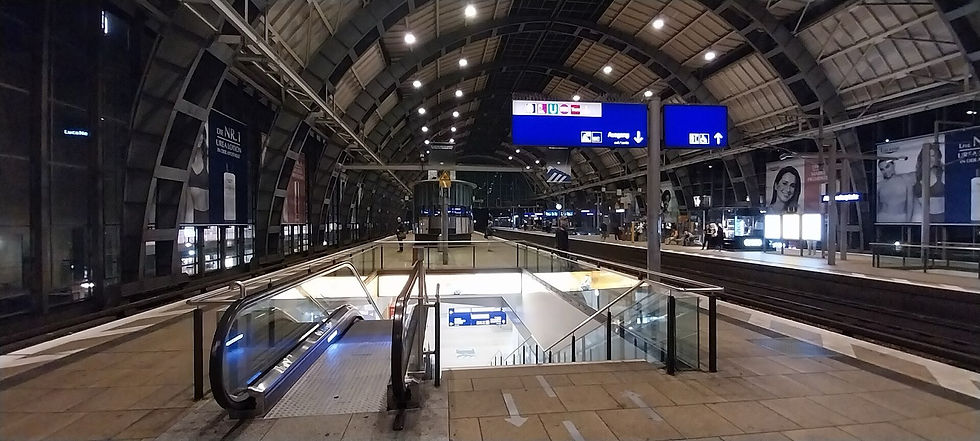
Alexanderplatz platform, where U-Bahn, S-Bahn and the Ringbahn all meet. Follow the blue Ausgang signs for the way out.
Image credits
S-Bahn at Alexanderplatz: Michael.F.H.Barth, CC BY-SA 4.0, via Wikimedia Commons.
U-Bahn at Innsbrucker Platz with departure board: Standardizer, CC BY-SA 3.0, via Wikimedia Commons.
S-Bahn showing S7 Ahrensfelde at Friedrichstrasse: Jivee Blau, CC BY-SA 3.0, via Wikimedia Commons.
Modern S-Bahn interior display: Geoprofi Lars, CC BY-SA 4.0, via Wikimedia Commons.
Alexanderplatz S-Bahn platform: Sebastian Wallroth, CC BY 4.0, via Wikimedia Commons.