How to Pronounce Berlin Station Names: A Simple Guide for Tourists
Updated: Jul 22
You are on a Berlin platform, the doors are about to close, and a calm voice announces a station that looks like someone sat on a keyboard. Gesundbrunnen. Schönhauser Allee. Zoologischer Garten. You freeze for a second, unsure if that was your stop, and by the time you have decided, the train has moved on.
I watch this happen to visitors all the time, and it is almost never a German problem. It is a confidence problem. German spelling is strict and consistent, which is good news: once you know how a handful of letters actually sound, most Berlin names stop being scary and start being predictable. This is a plain guide to how to pronounce Berlin station names, built around the stops and districts you will really use, not a grammar lesson.
The five sounds that unlock how to pronounce Berlin station names
You do not need to learn German. You need to learn a small set of letter-to-sound swaps that Berlin names use again and again. Get these, and you can read almost any sign on the U-Bahn map out loud.
w = v. A German w is an English v. So the district Wedding is "VED-ing", and Warschauer Straße starts "VAR-show-er". There is no English "w" sound in German.
z = ts. A z is always "ts", never a soft "zzz". That is why Platz is "plats", Kreuzberg is "KROYTS-bairk", and Bahnhof Zoo is "tsoh".
ei vs ie. These two trip up everyone. Say the name of the second letter: ei sounds like "eye", ie sounds like "ee". So Friedrichstraße is "FREE-drikh", not "FRY-drikh".
ö and ü. These are the sounds people fear, and they are close to English. For ö, say the vowel in "her" with rounded lips (Schöneberg is "SHUR-nuh-bairk"). For ü, say "ee" with rounded lips (Brücke, meaning bridge, is "BRUE-kuh"). Close is good enough.
au = ow, eu = oy. au is the "ow" in cow (Hauptbahnhof is "HOWPT-bahn-hohf"), and eu is "oy" (Neukölln is "noy-KURLN").
One more that saves your dignity: st and sp at the start of a word are said "sht" and "shp". Straße is "SHTRAH-suh", and Spandau is "SHPAN-dow".

Bülowstraße is "BUE-loh-shtrah-suh": the ü is an "ee" said with rounded lips, and the ß is just a double "s".
Start with the names you will actually say
Do not try to learn the whole network. On a normal trip you say maybe three or four station names out loud, so learn those first. For almost everyone, the priority list is your hotel's station, your arrival airport station, and the place you keep coming back to in the center.
That center is usually Alexanderplatz, said "ah-lex-AHN-der-plats", with the stress on AHN and the ending as "plats". It is named after a Russian tsar who visited in 1805, and it is a U2, U5, U8 and S-Bahn hub. It is also where I start my free walking tour, so it is a useful one to nail early. If you are coming in from the airport, the easy route into the center runs through here too.

A name band like this at Frankfurter Tor is exactly what you scan for from a train window. Read it as "FRANK-foor-ter TOR".
If you can say your stop, ask a local for it, and recognize it in an announcement, you have removed most of the stress of the Berlin U-Bahn and S-Bahn. Everything else is a bonus.
The station names tourists mangle most
Here are the ones I hear mangled most often, with a plain respelling and the stressed part in capitals. Read them out loud once and they will stick.
Alexanderplatz: "ah-lex-AHN-der-plats"
Friedrichstraße: "FREE-drikh-shtrah-suh" (ie = "ee", str = "shtr")
Gesundbrunnen: "guh-ZOONT-broo-nen" (the s sounds like "z")
Schönhauser Allee: "SHURN-how-zer ah-LAY" (Allee is stressed at the end)
Zoologischer Garten: "tso-oh-LOH-gish-er GAR-ten", or just say "Bahnhof Zoo"
Kottbusser Tor: "KOT-boo-ser TOR"; locals just say "Kotti"
Kreuzberg: "KROYTS-bairk"
Neukölln: "noy-KURLN"
Warschauer Straße: "var-SHOW-er SHTRAH-suh"
Hauptbahnhof: "HOWPT-bahn-hohf", the main station
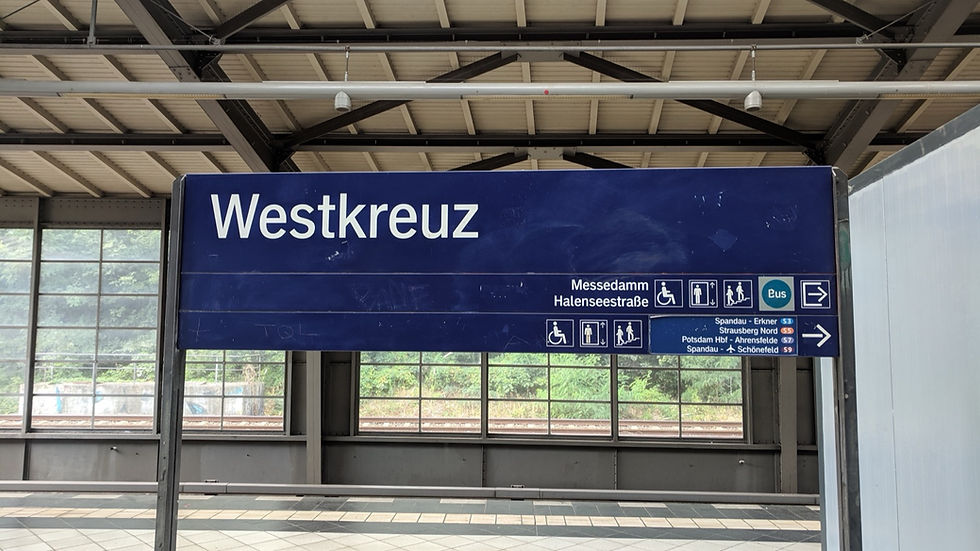
Westkreuz is a neat z lesson on a sign: the "kreuz" part is said "kroyts", so the whole name is "VEST-kroyts".
The Berlin -ow tell, and a few local giveaways
Here is the detail that quietly marks people as visitors. In Berlin-area names, the ending -ow is a long "oh", not the "ow" in cow. Pankow is "PAN-koh", Treptow is "TREP-toh", and Rudow is "ROO-doh". Say "PAN-cow" and every local within earshot knows exactly how long you have been in town. Get it right and you sound like you belong.
A few more that are worth knowing:
Köpenick, the pretty riverside district in the southeast, is "KUR-puh-nick", not "koh-PEN-ick".
Locals shorten the long ones. Kottbusser Tor becomes "Kotti", Görlitzer Bahnhof becomes "Görli" ("GUR-li"), and Schlesisches Tor becomes "Schlesi" ("SHLAY-zi"). Using the short form is a small, friendly shortcut.
Charlottenburg starts with a soft "sh", not a hard "ch": "shar-LOT-en-boork". The name comes from Queen Sophie Charlotte, and the burg ending is "boork".

Kochstraße, said "KOKH-shtrah-suh", is one more ß on a sign; the ß is only ever a double "s", never a "b".
Do you actually need to get this right?
Honestly, no, not perfectly. Signs are clear, most ticket machines and many staff switch to English, and you can always point at a map. You will get where you are going even if every umlaut comes out wrong. If you want the fuller picture, I have written about whether you need to speak German in Berlin at all.
But there is a real payoff for trying. Berliners are direct rather than rude, and a visitor who makes a genuine attempt at a station name gets a warmer response than one who does not. Pair a decent "Alexanderplatz" with the one word that clears a path in any crowd, "Entschuldigung", and a few lines from my 50 essential German phrases, and you will feel far less like a tourist and far more like someone who knows the city.
If you want to hear more of these out loud, the community pronunciation site Forvo has native recordings of most German words, and the official BVG journey planner is the fastest way to check which stations are actually on your route. And when you want a person rather than an app, that is what my tour is for: it meets at Alexanderplatz, runs about 2 hours through the historic center of the old East, and asking me "how do you say this one?" is very much allowed.
Image credits
Schönhauser Allee station sign: Bildarbeiter, CC BY-SA 4.0, via Wikimedia Commons.
Bülowstraße station hall: Taejo, CC BY-SA 4.0, via Wikimedia Commons.
Westkreuz S-Bahn sign: Clic, CC BY-SA 4.0, via Wikimedia Commons.
Kochstraße station sign: Tony Webster, CC BY 3.0, via Wikimedia Commons.