Berlin to Prague: Train, Bus, and Whether the Day Trip Works

Somewhere near the Neptune Fountain, on almost every tour, somebody asks me the same question. They have three days in Berlin, they have seen Prague on a map, and it looks close. Can they do it in a day?
The map is not lying. Berlin to Prague is 388 kilometres, and the direct train covers it in just under four hours. What the map hides is the shape of the day that comes out of those four hours, and one piece of engineering work that quietly deletes most of the timetable every Monday until the middle of December.
So here is the honest version, checked on 7 September 2026: what actually runs, what it costs, which day of the week to avoid, and whether the day trip is worth doing at all.
There is no flight, and that saves you a decision
Start with the option that does not exist. No airline flies nonstop between Berlin Brandenburg and Prague. Prague Airport lists 185 nonstop destinations across 63 countries and Berlin is not one of them, because the two cities are simply too close for anyone to sell a scheduled hop between them.
Any flight you find in a search is a connection through Frankfurt, Munich, Vienna or Warsaw. Add the ride out to BER, the security queue, the layover and the ride in from Prague airport, and the fastest of those beats a train by nothing at all while costing several times as much.
That leaves two real answers, the train and the bus, and they are closer to each other than most people expect.
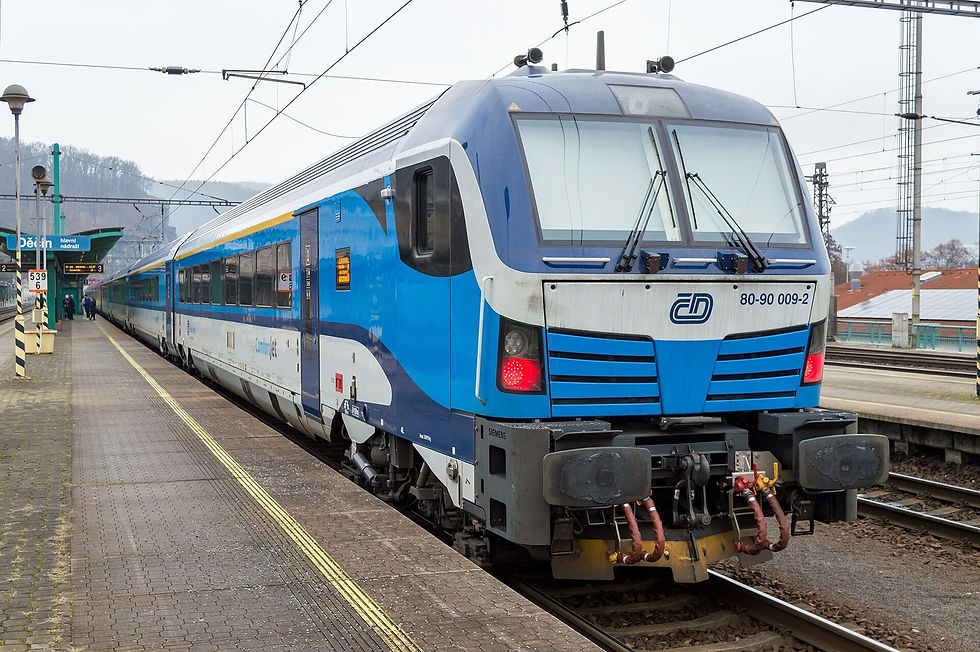
The ComfortJet at Děčín, the first Czech stop after the border. These trains took over most Berlin departures in 2025.
The direct train runs seven times a day
The Berlin to Prague EuroCity leaves Berlin Hauptbahnhof roughly every two hours, from 07:28 to 19:28, which is seven direct departures a day. Northbound there are six, from 06:31 to 16:31 out of Praha hlavní nádraží. Most departures now use Czech Railways ComfortJet stock, with a restaurant car, power at every seat and wifi that works better in Germany than in the valley.
The timetable is beautifully regular. Almost every run takes 3 hours and 57 minutes, and only the last one of the day stretches to a little over four hours.
Two practical details that matter more than they sound:
Sit on the left going south. After Dresden the line runs along the Elbe through Saxon Switzerland, with sandstone cliffs on one side and the river on the other, and the left-hand windows get the water. It is the best forty minutes of the journey and most people spend it looking at a phone.
Berlin Hauptbahnhof is a two-level station. The Prague trains leave from the lower deck, in the north-south tunnel, so give yourself the extra escalator time if you are arriving with luggage. My guide to Berlin Hauptbahnhof walks through the levels properly.

The lower deck at Berlin Hauptbahnhof, where the southbound long-distance trains leave from.
What a ticket costs
Advance fares for Berlin to Prague start at 18.99 euro in second class, and the fully flexible walk-up fare sits between 80 and 95 euro. That is a spread of roughly five to one, which is why the booking date matters more here than the travel date.
Buy at int.bahn.de, which charges no booking fee, or directly from Czech Railways.
Booking opens up to six months ahead. Dates after the mid-December timetable change usually go on sale in mid-October.
A seat reservation is optional most of the year and compulsory from mid-June to late August, which is exactly when the train is full of people who did not know that.
If you are also weighing up shorter hops out of the city, the ticket logic for those is different again, and I have written it up separately in train tickets for day trips from Berlin.
The Monday that deletes the timetable
This is the part no booking site puts in front of you, and it is the single most useful thing on this page.
Germany is rebuilding the railway between Schöna and Bad Schandau, on the German side of the border. Because of that work, on Mondays until 12 December 2026 almost every Berlin to Prague train is cancelled. Buses replace trains between Dresden and Ústí nad Labem, the through service is split in two, and Bad Schandau is skipped entirely.
What survives on those Mondays is thin: the 17:28 and the 19:28 out of Berlin, and the 06:31 out of Prague. That is it. A Monday morning departure does not exist, and neither does a Monday evening train home.
I have watched people find this out at the ticket machine on a Monday morning, which is a bad place to learn it. If your only free day is a Monday between now and mid-December, take the bus or move the trip.

Bad Schandau, the last German stop before the border. On the affected Mondays the through trains do not call here at all.
The board below has the real timetable in it. Put your travel day in and it shows which departures actually run, where the line is cut that day, and how many hours in Prague a same-day return would leave you.
The bus is a serious option, not a fallback
On most routes out of Berlin I would tell you to take the train and stop thinking about it. Here the bus earns a real look.
FlixBus lists around 25 Berlin to Prague departures a day, with a fastest scheduled run of 3 hours 40 minutes, which is quicker than any train on the line. RegioJet runs the same corridor from Berlin Südkreuz. Buses leave from several points across the city, including the central bus station out at Messe Nord, Südkreuz, Alexanderplatz and Hauptbahnhof.
Three honest caveats before you take that 3 hours 40 at face value:
It lands at Florenc, not in the old town. Florenc is a bus station on the edge of Karlín, two metro stops from the centre. Praha hlavní nádraží puts you a ten-minute walk from Wenceslas Square.
The bus risk is traffic, the train risk is trackwork. They fail on different days, which is the actual argument for knowing both.
The bus is not automatically cheaper. An advance train ticket at 18.99 euro is already bus money. The bus wins against the walk-up train fare, not against a ticket you booked three weeks ago.
Where the bus is unarguable is Monday. When the railway is cut, the motorway is not.

Florenc, where the Berlin buses arrive. It is on metro lines B and C, so the centre is a short ride away.
So is Berlin to Prague a day trip?
Let me do the arithmetic in public, using the best pairing the timetable allows.
Out on the 07:28, into Praha hlavní nádraží at 11:25. Back on the 16:31, into Berlin at 20:29. That is 7 hours 55 minutes on a train for 5 hours 6 minutes in Prague, and the last of those five hours is spent walking back to the station and finding your coach.
Five hours is enough to cross Charles Bridge in a crowd, look at the Astronomical Clock at the worst possible time of day, eat something forgettable near the Old Town Square and leave. It is the most expensive way to see the least of a city I know.
My advice: give Prague one night. The same two tickets then buy you an evening, a night and a morning, which is when Prague is actually good and empty. One night turns a train day into a trip.
If what you really want is a day out of Berlin and back, the city has better candidates that are genuinely built for it. Szczecin is two hours away and works. So does Dresden, which sits on this exact line about halfway to Prague, and the whole shortlist is in the best day trips from Berlin.

The Czech section of the run, along the water at Prague-Sedlec. The Elbe stretch north of the border looks much like this.
What to sort before you leave Berlin
Four things, none of which take long, and all of which people forget.
Carry your passport or national ID card. Germany has notified the European Commission of controls at all nine of its land borders, Czechia included, and the current period runs to 15 March 2027. Checks on this line are usually a walk through the carriage, but they do happen.
Czechia uses the koruna, not the euro. Some places take cards everywhere and euros grudgingly at a bad rate. When a machine or a terminal offers to charge you in euros, decline it and pay in koruna.
Book the train, not the day. Because the advance fare is tied to a specific departure, the cheap ticket is a commitment. Decide your return before you buy the outbound.
Check your exact date. The Monday rule is the big one, but engineering work moves. The board above is the shape of it, int.bahn.de is the final word, and seat61's Berlin to Prague page is the best plain-English explanation of the route I know.

Praha hlavní nádraží, the Fanta building. Walk out of the front and you are ten minutes from Wenceslas Square.
Where this fits with your Berlin days
One last thing, from the guiding side of my job.
If you are doing Berlin and Prague on the same trip, do Berlin's centre on foot first. Prague's old town is compact, medieval and intact, and Berlin's centre is none of those things, which is exactly what makes the comparison interesting instead of confusing. Walk the Berlin route while it is still a place you are reading, and the Czech old town will land as a contrast rather than as more of the same.
My free walking tour covers 11 stops and 16 places across the historic centre in about two hours, and it ends at Hackescher Markt, which is a fifteen-minute S-Bahn ride from the station your Prague train leaves from. That is not an accident of planning I am claiming credit for, but it is convenient, and I would use it.
Image credits
Source and licence details for the 3 photographs used in this article.
A ČD ComfortJet control car at Děčín, the first Czech stop on the Berlin to Prague line: RAIL P (FLUFFTECH.NET), CC BY-SA 4.0, via Wikimedia Commons.
Bad Schandau station in the Elbe valley, the last German stop before the border: Lukas Beck, CC BY-SA 4.0, via Wikimedia Commons.
The Fanta building, the Art Nouveau front of Praha hlavní nádraží: Yelkrokoyade, CC BY-SA 4.0, via Wikimedia Commons.