Szczecin Day Trip from Berlin: Trains, the Bus Bridge and the Right Ticket

Type Szczecin into a journey planner and Google will cheerfully show you a train from Berlin. What it does not show you is that the direct railway has been a construction site since the through trains stopped, that part of your trip will be a bus, and that the ticket machine will happily sell you the wrong ticket for the route you picked. I have sent guests on this trip and the ones who enjoyed it were the ones who knew all three things before they stood on the platform.
So here is the honest version of a Szczecin day trip from Berlin: how the crossing actually works until the rebuilt line opens in December 2026, which ticket fits which route, and what genuinely fits into the hours you get on the ground.
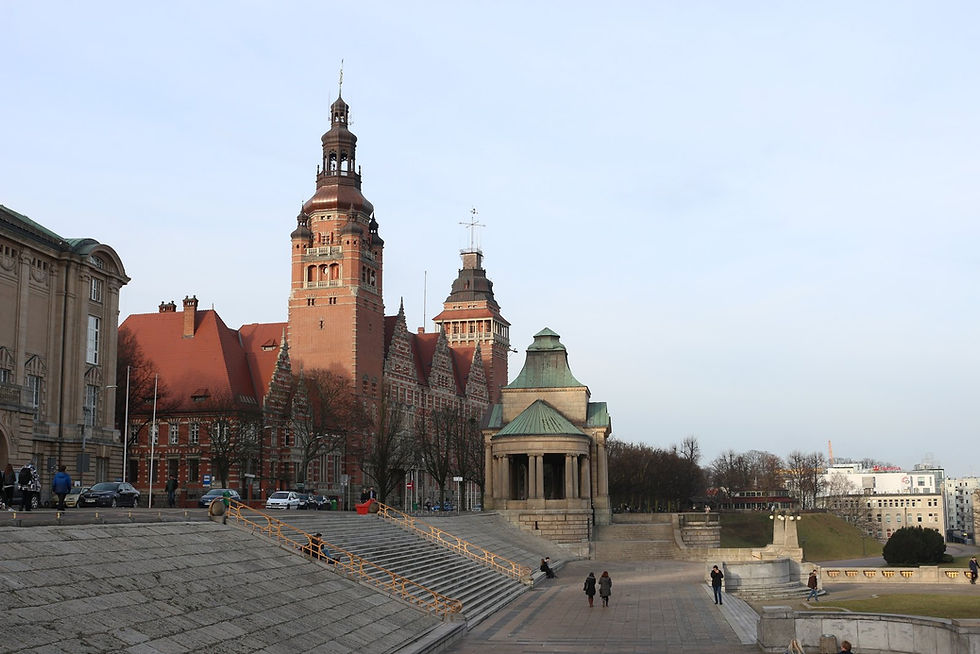
Wały Chrobrego, Szczecin's riverside terrace, about 25 minutes on foot from the main station.
How to get from Berlin to Szczecin right now
The Berlin to Szczecin line is being rebuilt: double track, electrification, and a promised 90 minute journey from 2027. Until 12 December 2026 the trains between Angermünde and Szczecin are cancelled, and a bus bridge fills the gap. That sounds worse than it is, because the replacement runs reliably every two hours and there are two rail detours worth knowing.
The three patterns, all starting at Berlin Gesundbrunnen (one S-Bahn ring stop from Hauptbahnhof):
The standard corridor: RE3 plus the RB66 bus. RE3 leaves Gesundbrunnen at 32 past every second hour (06:32, 08:32, 10:32), reaches Angermünde 51 minutes later, and the RB66 replacement bus continues over the border to the Kolumba stop beside Szczecin Główny station. About 3 hours door to door.
The express bus hours. On the alternate hours (09:32, 11:32 from Gesundbrunnen) the Angermünde connection is a nonstop POLREGIO express bus that does the border leg in about 1 hour 20. Roughly 2 and a half hours total.
The all rail detour via Pasewalk. On even hours you can stay on trains the whole way: RE3 to Angermünde, RE30 to Pasewalk, RE4 into Szczecin Główny. The 08:32 lands at 10:54, about 2 hours 22 minutes, the fastest current pattern. The catch sits in the ticket section below.
Coming back, the useful departures are the 15:01 express bus pattern, the all stops bus at 15:26, 19:26 and 21:26 from Kolumba, and all rail returns at 17:01, 19:01 and 21:01 from Szczecin Główny. The 21:01 has you at Gesundbrunnen by 23:26. I checked all of these on the current timetable on the day of writing; confirm your exact day on bahn.de or the VBB journey planner before you go, because construction timetables move.
The ticket that actually works
This is where most people overpay or underpay. The VBB tariff runs across the border to Szczecin, but only on the standard corridor via Tantow, and the ticket machine will not warn you about the difference.
Single Berlin AB to Szczecin: 16.80 euros. Valid on the RE3, the RB66 bus and onward Szczecin trams and buses to your destination. At a DB machine, simply enter Szczecin as the destination.
24 hour ticket Berlin AB to Szczecin: 33.60 euros. The same corridor both ways plus Szczecin city transport all day. For a normal day trip this is the one I would buy.
Groups of up to 5: the Brandenburg-Berlin-Ticket. Valid to Szczecin on weekdays from 09:00 and all day on weekends, Szczecin trams and buses included. Write all names on the ticket.
Deutschlandticket holders: your ticket ends at Tantow, the last German station. The add on is tiny: 4.40 euros one way, or 8.80 for a 24 hour ticket that also covers Szczecin city transport. A whole Polish day trip for under 9 euros extra is one of the best deals in the region.
BahnCard 25 or 50 gets you the reduced VBB tariff: 12.20 for the single, 24.40 for the 24 hour ticket.
The fine print: the fast all rail detour via Pasewalk runs outside the VBB tariff, so those trains need a normal DB ticket bought on bahn.de, where the price depends on the day. My advice: take the 24 hour VBB ticket and the corridor out in the morning, and decide on the ground whether the faster rail return is worth a separate ticket to you. All prices here are the official VBB tariff for travel to Poland, checked on 3 September 2026.
What actually fits into one day on the ground
Szczecin was German Stettin until 1945, which is why the city reads like a Baltic cousin of Berlin: heavy 19th century avenues, a rebuilt old town, and a waterfront that was clearly built to impress arriving ships. Everything a first visit needs sits within a walkable loop from the station.
Slide the hours you want on the ground and the map below matches the closest real train pair and lights up what honestly fits:
The stops, in the order I would walk them:

The main courtyard of the Pomeranian Dukes' Castle. The museum rooms are closed for renovation, but the courtyard and tower are open.
Start underground if you can catch 12:00. Under the main station hides one of Poland's largest civilian air raid shelters, and the Underground Routes tour walks you through it daily at 12:00 with no reservation needed for individuals; the entrance is at Kolumba 2 by platform 1. It is the single most memorable hour in the city, and it starts twenty steps from your arriving bus.
Then climb into the rebuilt old town. The gabled houses of Podzamcze and the brick Old Town Hall were rebuilt from wartime rubble, and the square around them is where Szczecin feels most like the Hanseatic port it once was. Ten minutes uphill sits the Pomeranian Dukes' Castle; its museum rooms are closed for renovation, but the courtyard is free and the tower steps cost a few złoty for the view.

The Old Town Hall in Podzamcze, rebuilt after 1945 in its late Gothic form.
Finish along the water. Wały Chrobrego is the postcard: a 500 metre terrace above the Oder with the maritime museum and the old provincial government palaces lined up behind it. From there it is a short walk inland to the Szczecin Philharmonic, the folded white glacier of a concert hall that won the European Union's top architecture prize in 2015, the first Polish building to do it. Circle it even if you cannot catch a concert.

The Szczecin Philharmonic after dark. The jagged glass roofline glows from inside.

Inside the civilian air raid shelter under the main station, visited on the daily 12:00 Underground Routes tour.
Lunch is a pastry from 1969
Skip the restaurant search. Szczecin's own street lunch is the pasztecik szczeciński, a deep fried yeast pastry filled with meat or cheese and mushrooms, invented here in 1969 on a machine the city inherited from the Soviet army. The original Bar Pasztecik at aleja Wojska Polskiego 46 still runs, and the ritual matters: eat standing at the mosaic counter, with a plastic cup of red barszcz on the side. The whole lunch costs a few złoty.

Bar Pasztecik on aleja Wojska Polskiego, serving the same fried pastry since 1969.

The classic order: two paszteciki and a cup of red barszcz, eaten standing.
The tinned cousin, paprykarz szczeciński, is a paprika and fish spread with its own monument in town; a tin from any supermarket is the cheapest honest souvenir Poland makes. Poland uses the złoty, not the euro, and while cards are accepted almost everywhere, a small bar may want cash. Your EU roaming works in Poland exactly as in Germany.
Passport, border checks and the small print
Poland and Germany are both in Schengen, but Germany currently runs temporary checks at its land borders, extended through 15 September 2026 and already notified onward into March 2027. In practice that means police may board the bus or train near the border for a spot ID check, mostly on the way back into Germany. Carry your passport or EU identity card; a phone photo of it does not count. The checks add a few minutes, not hours, on this quiet crossing.
Is Szczecin worth one of your Berlin days?
Here is my honest ranking logic. If this is your first Berlin trip and you have one spare day, Potsdam still wins on pure sights per hour. But Szczecin gives you something Potsdam cannot: a second country before dinner, a city with almost no tourists, and prices that make Berlin look expensive. It beats Hamburg on cost and crowds, and unlike the Spreewald it works in any weather, because half the loop can move indoors.
It fits best on the middle of a longer stay, when the Berlin checklist pressure is off. Go out on the 08:32 or 09:32, take the walking loop, and you are back in Berlin in time for a late dinner. And if you want the same kind of honest, on foot orientation for Berlin itself, that is exactly what I do: my free Berlin walking tour covers the historic centre in about 2 hours, and the Berlin trip planner helps you decide which day a Szczecin escape fits into.
Image credits
Source and licence details for the 7 photographs used in this article.
The Waly Chrobrego terrace with the maritime museum towers in Szczecin: Michalpe96, CC BY-SA 4.0, via Wikimedia Commons.
The main courtyard of the Pomeranian Dukes Castle in Szczecin: Kapitel, CC BY-SA 3.0 PL, via Wikimedia Commons.
The gabled Old Town Hall of Szczecin seen from above: Kapitel, CC BY-SA 4.0, via Wikimedia Commons.
The Szczecin Philharmonic glowing at night in winter: Grzeeesiek, CC BY-SA 4.0, via Wikimedia Commons.
An exhibition room in the air raid shelter under Szczecin Glowny station: Kapitel, CC BY-SA 4.0, via Wikimedia Commons.
The Bar Pasztecik storefront on aleja Wojska Polskiego in Szczecin: Mateusz War., CC BY-SA 3.0, via Wikimedia Commons.
Two paszteciki and a cup of red barszcz on the mosaic bar table: Mateusz War., CC BY-SA 3.0, via Wikimedia Commons.