Berlin Bulky Waste: What Sperrmüll Costs and Where It Actually Goes

The wardrobe has been standing in the hallway for eleven days. It came apart during the move, it will not go back together, and every morning you edge past it on the way to the door. Somebody in the building has already suggested just putting it out by the bins on a Sunday night, because that is what people do.
That suggestion is the most expensive sentence in this article.
Getting rid of a big object in Berlin is not hard, and for most of what comes out of a flat it is free. What makes it go wrong is that the free version has one hard number attached to it, and if you cross that number by a single armchair the whole trip is wasted. I have driven a car to a yard and driven the same load home again, which is a very quiet forty minutes.
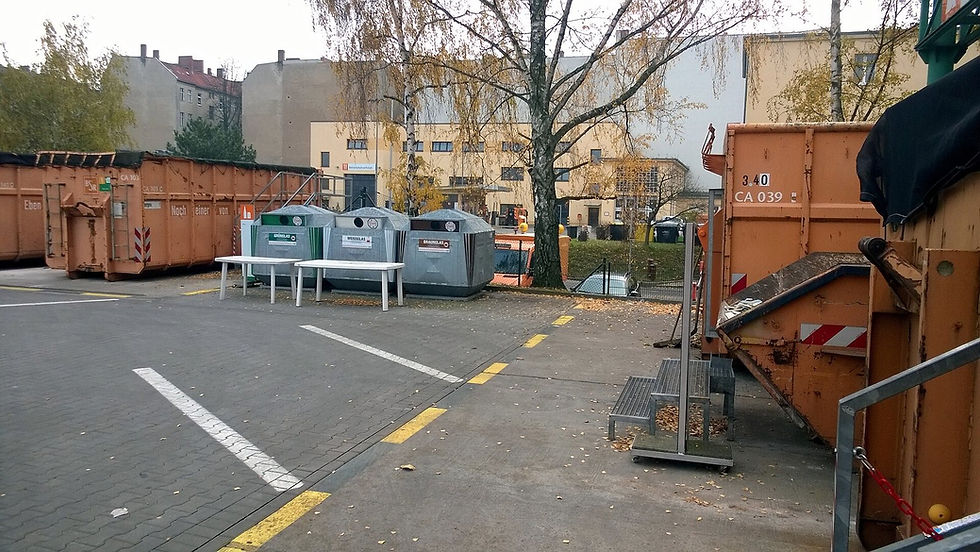
The recycling yard on Ilsenburger Strasse in Charlottenburg. Orange containers for bulky waste, the glass banks in the middle, and a ramp you reverse up to. There are fourteen of these across the city.
What counts as Berlin bulky waste, and the three cubic metre line
The city's waste company, BSR, runs fourteen recycling yards, and a Berlin household can drive up to 3 m³ of bulky waste to one of them free of charge. That covers old furniture, and it also covers scrap wood, scrap metal and hard plastics, because all four count together as a single waste type against the same allowance.
Three cubic metres is more than it sounds and less than you hope. BSR's own rule of thumb, and the yard staff use it because nothing is weighed, is that a full Multivan boot is about 3 m³. A two door wardrobe eats a third of it. A two seat sofa eats another third.
Two details change the arithmetic more than people expect:
The limit counts per vehicle, not per person. Two of you arriving in one car share one allowance.
Nothing is weighed. Staff estimate the volume by eye at the gate, so a load that looks like four cubic metres is four cubic metres.
Upholstered furniture has one exception. A full suite over 3 m³ can still be unloaded, and you may bring one further cubic metre of bulky waste alongside it.

This is roughly two cubic metres. Stacked flat in a car it would fit inside the free allowance with room left over, which is exactly the judgement worth making before you load anything.
The rule that costs people a Saturday
Here is the part that is not on any poster at the gate. You cannot unload part of a load. Partial unloading is forbidden, so a delivery that goes over the limit is refused whole, and you take all of it home.
BSR spells this out with its own worked example: someone arrives with four cubic metres of bulky waste and a fridge. The fridge is accepted as an electrical appliance. The four cubic metres of furniture are turned away.
That is why the measurement happens in the hallway and not at the gate. If the pile looks close to the line, the honest move is to split it across two trips on two days, or to stop driving and book a collection.
The tool below is the version of that decision I use. Tap in what is actually going out, watch the bulky bar fill toward the 3 m³ mark, and every route reprices itself against the same pile.
Electrical appliances are the free lane, always
Anything with a plug is treated separately and generously. Electrical appliances are free at every yard, in household quantities, with no volume limit at all, and they are never counted against your bulky waste allowance. A fridge freezer, a washing machine, a television, a box of cables: all free, on the same trip.
Two practical points:
Take the batteries out where you can and tape the poles. A shorted lithium cell in a container is a genuine fire risk, and staff would rather take a loose battery at the desk than find one later.
A shop may be closer than a yard. German law makes any retailer with at least 400 m² of electrical sales floor, or a supermarket over 800 m² that sells electricals regularly, take back a comparable old device when you buy a new one, and take small devices no bigger than 25 cm on any side free of charge with no purchase at all, up to three per device type. That is the rule that gets an old toaster out of your kitchen on the way to buy bread.

Rubble travels in its own container and on its own tariff. This is the material that turns a cheap clear-out into an expensive one.
The parts that genuinely cost money
Three categories sit outside the free allowance, and one of them is brutal.
Mineral rubble: €4 per started 10 litres. Tiles, brick, concrete, mortar, plaster, ceramic. That works out at €400 a cubic metre, and there is no free amount at all. Strip the tiles off four square metres of bathroom floor and you are already at about €24. Mixed building and demolition waste is refused outright.
Bagged household and renovation waste: €3 per started 50 litres, up to a ceiling of 500 litres in one delivery.
Priced by the piece: a car tyre under a metre is €3 and over a metre is €8, and a toilet or washbasin is €6 each.
Paint, solvents, weedkiller and old oil are free up to 20 kg per waste type per day, which covers a normal flat clear-out several times over. Above that the rates run from €1.30 a kilo for old oil and medicines to €6.40 for chemicals. The catch is location: only five Berlin yards have a hazardous waste counter, so check before you drive. Ordinary household batteries, car batteries, fluorescent tubes and LEDs are free at all fourteen.

The gate on Berliner Strasse in Wilmersdorf. Midday, Saturdays and the day after a public holiday are the three slots to avoid, and every yard is shut on Sundays.
Getting through the gate without losing the afternoon
A few things smooth the trip, and they are the sort of thing you learn on the second visit:
Go midweek or at the edges of the day. BSR names midday, Saturdays and the days after public holidays as the busy periods. Yards also close briefly whenever a container is swapped, so a queue can appear out of nothing.
Sort the load before you set off. Wood in one part of the boot, metal in another, electricals separate. The unload is much faster and the volume estimate is easier to agree.
Bring ID. Only Berlin waste is accepted, and anyone delivering from outside the city has to prove the waste came from Berlin, normally with the original ID card of the person it belongs to.
A friend can drive it, a company cannot. The acceptance rules let you send a neighbour, friend or relative with a private, hired or borrowed vehicle. A commercial hauler is not allowed to deliver household waste at a yard.
One yard runs longer hours. The Recyclinghof Plus on Gradestrasse in Neukölln is open twelve hours a day and is the only one that keeps working during a container change. It is also the only counter that will take an over-size load: on Saturdays it accepts 3 to 5 m³ of bulky waste for a flat €180, paid by card or cash before you unload.
If your load is over the line and you have no van, the collection is usually the better answer. The saver fee is €50 for up to 5 m³, collected from the sixteenth working day. The standard fee is €100 for the same volume, collected inside fifteen. Both are booked online. Both take electrical appliances and clean bagged textiles along free, both need everything ready on the pavement or in the courtyard by the collection morning, and both expect furniture taken apart. Neither will touch rubble.

The NochMall on Auguste-Viktoria-Allee in Reinickendorf, BSR's own second-hand department store. Five of the fourteen yards feed it directly.
Before you throw it away, check whether it is still furniture
A working wardrobe is not waste, and Berlin has more routes out of a flat than most cities.
Hand it in at a yard that takes usable goods. Gradestrasse, Ostpreussendamm, Hegauer Weg, Lengeder Strasse and Rahnsdorfer Strasse pass good items to the NochMall, BSR's second-hand department store in Reinickendorf, open Monday to Saturday from 10 to 20.
Sell it or give it away. The city's flea markets and its second-hand and vintage shops absorb a lot of furniture, and a Kiez group will usually clear a decent bookshelf in an evening.
A "zu verschenken" box is for books and mugs. A wardrobe left on the pavement with a hopeful note on it is still an illegal deposit, and the fine below applies to it exactly as written.

Fuerstenberger Strasse in Mitte. One cabinet, on a public pavement, with nobody around it. In the current fine catalogue that is a €1,500 to €4,000 item.
What the pavement version actually costs
Berlin rewrote its fine catalogue for environmental offences in November 2025 and the numbers went up sharply. For furniture and electricals left in a public place:
€300 to €1,500 for a single small item: a mattress, a suitcase, a chair, a small cabinet, a pram.
€1,500 to €4,000 for several small items, or one larger one: a wardrobe, a bed frame, a stove, a bathtub, a door, a radiator.
€4,000 to €8,000 once the pile reaches a cubic metre or 100 kg.
€8,000 to €11,000 above that.
€1,000 to €15,000 for anything with hazardous parts, whatever its size. That band covers a fridge, a television, a monitor, a boiler, a washing machine, a fluorescent tube and a mobile phone.
Set that against the same pile going through a gate for nothing, or being collected from your door for €50, and the arithmetic answers itself. The catalogue even makes the point in its own notes: electrical appliances from private households can be handed in at the recycling yards free of charge.
My advice
Measure the pile before you touch the car. Stand in the hallway, picture a full Multivan boot, and ask whether what is in front of you would fit in it. Under that line, a yard visit on a Tuesday morning costs you an hour and nothing else. Over it, book the €50 collection and spend the sixteen working days doing something better than reversing up a ramp twice.
And if the wardrobe still shuts properly, drive it to Gradestrasse or Hegauer Weg and let it turn up in the NochMall instead. Someone two districts away is looking for exactly that wardrobe this week.
Berlin runs on this kind of small local knowledge, the sort that only pays off the second or third time you need it. It is the same instinct behind quiet hours in a Berlin building and behind what your landlord owes when the flat goes cold: the rule exists, it is knowable, and knowing it is the difference between a normal week and an expensive one.
Image credits
Source and licence details for the 6 photographs used in this article.
The BSR recycling yard on Ilsenburger Strasse in Berlin-Charlottenburg: Fridolin freudenfett, CC BY-SA 4.0, via Wikimedia Commons.
Kitchen cabinets and a chair set out for a bulky waste collection: 3268zauber, CC BY-SA 3.0, via Wikimedia Commons.
A steel skip for building rubble: PantheraLeo1359531, CC BY 4.0, via Wikimedia Commons.
The entrance to the BSR recycling yard on Berliner Strasse in Berlin-Wilmersdorf: Fridolin freudenfett, CC BY-SA 4.0, via Wikimedia Commons.
The NochMall second-hand department store in Berlin-Reinickendorf: Lukas Beck, CC BY-SA 4.0, via Wikimedia Commons.
A cabinet left on the pavement of Fuerstenberger Strasse in Berlin-Mitte: BerlinMitteFoto, CC BY-SA 4.0, via Wikimedia Commons.