Vintage Shopping in Berlin: Where to Find the Good Stuff
On a Saturday afternoon in Neukölln you can pass a dozen small shops, each with a single rail of hand-picked clothes in the window and a price on a leather jacket that stops you in the doorway. Berlin has one of the best second-hand scenes in Europe. It also has one of the most confusing. The shops sit in four or five separate districts, prices swing from a few euro to a few hundred, and a lot of what the older guides still tell you has quietly moved or closed.
This is a guide to vintage shopping in Berlin that a first-time visitor can actually use: which district to head for, what each one is really like on the ground, how the pay-by-weight shops work, and the one day of the week when the whole plan falls apart. I walk these streets between tours, so the honest version is the one I care about.

A second-hand shop in Kreuzberg. Storefronts like this turn up all over Berlin's eastern districts.
Is vintage shopping in Berlin still cheap?
Berlin's reputation is that it is a cheap treasure hunt where a student furnishes a whole wardrobe for the price of a coffee. That reputation is a few years out of date. The scene has shifted toward curated, hand-picked shops with boutique prices, and second-hand has quietly become its own kind of luxury. You can still find honest value at the big halls and the pay-by-weight stores, but genuinely cheap everyday vintage is harder to find than the myth suggests. Come for the hunt and the quality, and treat a real bargain as a bonus rather than the plan.
Pick one district, not the whole city
The single biggest mistake I see visitors make is trying to shop the entire city in an afternoon. Berlin is wide, the good shops sit in tight clusters, and a day disappears fast on the U-Bahn between them. My advice: choose one district that matches what you actually want, then work it slowly on foot.
Here is the short version of who each area is for:
Neukölln (around Weserstraße) has the densest run of small, owner-picked shops, and it is where the scene genuinely lives.
Friedrichshain (around Boxhagener Platz) is the value end, with big second-hand halls and a lighter touch on your wallet.
Kreuzberg (Bergmannstraße) is worth the trip mainly for the pay-by-weight kilo store.
Mitte (around Hackescher Markt) is the most central and the most upscale, best for designer resale.
Prenzlauer Berg (Oderberger Straße) is polished and gentrified, with the Mauerpark flea market next door.
The tool below turns that into a plan. Pick a district and it gives you the character, the nearest station, the specific shops worth your time, and what to do there when it is a Sunday.
Neukölln: where the scene actually lives
If you only have time for one area, make it Neukölln, along Weserstraße and the streets running off it toward the canal. This is the densest cluster of small independent shops in the city, most of them curated by the person behind the counter. It is a browsing district more than a bargain district: rails are edited, the good pieces are chosen, and the prices reflect that.
Do not aim for a single address. Walk Weserstraße between Schönleinstraße and Sonnenallee, dip into whatever looks interesting, and let the block do the work. Shops like Let Them Eat Cake and Sing Blackbird anchor it, but the pleasure here is the density. The nearest station is U8 Schönleinstraße, and cash is the safe bet in shops this small.

Weserstraße in Neukölln, the spine of the city's small-shop vintage scene.
Friedrichshain: the value end
Friedrichshain, around Boxhagener Platz, is the district for volume browsing on a smaller budget. It is far less precious than Neukölln, with large second-hand halls and casual buy-sell-trade shops where prices stay reasonable. The obvious anchor is the five-floor Humana at Frankfurter Tor 3, which has a proper vintage department upstairs above the everyday second-hand. Start there, then walk south toward the square and circle the streets around it.
The bonus here is timing. Boxhagener Platz holds its own flea market on Sundays, so this is one of the few areas that still works for second-hand on the day the shops are shut. Get there by S or U-Bahn to Frankfurter Tor or Warschauer Straße.

Simon-Dach-Straße in Friedrichshain, a few minutes from the Boxhagener Platz shops and the Sunday market.
Kreuzberg and how the pay-by-weight shops work
Come to Bergmannstraße in Kreuzberg mostly for one experience: buying clothes by the kilo. Colours, on the first floor of a building on the street, is the landmark, and the mechanic surprises a lot of first-timers.
Here is how it works. You are not charged per garment. Clothes are grouped by coloured tags, each colour has a fixed price per kilo, and everything you pick is weighed together at the till. Rates run roughly from the low twenties to near a hundred euro a kilo depending on the tag, which changes how you shop: light shirts and dresses are the real value, while one heavy coat can cost as much as a small pile of tops. Both Colours and Made in Berlin over in Mitte usually cut the kilo price on a Tuesday. Bring a tote, try things on, and weigh up the coat before you commit to it.
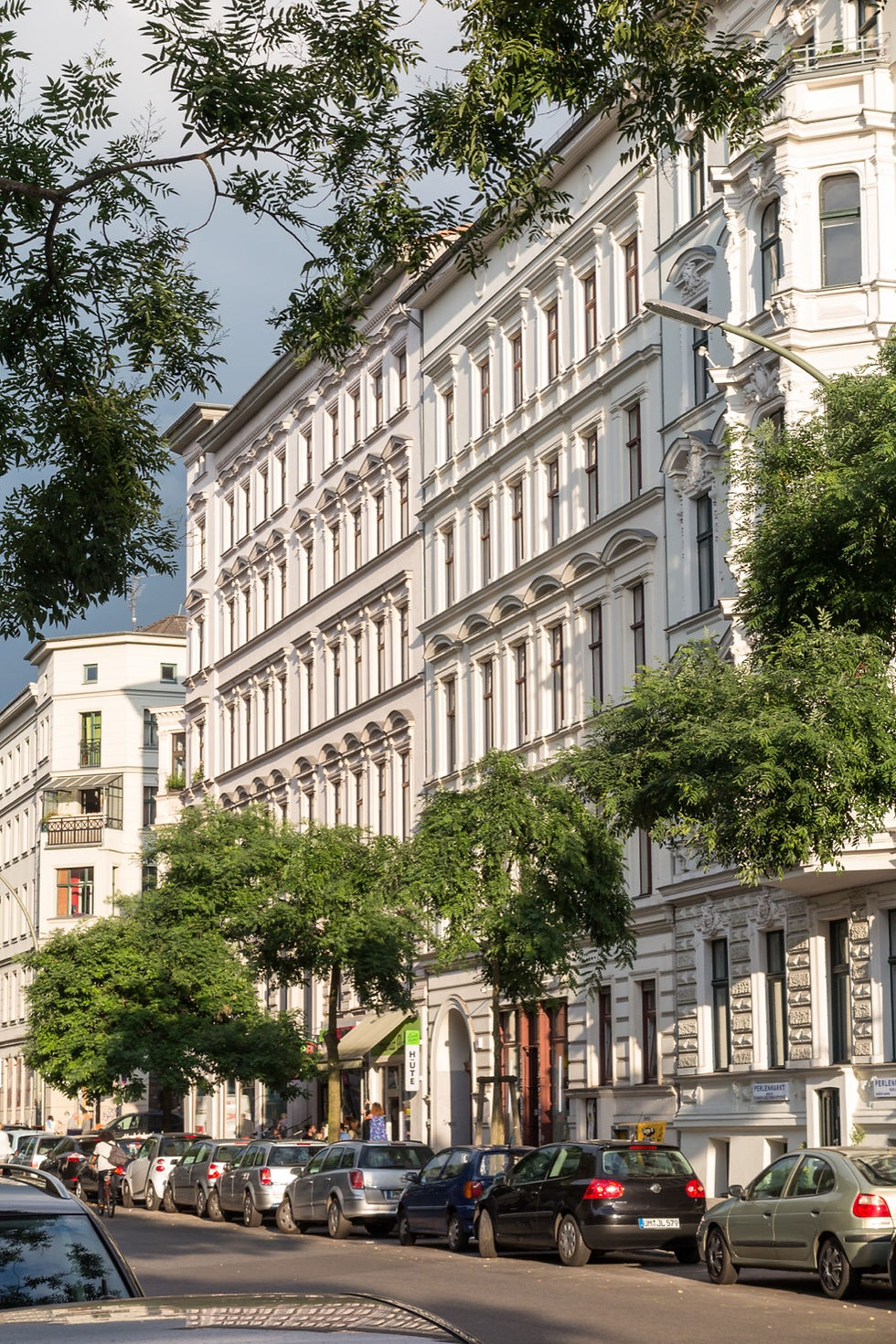
Bergmannstraße in Kreuzberg, home of the Colours pay-by-weight store.
Mitte: central, upscale, and two minutes from where my tour ends
Mitte holds the old fashion quarter around Mulackstraße and Neue Schönhauser Straße, the priciest cluster and the best one for designer resale. Das Neue Schwarz on Mulackstraße is the shop for high-end labels, worth a look even if you leave empty-handed. The affordable exception is Made in Berlin on Neue Schönhauser Straße 19, two colour-sorted floors with a discounted kilo hour on Tuesdays.
This is also the cluster my free walking tour ends beside. The route finishes at Hackescher Markt, a two-minute walk from these streets, so the natural plan is simple: do the walking tour in the morning to get your bearings in the historic centre, then browse the vintage quarter in the afternoon while you are already there.
Prenzlauer Berg: polished, with Mauerpark next door
Ignore the old advice that sends you to Kastanienallee for vintage. That street is mostly mainstream boutiques now. The real second-hand in Prenzlauer Berg sits a little east, on Oderberger and Stargarder Straße, near U2 Eberswalder Straße. Paul's Boutique on Oderberger Straße is the anchor, a curated mix of vintage, designer second-hand and sneakers on one of the prettiest streets in the district.
The honest reason to route here, though, is the Mauerpark flea market. It runs right beside these streets every Sunday from mid-morning, clothes and vinyl included, with the famous karaoke in the afternoon.
The Sunday problem, and the fix
This is the fact that catches out more visitors than any other. Under Berlin's shop-closing law, almost every clothing shop, vintage and second-hand included, is closed on Sundays. If you have set aside Sunday for vintage, you will find shuttered doors down every street.
The fix is the flea markets, which run on Sunday precisely because the shops cannot. The big three are Mauerpark in Prenzlauer Berg, Boxhagener Platz in Friedrichshain, and Arkonaplatz just north of Mitte, with the Nowkoelln Flowmarkt on the Maybachufer canal on some Sundays too. Plan the shops for Monday to Saturday and keep Sunday for the markets. Our full guide to Berlin flea markets breaks down which one suits which kind of visitor.

On a Sunday the shops are shut and the flea markets, like the Nowkoelln Flowmarkt on the Maybachufer, take over.
A few practical things before you go
Carry some cash. The big chains take cards, but the small owner-run shops in Neukölln and Kreuzberg often prefer notes, and a few set a card minimum.
Do not shop early. The big halls open around 10:00, but the small independents often open only at 11:00 or noon, and some close one weekday. For the tiny places, glance at the current listing before you cross the city.
Sizes and returns are their own world. Vintage sizing is inconsistent and there is rarely a returns desk, so try things on properly, because the label often lies.
Weigh the trade at the kilo shops. Light items are where the value hides, so a stack of shirts beats a single heavy coat on the scales.
If you are still deciding where in the city to base yourself, our guide to where to stay in Berlin puts you within walking distance of most of these districts.
Image credits
Source and licence details for the 5 photographs used in this article.
A second-hand shop front in Berlin-Kreuzberg: Neuköllner, CC BY-SA 4.0, via Wikimedia Commons.
Weserstraße in Berlin-Neukölln: Nicor, Tabsnic, CC BY-SA 3.0, via Wikimedia Commons.
Simon-Dach-Straße in Berlin-Friedrichshain: Gryffindor, Public domain, via Wikimedia Commons.
Bergmannstraße in Berlin-Kreuzberg: JoachimKohler-HB, CC BY-SA 4.0, via Wikimedia Commons.
The Nowkoelln Flowmarkt on the Maybachufer canal in Neukölln: Roy Zuo, CC BY-SA 4.0, via Wikimedia Commons.