Quiet Hours in Berlin: The Flat Rules Visitors Break Without Knowing

You get back to the flat in Prenzlauer Berg at half past midnight, still full of the evening, and you put a speaker on the kitchen table while you unpack. Twenty minutes later somebody rings your bell. Nobody is shouting, but the message is clear, and now you are standing in a doorway in a foreign language wondering what exactly you did wrong.
You did not do anything strange. Quiet hours in Berlin are written into state law, and the people who enforce them are the ones living on the other side of your wall. That is the one Berlin rule nobody puts on the booking page.

Landshuter Straße in Schöneberg, a little before midnight. Behind that door there is a stone stairwell, and every word said in it goes up five floors.
Quiet hours in Berlin: the two rules that actually matter
Berlin's noise law, the Landes-Immissionsschutzgesetz, is short in the part that concerns you. Two things are protected.
The night, from 22:00 to 06:00. During those hours it is forbidden to make noise that could seriously disturb another person. That is the whole test: not a decibel number, not a device list, just whether the person on the other side of your wall is being seriously disturbed.
Sundays and public holidays, the entire day. There is no clock on this one. The same prohibition that covers 03:00 on a Tuesday covers 14:00 on a Sunday.
Building sites run on a stricter night, 20:00 to 07:00, which is why the scaffolding outside your window goes silent so early. The official Berlin summary of these rules sits on the Senate environment pages.
The Sunday half is the one that catches visitors, because it does not exist in most countries the same way. Sunday in Berlin is a legal category, and the ten dates in my Berlin public holidays guide behave exactly like Sundays. If you are here on 3 October, that Saturday is a public holiday, so it follows the Sunday rule and not the Saturday one.
The 13:00 to 15:00 pause that is not a law
Somewhere in your building there is probably a laminated sheet listing a Mittagsruhe between 13:00 and 15:00. Half the visitors who see it assume it is city law. It is not in the Berlin noise law at all.
Two separate things got tangled together. The early-afternoon pause is a house rulebook, the Hausordnung, which is a private agreement attached to the flat. The genuine 13:00 to 15:00 restriction in German federal law applies to outdoor garden and building machinery, things like leaf blowers and grass trimmers in residential areas, and it has nothing to do with what you are doing inside a kitchen.
That distinction matters more than it sounds. A house rule binds you through the flat, so your host can be held to it and can pass the problem to you. The noise law binds you through the city, and a neighbour can call it in directly. Same yellow sheet in the hallway, two completely different consequences.

Barbarossastraße after 22:00. This is the level of street noise your neighbours are used to, which is why one open window changes everything.
Use the Berlin Quiet Clock
Pick the thing you are about to do and drag through the week. Green is normal, yellow means restricted by your building's rulebook or only allowed in a quiet version, and red is the state law a neighbour can act on.
The grid is worth thirty seconds even if you think you know the answer, because the activities behave very differently. A shower at 01:00 is fine. A vacuum at 15:00 on a Sunday is the single most complained-about thing in Berlin housing. Those two feel similar from inside the flat and are not the same at all outside it.
What Zimmerlautstärke actually means
The word you will meet in every rulebook is Zimmerlautstärke, room volume. There is no legal decibel figure behind it, which frustrates people who want a number. The working definition is simpler: the sound stays inside your room. If a neighbour can follow your music, hear the dialogue of your film, or tell which song is playing, you are above it.
After 22:00, room volume is the standard for everything that makes sound on purpose. Speakers, television, an instrument, a video call with the laptop speakers on. Berlin's older buildings carry sound through the floorboards and the ventilation shafts far better than a modern hotel does, and you get no warning about that from inside your own flat.
There is a nice piece of counter-intuition here too. German courts have repeatedly refused to enforce house rules banning night-time showering and bathing, treating around half an hour as ordinary household noise. So the thing that feels rude at 01:00 is allowed, and the thing that feels harmless, one speaker on a table, is the one with a fine attached to it.

Kopenhagener Straße in Prenzlauer Berg. Six flats face this one courtyard wall, and the wall reflects sound straight back at all of them.
The courtyard is the part visitors get wrong
A Berlin Hinterhof is a stone box open at the top, usually with a rear building behind the street building and flats on all four sides. It was built in the nineteenth century to squeeze more housing onto one plot, and the acoustic side effect is that it works like a chimney for sound.
Four people saying goodnight in a courtyard at 01:00 reaches more bedrooms than the same four people on the pavement outside the front door. So does a phone call, a lighter conversation on a balcony, and a bottle going into a glass bin. My advice: move the goodbye to the street. Step out through the front door, say what you need to say on the pavement, and let the building sleep. It costs you nothing and it is the single most useful habit a visitor can pick up here.
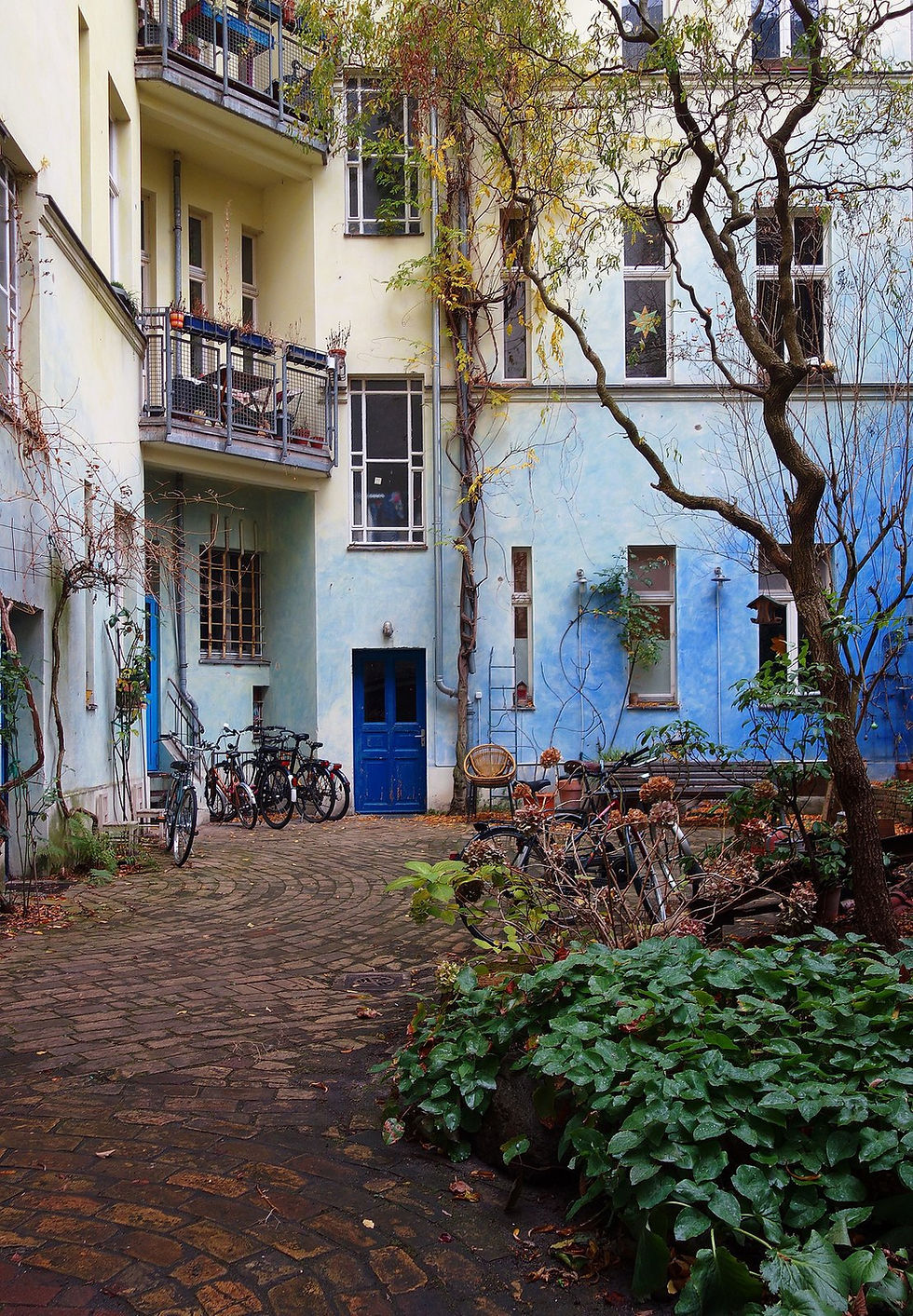
Nehringstraße in Charlottenburg. Every one of those balconies is a bedroom window in summer.
Stairs, the front door and the suitcase
The other classic is a departure, not an arrival. An early flight means a hard-shell case on old stair tiles at 05:30, and the sound of plastic wheels going down four flights is unmistakable at the bottom of the building.
Carry the case down the stairs. Ninety seconds of effort, and it removes the loudest thing you will do all week.
Close the front door with your hand on it. Berlin street doors are heavy and sprung, and they slam like a gunshot into a stairwell.
Keep the conversation for outside. The stairwell amplifies exactly like the courtyard, and at 05:30 it is the only sound in the building.
Take the bins out during the day. Glass into a container at 23:00 is loud enough to be an offence in its own right.

Meinekestraße in Charlottenburg. Wood, stone and a stairwell that runs the full height of the building. Wheels are a bad idea in here.
If somebody does complain
Berlin has an unglamorous, orderly process for this, and knowing it takes most of the fear out of the doorbell.
During office hours the responsible authority is the district Ordnungsamt. In the evening, at night and at weekends, the police handle it instead, and the official Berlin service page for household and neighbourhood noise says exactly that. It also says, first, that a neighbour should talk to you or to the landlord before making a report. Most of the time that is what happens, which is why the first contact is almost always a doorbell, not a uniform.
If it does become formal, the published fine bands for private individuals run from 50 to 2,500 euros for night noise and from 40 to 2,000 euros for a Sunday or a public holiday. Those are catalogue ranges, not a bill anyone should expect from one loud evening, and they are halved where the offence was careless instead of intentional. The realistic outcome of a first complaint is a request to turn it down and a slightly awkward morning.
What I would avoid is treating the knock as a negotiation. Berliners are direct, which visitors sometimes read as anger when it is simply the local way of saying something plainly. I wrote about that in why Berliners are not rude. Say sorry, turn it down, and the whole thing is over.

A landing on Rosenthaler Straße in Mitte, a few doors from the Hackesche Höfe. This is where you meet the neighbour, so it helps to have given them nothing to say.
What I would do on your first night
Berlin flats are wonderful and they are also thin, shared, hundred-year-old buildings full of strangers who get up early. The visitors who never have a problem all do roughly the same small things.
Find the house rulebook on the first evening. It is usually a printed sheet in the flat or a frame in the hallway, and it takes two minutes.
Treat 22:00 as the moment you close the windows, not the moment you get quiet.
Put anything loud, laundry, a suitcase repack, moving furniture, into daylight on a weekday.
Assume Sunday is different, and check my public holidays guide if your dates include one.
Say goodnight on the pavement.
If you are still choosing where to stay, the trade-off between a flat and a hotel is a real one and I have broken down where the cost flips in hotel or apartment in Berlin. A flat gives you a kitchen, a neighbourhood and a much better sense of the city. It also gives you neighbours, and the whole deal works if you treat the building as somebody's home rather than a hotel corridor.
There is one more thing that helps, and it is not a rule. Once you have walked the historic centre and seen how tightly Berlin is stacked, courtyard behind courtyard behind street, the noise habits stop feeling like bureaucracy and start feeling obvious. That is a large part of what I try to show people on the free walking tour, which starts at Alexanderplatz and takes about two hours through the old heart of the city.
Rules and fine ranges checked on 6 September 2026.
Image credits
Source and licence details for the 3 photographs used in this article.
An Altbau stairwell landing on Rosenthaler Strasse in Berlin-Mitte: Mark Ahsmann, CC BY-SA 3.0, via Wikimedia Commons.
A rear courtyard on Nehringstrasse in Berlin-Charlottenburg: Neuköllner, CC BY-SA 4.0, via Wikimedia Commons.
The rear building of a courtyard on Kopenhagener Strasse in Prenzlauer Berg: Ansgar Koreng, CC BY 3.0 DE, via Wikimedia Commons.