Berlin Heating Season: What Your Landlord Owes You When the Flat Goes Cold

There is a week in October when the Berlin flat you have lived in for years turns into a different building. The radiators tick. One room stays warm and one never does. And somewhere between the third cold evening and the first argument with the Hausverwaltung, you realise you do not actually know what your landlord owes you, or from which date.
I have had that week. The first time I put a jumper on indoors and called it German autumn. The second time I looked it up, and it turned out I had been sitting in a flat that was several degrees below the line for most of a month.
This is the version I wish I had read the first October.

Somewhere in a building like this one, on a night like this one, a radiator is not doing its job. The question is whether that is a defect or just weather.
When the Berlin heating season actually starts
The Berlin heating season, the Heizperiode, runs from 1 October to 30 April. That range is a convention built out of tenancy agreements and court decisions, not a line in a statute, which is why nobody can hand you the law that says it.
The date most people miss is the other one. Outside the heating period, a landlord still has to heat when it gets genuinely cold. The threshold Berlin tenant advice uses is three days in a row with the outside temperature below 12 °C at 21:00. Hit that in September and the duty starts early.
So I checked how often Berlin actually hits it. Using the hourly ERA5 archive for Berlin Mitte, the first three-day run of sub-12 °C evenings landed here:
2018: 25 September. 2019: 19 September. 2022: 19 September. 2024: 30 September. Four of the last eleven autumns crossed the line before October began.
2023 was the latest at 16 October, so half of that month passed with no duty triggered by cold alone.
The rest cluster in the first two weeks of October: 2 October 2015, 6 October 2016, 7 October 2017, 12 October 2020, 10 October 2021, 1 October 2025.
This year the calendar looks like it wins. Checked on 9 September 2026, the forecast keeps Berlin evenings above 15 °C into the third week of the month, so 1 October is the date that will bite first in 2026. Worth knowing if your building has a caretaker who likes to say the season has not started. If you want the longer view of how the city cools down, the month by month temperature picture explains why October is the month that catches people.

Sponholzstrasse in Schoeneberg. The lit windows are the useful detail: heating duty is measured by the hour, and the evening hours are the ones people actually notice.
The temperature a landlord owes, hour by hour
Where the tenancy agreement is silent, and most are, these are the figures Berlin tenant advice treats as sufficient during the heating period, between 06:00 and 24:00:
Living rooms and kitchens: 20 to 22 °C.
Bathrooms: 23 °C. The highest figure in the flat, because you are wet and standing still in it.
At night the floor drops, and this is the contested part. Berlin tenant advice accepts that a reduction to 16 °C can still be lawful; other guidance puts the night floor at 18 °C. Treat a cold night as the weaker half of your case.
Two things follow from that. The first is that a single afternoon reading proves very little, because the duty is defined across a window of hours. The second is worth remembering if your contract does contain a temperature clause: a clause setting lower temperatures than these is generally treated as invalid, because it puts the tenant at an unreasonable disadvantage.

The valve does not set the temperature of the water arriving in the radiator, only how much of it passes. If the flat stays cold with this on maximum, the problem is upstream of your flat.
The tool below draws that band across a day and puts your own readings on top of it, so you can see at a glance which ones a landlord actually has to answer for.
How to measure so the number counts
Here is the part that decides everything, and almost nobody is told it: the tenant carries the burden of proof. If you say the flat was cold, you have to show it. Which means the measurement has to be taken in a way that survives being questioned.
Middle of the room, about one metre above the floor. Not on the windowsill, not next to the radiator, not in the draught by the door.
Several times a day, on several days. Berlin tenant advice describes a daily record with readings at different times, kept in a table. One number on one evening is an anecdote.
Every room, including the ones that are fine. A log showing the kitchen at 21 °C and the bedroom at 17 °C is far more convincing than a log showing only the bad room.
Write down the date and the hour, not just the temperature. The hour is what decides which floor applies.

The classic mistake is measuring here. Stand back to the middle of the room, hold the thermometer at about waist height, and give it a few minutes to settle.
Which of Berlin's two heating systems you are arguing with
Berlin is unusually simple on this point. According to the 2022 census, with a reference date of 15 May 2022, Berlin had 921,188 dwellings heated by gas and 869,472 by district heating. Together that is about 89 per cent of the city's flats. Heat pumps, solar and geothermal covered 13,892 dwellings, under one per cent.
That matters because the two systems fail differently.
District heating (Fernwärme). The heat arrives from outside the building through a transfer station in the basement. You cannot switch supplier and you cannot fix anything yourself. Berlin's largest network was bought back by the state and now runs as Berliner Energie und Wärme, so the network behind roughly a third of Berlin households is publicly owned. That changes the politics, and so far not the radiator.
Gas. Either a central boiler for the whole building, which is the landlord's problem entirely, or a Gasetagenheizung, your own boiler inside the flat. With the boiler in your flat the gas contract is often in your name, but the working heating system is still owed by the landlord. Paying the gas bill does not transfer the repair duty to you.
Knowing which one you have changes the first line of your email. With district heating there is no boiler in your flat to blame.
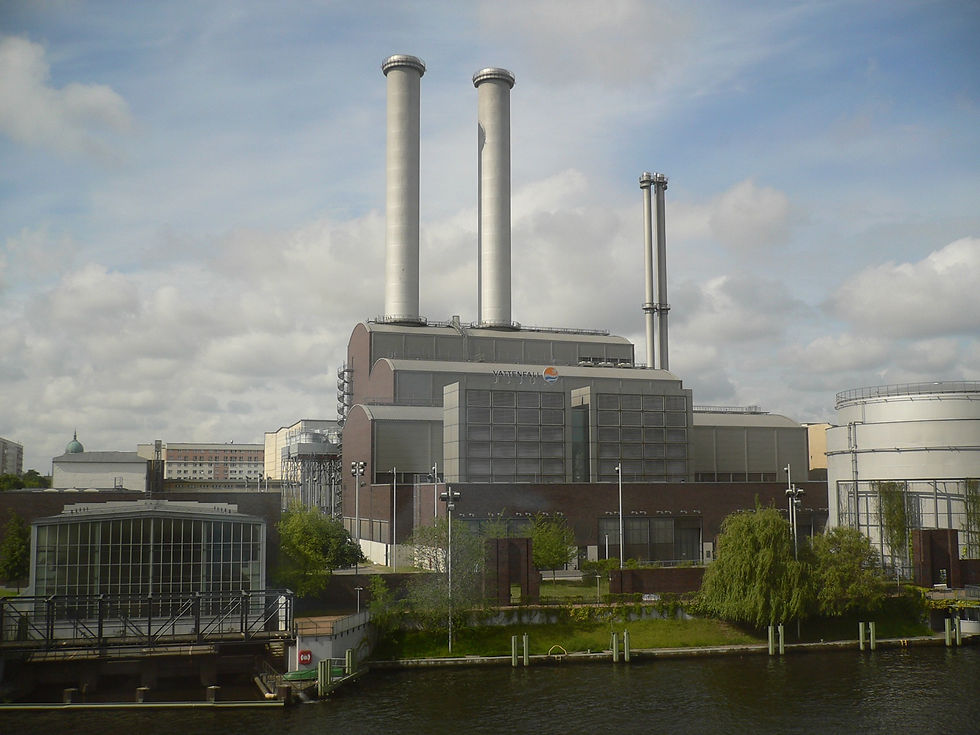
Heizkraftwerk Mitte on the Spree, a short walk from the Jannowitzbrücke end of the historic centre. Plants like this one are where Berlin's district heating starts.
The order of the steps, and the one you cannot skip
Rent reduction is the step everyone has heard of and the step most people take too early. It comes after a notice, never instead of one.
First, log it. Readings, rooms, hours, dates. A week is better than a night.
Second, report the defect in writing. A Mängelanzeige. Say which rooms, what temperatures, at what hours, and set a short deadline for repair. Three days is the deadline Berlin tenant advice suggests for heating, because heating is urgent.
Third, state that further rent is paid under reserve. One sentence, and it protects your position while the matter is open.
Fourth, and only then, look at a reduction, after taking advice. Reported rulings sit anywhere from a few per cent for a flat that reaches only 18 °C to seventy per cent or more when the heating fails outright during the season. The Landgericht Berlin has granted both ends of that. Which number fits your flat is a judgement about your case, and getting it wrong in the wrong direction is a rent arrears problem.
That last step is the one I would not improvise. A reduction taken at the wrong percentage is a much worse week than a cold flat.
Two smaller rights that are worth ten minutes
While you are in the paperwork, two things in the Heizkostenverordnung are quietly worth money and almost nobody claims them.
Monthly consumption information. Since 1 January 2022, if your building has remotely readable heat meters, the landlord has to send you a consumption update every month, by app, portal, email or post. If that information is not provided as required, section 12 lets you cut your share of the heating costs by 3 per cent. Go and check whether you have had twelve of those this year. Many Berlin tenants have had none.
The meter deadline. Meters that cannot be read remotely have to be retrofitted or replaced by 31 December 2026. That is three and a half months away, so a Handwerker appointment about your radiators this autumn is quite likely to be this and not a repair.

A Heizkostenverteiler on the radiator. If yours is an old evaporation tube like this rather than a radio device, it is the kind that has to be replaced before the end of 2026.
Where to take the log
This is the Berlin-specific part, and it is genuinely good. Every one of the twelve districts runs a free tenant advice service, funded by the Senate, open to any tenant living in that district. Legal representation in court is excluded, but reading your log and telling you whether you have a case is exactly what it is for. The directory of district offices is on the Senate's own site.
Take the printed log with you. An advisor who can see three days of readings at three times a day will get to an answer in ten minutes. An advisor hearing "it feels cold" will not.
My advice, if you want one move out of all this: buy a cheap room thermometer this week and start logging on 1 October, before you have a complaint. If the flat is fine you will have wasted four minutes a day. If it is not, you will have the one thing that is impossible to produce afterwards.
And if you want the cold weeks to feel shorter, the answer in Berlin has always been to go outside anyway. Plenty of the city is still open in October, and I have written elsewhere about what actually closes in Berlin in winter and the flat rules that catch people out. The heating rules belong on the same shelf.
Image credits
Source and licence details for the 3 photographs used in this article.
A radiator with a thermostat valve and a heat cost allocator fitted: FrankenBeer, CC BY-SA 4.0, via Wikimedia Commons.
The Heizkraftwerk Berlin-Mitte combined heat and power station on the Spree: Georg Slickers, CC BY-SA 3.0, via Wikimedia Commons.
A heat cost allocator mounted on a radiator: Man, CC BY-SA 3.0, via Wikimedia Commons.