What Closes in Berlin in Winter: The Dates the Lakes, Pools and Boats Stop

Every autumn I meet visitors who packed for the Berlin they saw in photographs. They arrive in the second week of October with a swimming towel in the suitcase, a plan to take a boat down the Spree at seven in the evening, and an idea that the city is one continuous outdoor summer. Then they walk down to Strandbad Wannsee and find a locked gate, a raked beach and a row of empty wicker beach chairs.
Nothing has gone wrong. Berlin simply runs on a seasonal timetable that almost nobody writes down in one place, and the dates are earlier than most people expect.
What closes in Berlin in winter, and in what order
The useful thing to understand is that Berlin does not shut for winter on a single date. It closes in stages between the second week of September and the end of November, and each stage belongs to a different operator with its own calendar.
Roughly, the order looks like this:
Mid-September: the outdoor pools and the lake bathing season end.
1 October: the Botanic Garden switches to winter hours.
25 and 26 October: the clocks go back and the zoo drops to its short winter day.
30 October: the last outdoor pool in the city closes.
1 November: the public saunas open.
20 November: the Spree boats move to a weekend-only winter tour.
23 November: the Christmas markets open.
Once you can see it as a sequence, a shoulder-season trip stops being a gamble. You are not asking whether Berlin is open. You are asking which stage you are landing in.

Strandbad Wannsee outside the bathing season. The beach and the chairs stay, the lifeguards and the swimming season do not.
The water goes first, and it goes fast
Berlin's outdoor swimming ends in a tight cluster of days, and this is where most autumn plans break.
In 2026 the Berliner Bäder-Betriebe calendar ran like this: Sommerbad am Insulaner, Sommerbad Humboldthain and Sommerbad Pankow had their last day on 11 September. Kombibad Gropiusstadt, Sommerbad Neukölln and Strandbad Wannsee closed the bathing season on 13 September.
Wannsee has a detail worth knowing. The swimming season ends, but the site keeps a reduced life for three more weeks: from 14 September to 4 October it opens for sunbathing and the sauna only, from noon on weekdays and from 10:00 at weekends. If you want the enormous beach without the crowd, that window is the quiet one.
There is one exception, and it is the one I actually recommend to people arriving in October. Sommerbad Kreuzberg, the Prinzenbad, stays open until 30 October. It sits directly beside U-Bahn Prinzenstraße on the U1, it is heated, and it is the only outdoor pool in Berlin still swimming when the leaves are down. On a cold bright Wednesday in the middle of October it is one of the best things you can do in this city.
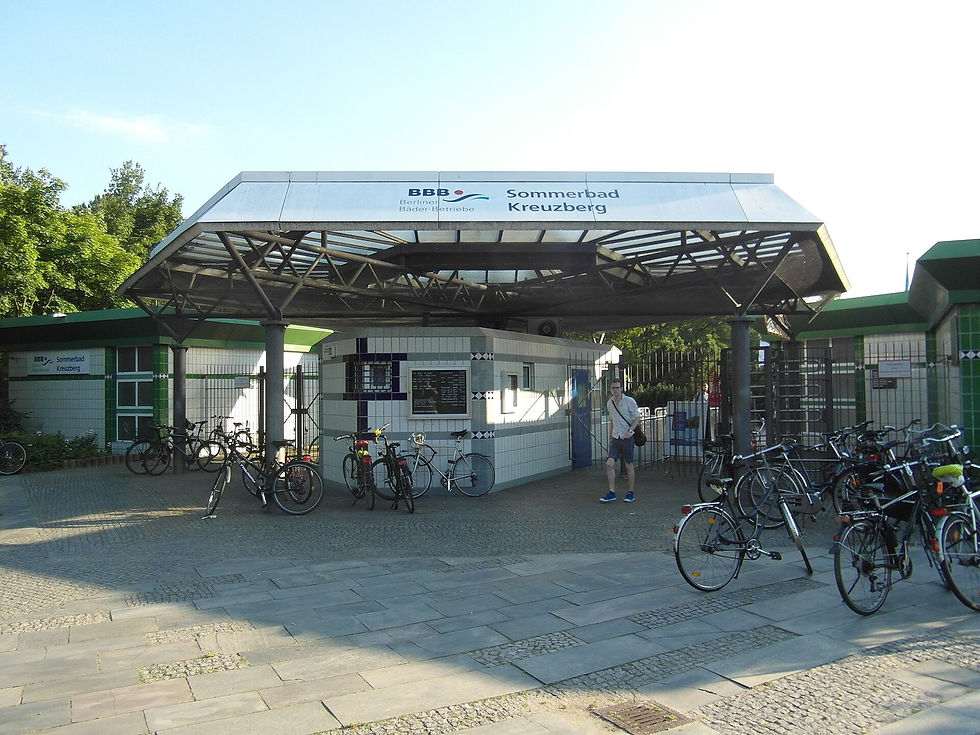
The Prinzenbad entrance on Prinzenstraße. The last outdoor pool in Berlin still open in late October.
Indoor swimming works in the opposite direction. The Hallenbäder reopen in waves across September and October, on 7, 14 and 21 September and then 3, 5 and 21 October, so a pool that was shut for the summer break may be open again by the time you visit. If swimming matters to your trip, check the specific pool rather than the city.
The city swimming pools and the lakes each have their own guide here, and both are worth reading before you plan a water day in the shoulder season. Current dates are published by the Berliner Bäder-Betriebe.
The clocks go back, and the gates move with them
The single biggest change in the Berlin calendar is not a closure at all. It is the last Sunday of October, 25 October in 2026, when the clocks go back an hour and the city loses its evenings.
Watch what happens immediately afterwards. Zoo Berlin runs 09:00 to 18:00 with last admission at 17:00 until 25 October, and from 26 October it drops to 09:00 to 16:30 with last admission at 15:30. That is ninety minutes of visiting time gone overnight. If you have one zoo afternoon in your trip and it falls in late October, the side of that Sunday you land on decides whether it works.
Parks do the same thing on a monthly rhythm. Tempelhofer Feld is open 06:00 to 20:30 in September, 07:00 to 19:00 in October, 07:00 to 18:00 in November, and 07:30 to 17:00 in December and January. The entrances shut at closing time, so a late arrival finds the gate locked even though people are still leaving through the revolving exits.

Tempelhofer Feld. In December the gates shut at 17:00, which in Berlin is well after dark.
The Botanic Garden in Dahlem is stricter than most people realise. From 1 October the ticket desk and the greenhouses run 09:00 to 18:00 and the garden exits close at 19:00, and the garden says plainly that once the exits close you cannot leave. That is a real constraint on a big site: give yourself a proper hour to walk back to the gate.
My advice: from October onwards, treat the closing time as the time you should already be walking towards the exit. I have misjudged that at the Botanic Garden myself, and jogging across a dark arboretum is not the memory you came for. The same logic applies to museums, and the last admission times are usually an hour before the door.
The boats do not stop, they shrink to a weekend
Spree boat tours are the classic autumn disappointment, because people assume they either run or they do not.
What actually happens with Stern und Kreis, the main operator on the central Spree, is a change of format. The regular city tours from Friedrichstraße run through the autumn. Then the Winterliche Citytour takes over from 20 November to 20 December, Friday to Sunday only. Same river, same bridges, three days a week instead of every day.
So a November boat trip is entirely possible. A November boat trip on a Tuesday is not. If a river hour matters to you, put it on a weekend and book it before you fly, the way you would with any other boat tour ticket in Berlin. Current sailings are listed by Stern und Kreis.

A city tour boat below the Berliner Dom in February. The river season narrows in winter, it does not vanish.
What opens instead
Berlin gives things back at almost exactly the moment it takes the outdoor season away, and the handover happens in the first week of November.
1 November: the saunas. The saunas inside the city swimming pools open for the season. These are municipal prices, not spa prices, and I think they are the most underrated thing in a Berlin winter. There is a full Berlin sauna guide here with what it costs and what the etiquette is.
23 November: the Christmas markets. The season opens on 23 November 2026. The market on Gendarmenmarkt runs to 31 December, and the ones at Breitscheidplatz and Wittenbergplatz run into early January. My Christmas market guide sorts them by what each one is actually for.
All winter: the glasshouses. The Great Tropical Greenhouse at the Botanic Garden is 25 degrees and humid in the middle of a Berlin January. On a grey day it is a genuinely restorative hour.

The Großes Tropenhaus in Dahlem in early November. Twenty-five degrees inside, whatever the city is doing outside.

The market in front of the Konzerthaus on Gendarmenmarkt, which opens on 23 November and runs to the end of the year.
The part of Berlin that has no season
Here is the thing the seasonal calendar hides: the historic centre of Berlin is almost entirely season-proof.
The World Clock, the TV Tower, the Rotes Rathaus, Marienkirche, the Marx-Engels-Forum, the Humboldt Forum, the Lustgarten, Museum Island and Hackescher Markt are all open air or indoors and open all year. Museum opening hours barely move. The Reichstag dome runs through the winter. The walk between all of it is about three kilometres of flat pavement.
That is the whole argument for a winter trip to Berlin. The things that close are the lakes, the outdoor pools and the open-air cinemas. The things that made you want to come are the things that stay.
My advice for a shoulder-season Berlin day
Pick the layer of the city that matches the date instead of fighting it.
Early September: the water is still there. Wannsee, the outdoor pools, the last open-air film screenings.
October: the Prinzenbad until the 30th, Tempelhofer Feld before 19:00, and the centre from mid-afternoon once the light goes.
November onwards: saunas, glasshouses, museums, the Christmas markets from the 23rd, and a weekend boat.
One simple move if you are here in the cold months: do the outdoor part of your day first and the indoor part after 16:00. Berlin's darkness arrives around 16:00 in December, and everything with a gate closes with it, while everything with a roof does not. Walking the central route in the dark is not a compromise either. The Dom lit from the Friedrichsbrücke in December is better than the same view in July.
Image credits
Source and licence details for the photographs used in this article.
Strandbad Wannsee: Dirk Ingo Franke, CC BY-SA 4.0, via Wikimedia Commons.
Entrance to Sommerbad Kreuzberg: IngolfBLN, CC BY-SA 2.0, via Wikimedia Commons.
Runway on Tempelhofer Feld: Tony Webster, CC BY 2.0, via Wikimedia Commons.
Boat tour below the Berliner Dom: Waheed Shhadi, CC BY-SA 4.0, via Wikimedia Commons.
Christmas market on Gendarmenmarkt: Andreas Trojak, CC BY 2.0, via Wikimedia Commons.