Schöneberg Berlin: Bowie, Kennedy and the District That Whispers
Updated: Jul 22
Most people arrive in Schöneberg by accident. The hotel was cheaper than Mitte, the flat was near a U-Bahn station with four lines, and then they step out onto Nollendorfplatz on a Tuesday morning with no idea what any of it is. Others come on purpose, looking for the flat where David Bowie made three albums, and find a physiotherapy practice on the ground floor and a small metal plaque next to the door.
Both groups are having the same experience. Schöneberg Berlin keeps almost all of its history at eye level, screwed to buildings that people still live in, and it does not announce any of it.
My advice: come here for one thing, not for a list. I have tried to chain Bowie, Kennedy, Marlene Dietrich and the market into a single afternoon, and it turns into a tour of doorways with a lot of U-Bahn in between. Pick the Saturday market, or pick the memorial quarter, or pick the Kennedy square. Do that one properly and let the rest be things you walk past.

Saturday at Winterfeldtmarkt. Around 250 stalls, and the tower of the Apostel-Paulus-Kirche watching over the cheese.
Schöneberg is four separate places wearing one name
This is the single most useful thing to understand before you go. Schöneberg is not a walkable neighbourhood in the way Prenzlauer Berg or the middle of Kreuzberg is. It is a district, and its interesting corners are genuinely far apart.
There are four of them:
Nollendorfplatz and Winterfeldtplatz in the north: the market, the bars, and one of Berlin's oldest queer neighbourhoods.
The Akazienkiez, around Akazienstraße and Eisenacher Straße: independent shops and cafes rather than department stores, and the part of Schöneberg that is simply a good place to live.
The Bayerisches Viertel, around Bayerischer Platz: quiet, well-off, and carrying the most unusual memorial in Berlin.
Rathaus Schöneberg and the Rote Insel in the south: Kennedy's square, and the street where Marlene Dietrich was born.
The U-Bahn is what holds them together. U1, U2, U3, U4 and U7 all serve the district, and the U4 is a small oddity worth knowing: it runs entirely inside Schöneberg, five stations over 2.9 km from Nollendorfplatz to Innsbrucker Platz, and it opened in December 1910 as Germany's first municipally built U-Bahn line. Nollendorfplatz itself is the only station in Berlin served by four U-Bahn lines, and it is about ten to twelve minutes from Alexanderplatz on a direct U2.
If you are still choosing where to base yourself, my guide to where to stay in Berlin puts this district in context against the rest of the city.
The thing nobody tells you: most of it is a plaque
Schöneberg's famous addresses are almost all private buildings. There is no Bowie museum. There is no Isherwood house you can tour. There is no Dietrich birthplace with an entrance fee. What there is, in each case, is a small plaque, a real building, and a street full of people going about their day.
I do not say that to talk you out of coming. Standing in front of the actual door is worth something, and Berlin is unusually good at this quiet kind of marking. But it is worth knowing before you spend forty minutes on the U-Bahn expecting an exhibition.
So before you build a route, set your own bar. The tool below lists what is actually waiting at each address, from "a plaque is enough for me" up to "I want something curated to read", and it accounts for the days things are shut.
Winterfeldtmarkt is the reason to set an alarm
If you only do one thing in Schöneberg, do this one.
Winterfeldtmarkt runs on Saturdays from 8:00 to 16:00 and on Wednesday mornings, and the Saturday version is Berlin's biggest weekly market: around 250 stalls spread over roughly 5,000 square metres of Winterfeldtplatz. Cheese, fish, bread, flowers, Turkish produce, a lot of very good coffee, and a crowd that is mostly people who live within a few streets.
The Wednesday market is a smaller, quieter thing that winds up in the early afternoon. It is pleasant, but it is not the event.
My advice: go on Saturday, go before 11:00, and eat there rather than planning lunch somewhere else. Then walk fifteen minutes south to Akazienstraße and keep going. That is the whole morning, and it is better than any three sights stitched together.
One warning that catches people out: on public holidays there is no market at all, and most German shops do not open on Sundays, which turns the Akazienkiez into a nice but very quiet street. If markets are your thing generally, Berlin's flea markets run on a different rhythm and fill the Sunday gap.
Hauptstraße 155: Bowie's Berlin is a doorway
Between 1976 and 1978, David Bowie lived on the first floor of Hauptstraße 155 during the Berlin years of Low, "Heroes" and Lodger. Iggy Pop came with him and later moved into the rear building of the same address. It is, by a distance, the most requested Schöneberg address.

The plaque went up in 2016. The first one was stolen within weeks and replaced with a reinforced frame.
Here is the honest version of the visit. It is an ordinary lived-in apartment house. People come home with their shopping while you photograph the wall. The plaque, unveiled in August 2016 and quoting the Berlin trilogy, is everything there is to see, and it takes about four minutes.
What makes the trip worth it is next door. Café Neues Ufer at Hauptstraße 157 opened in 1977 as Anderes Ufer, one of West Berlin's early openly gay cafés, with its life visible through a plain street window rather than behind a curtain. Bowie drank here. Unlike the plaque, you can sit down in it, which turns a photograph of a doorway into an actual hour of your day. Nearest station is U Kleistpark on the U7.
Nollendorfplatz, and a memorial from 1989
On the wall of Nollendorfplatz U-Bahn station, at the Motzstraße end, there is a triangle of red granite. It reads "Totgeschlagen, Totgeschwiegen", beaten to death and silenced to death, and it is dedicated to the homosexual victims of National Socialism.
It was unveiled in June 1989 and it was the first memorial to homosexual Nazi victims anywhere in German public space. A bronze panel added in 1993 explains what the pink triangle meant in the camps, and how from January 1933 the Nazis shut down or raided nearly every gay venue around this square.

Two minutes at the Motzstraße end of the station, on the way to anywhere else in Schöneberg.
The streets around it, along Motzstraße, Fuggerstraße, Nollendorfstraße and Karl-Heinrich-Ulrichs-Straße, are the Regenbogenkiez, the rainbow quarter, and the scene here is not a recent arrival. In the 1920s this was Eldorado territory, and in 1930 a young English writer took a room at Nollendorfstraße 17 in the flat of Meta Thurau, who became Fräulein Schroeder in his book. That was Christopher Isherwood, the book was Goodbye to Berlin, and the musical it eventually became was Cabaret. His plaque is there too, and researchers have pointed out that the dates on it are wrong: he actually arrived in December 1930 and left in May 1933.
I keep this section short on purpose, because I have written the full version elsewhere. If this is why you came to Berlin, read my guide to Berlin Pride and the history behind it instead of this paragraph.
The Bayerisches Viertel memorial is the one that stays with you
This is the piece of Schöneberg I send people to when they think they have seen enough Berlin memorials.
In the quiet, well-off streets around Bayerischer Platz there are eighty double-sided signs, each 50 by 70 centimetres, mounted about three metres up on ordinary lamp posts. They were made by Renata Stih and Frieder Schnock and installed in 1993, and they are called Orte des Erinnerns, places of remembering.
One side of each sign carries a plain, almost cheerful image. The other side carries the abbreviated text of a real anti-Jewish law, with its date. Jewish children may only use public transport to get to school if the school is more than five kilometres away. Jews are forbidden to visit cinemas, theatres, operas and concerts. Jews may only shop between four and five in the afternoon. Jews must hand in their radios.
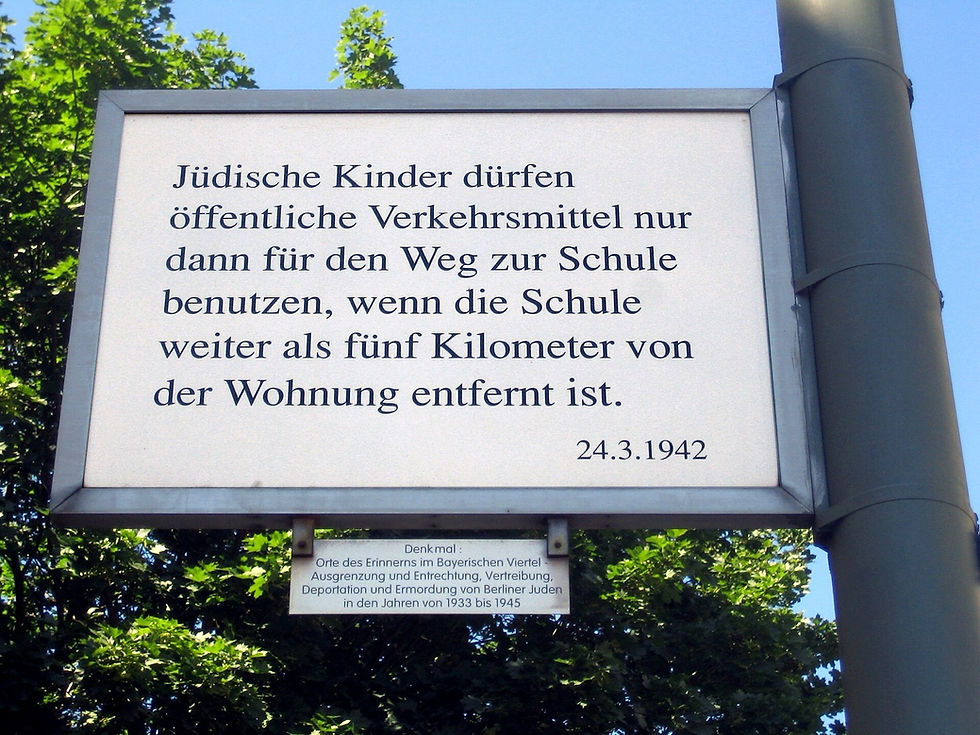
One of eighty signs by Renata Stih and Frieder Schnock, mounted on a normal lamp post in a normal street.
There is no entrance, no ticket and no building. You walk from one lamp post to the next in a comfortable residential district, and the exclusion accumulates on you street by street, in the exact place where it happened to the actual neighbours. Before the war this quarter was so heavily Jewish and so full of writers and scientists that people called it the Jewish Switzerland. Albert Einstein lived here.
Orientation boards at Bayerischer Platz, at Rathaus Schöneberg and on Münchener Straße mark all eighty signs, so start at one of those. Nearest station is U Bayerischer Platz, on the U4 and U7. Give it an hour.
Rathaus Schöneberg: the square where Kennedy said it
On 26 June 1963, John F. Kennedy stood in front of this building and told a crowd of several hundred thousand people "Ich bin ein Berliner". With the Rotes Rathaus in East Berlin after the division, this district town hall became the seat of West Berlin's government, which is why the most famous sentence of the Cold War was spoken in a suburban square rather than beside the Brandenburg Gate.

The tower holds the Freedom Bell. It still rings at noon, every day, for two minutes.
In the 70 metre tower hangs the Freiheitsglocke, the Freedom Bell: a replica of the Liberty Bell paid for by an American public campaign, dedicated in October 1950, with the signatures of millions of Americans stored in a shrine in the tower. It rings daily at noon for two minutes. If you time your visit for 12:00 you get the one genuinely theatrical thing this square still does.
Two practical points, because both catch people out:
The tower is not a walk-up. You cannot climb it on your own. It only opens on guided tours.
Inside, to the right of the main entrance, there is a free permanent exhibition called Wir waren Nachbarn, We Were Neighbours, telling the stories of Jewish residents of this district through their own biographies. It is open Monday to Thursday and Saturday to Sunday, 10:00 to 18:00, and closed on Fridays. It is the only curated indoor thing on this whole list, so do not turn up on a Friday expecting it.
And since the sentence itself is the reason most people come: no, he did not accidentally call himself a doughnut. I have written the whole Ich bin ein Berliner myth up properly, and the short answer is that the grammar he used was correct.
Kleistpark: colonnades in front, a very dark file behind
Get out at U Kleistpark on the U7 and the first thing you see is a pair of baroque colonnades that look like they wandered in from another city. They did, more or less. Carl von Gontard built the Königskolonnaden between 1777 and 1780 near Alexanderplatz, and in 1910 they were dismantled and moved out here to get them away from the traffic.

Free, open, and the best photograph in Schöneberg. Walk through them and you are in the park.
Walk through them into Heinrich-von-Kleist-Park and the large building at the far end is the Kammergericht, and its twentieth century is genuinely heavy. From August 1944 to January 1945 Roland Freisler's Volksgerichtshof sat in this building and staged the show trials against the officers of the 20 July 1944 plot against Hitler. After the war the Allies took it over as the seat of the Allied Control Council, and the Four Power Agreement on Berlin was signed in its plenary hall on 3 September 1971.
Today it is a working court again, with security at the door. Treat it as a facade you stand in front of and understand, not a museum you go into. If Cold War Berlin is what you are chasing, my list of five Cold War locations you can still visit covers the sites that are set up for visitors.
Marlene Dietrich, from Leberstraße to Friedenau
Marlene Dietrich was born in Schöneberg, on the Rote Insel, the red island: a small triangle of streets hemmed in by railway lines that was a working-class, strongly left-wing pocket of the district. She lived on the first floor of Leberstraße 65 until she was three. There is a portrait relief there from 1992 with her film titles around it, and a Berliner Gedenktafel added in 2008. It is a residential street, and the plaques are the whole visit.
Her grave is a different matter, and it is the better stop.

Friedhof Stubenrauchstraße. The stone says only "Marlene", and there are usually fresh flowers on it.
She died in Paris in May 1992 and was buried at Friedhof Stubenrauchstraße 43 to 45 in Friedenau, next to her mother. The stone says only "Marlene". Berlin made it an Ehrengrab, an honorary grave, that December. Helmut Newton is buried in the same cemetery.
It is free and open, but the gates close around dusk and the hours shift with the season, so make it an afternoon rather than an evening.
What about the Gasometer?
People ask about this one, so here is the straight answer: do not go for the view.
The listed 1910 gas holder frame in the south of the district is genuinely striking, and it now wraps a modern glass office building, finished in 2024 and leased to Deutsche Bahn, at the centre of the EUREF business campus. There is a roof terrace at roughly 66 metres.
It is private event space. No tickets, no opening hours, no walking up. Anyone describing it as a Berlin viewpoint is describing a venue you can hire. You can cross the campus, look up at the frame and eat there, and that is the honest extent of it. For actual viewpoints, my guide to the best views in Berlin you can find on foot has the ones that let you in.
How I would actually spend a half day here
Two routes, depending on which Schöneberg you came for. Do one, not both.
The Saturday morning. U Nollendorfplatz around 9:30. Winterfeldtmarkt until 11:30, eating as you go. Walk south to Akazienstraße and let it take as long as it takes. If there is still energy, U7 one stop to Kleistpark for the colonnades and the park. Home by mid-afternoon, having done one thing well.
The memory route. U Bayerischer Platz, an hour walking the eighty signs of Orte des Erinnerns from the orientation board. Then U4 three stops south to Rathaus Schöneberg for the Kennedy square and Wir waren Nachbarn. Any day except Friday, and aim to be at the square for the noon bell.
Both of these are the opposite of the way I work in the centre. On my free walking tour I cover Berlin's historic core from Alexanderplatz in about 2 hours, because in the middle of the city the stories sit on top of each other and you can walk between them in minutes. Schöneberg is the reverse: spread out, quiet, and mostly written on small signs at head height. It rewards the second or third day of a trip, once you already know what Berlin is, and it is a good argument for staying longer than a weekend.
Image credits for this article are available from the compact Image credits button inside the plaque check above.