Is Berlin Walkable? How Far Apart the Main Sights Really Are

Updated: Jul 22
You open the map on your first morning in Berlin, drop pins on the Brandenburg Gate, Museum Island and Alexanderplatz, and they all look close together. Then you notice the city stretches for miles in every direction around them, and the doubt creeps in: can you actually walk this, or will you spend the whole trip working out train lines? I get this question at the start of almost every tour, usually from people who have just arrived and are staring at their phones.
Here is the short version. The famous central sights are much closer to each other than Berlin's size suggests, and the walking between them is some of the best sightseeing in the city. The trick is knowing where walking is the joy of the trip and where it turns into a slog you should hand to the U-Bahn.

Museum Island and the TV Tower: two of the big central sights that sit within a short, flat walk of each other.
Is Berlin walkable? The honest answer
Yes, central Berlin is very walkable, and it is one of my favourite cities in Europe to explore on foot. The historic core around Mitte is flat, the streets are wide and straight, and the biggest sights sit within about a 25-minute walk of each other. On a dry day you can string the Reichstag, the Brandenburg Gate, Unter den Linden, Museum Island and Alexanderplatz into one easy line without touching a train.
The honest catch is scale. Berlin is enormous, more than eight times the size of Paris by area, so the sights that look neighbourly on a phone screen are surrounded by a huge city. The rule I give everyone is simple: walk inside a district, and take transit between districts. Get that split right and Berlin feels made for walking. Get it wrong, try to walk from Mitte out to Charlottenburg, and you will be tired and grumpy by lunch.
The central sights are closer than the map makes them look
The thing most first-timers get wrong is overestimating the gaps between the headline sights. The tight central cluster is genuinely tiny. The Brandenburg Gate, the Reichstag and the Holocaust Memorial are all within about five minutes of each other, so if you ever catch yourself checking a train app to get between them, put the phone away and just walk.
From the Brandenburg Gate, Potsdamer Platz is about a 15-minute walk through the edge of the Tiergarten, Gendarmenmarkt is around 16 minutes, and Museum Island is roughly 25 minutes straight down one boulevard. None of those need a ticket. I have watched plenty of visitors buy a fare, wait for a train, ride one stop and climb back up, when the walk would have been quicker and shown them the city in between.

The Brandenburg Gate at the head of Unter den Linden. From here the Reichstag and the Holocaust Memorial are both about five minutes away on foot.
The one walk to do on foot: Unter den Linden
If you only walk one stretch in Berlin, make it Unter den Linden. This is the grand boulevard that runs from the Brandenburg Gate east to Museum Island, and covering it on foot is about 1.9 km, or roughly 25 minutes at an easy pace before you stop for anything. The walking is the point here, not a shortcut.
Along the way you pass Bebelplatz, the Humboldt University, the State Opera and the German Historical Museum, and the street opens out onto the Spree and the Museum Island cluster at the far end. There is no train that improves on this. My advice is to walk it slowly one way in the morning light, see everything in between, and only think about the tram or U-Bahn for the trip back when your legs have had enough.

Unter den Linden is the walkable spine of central Berlin. Brandenburg Gate to Museum Island along it is about 25 minutes of pure sightseeing.
Where walking stops making sense
Walking is the wrong tool the moment a route crosses the city rather than a district. The clearest example is the East Side Gallery: from the Brandenburg Gate it is about 4.8 km, close to an hour on foot, and the honest move is to take the S-Bahn or U-Bahn towards Warschauer Straße and save your legs for the Wall itself. The same goes for Charlottenburg Palace, the Olympiastadion and any of the day trips out to Potsdam or the lakes.
This is where a single AB ticket earns its place. Berlin's public transport network covers the whole city on one fare, the U-Bahn and trams run late, and the S-Bahn ring will loop you around the edge of the centre far faster than your feet. The tool below does the maths for you: pick where you are starting, and it shows how many minutes it really takes to walk to every other main sight, and where you are better off underground.
Berlin is flat, but plan your feet
One thing that genuinely helps here is that Berlin is famously flat. There are no hills to climb in the centre, so the walking is gentle and the distances are the only real effort. That is exactly why they sneak up on you. A day of stringing sights together on foot can quietly add up to 15 km, and cobbles around Museum Island and the rebuilt old town are hard on thin soles.
Two small Berlin details save a lot of pain. First, wear comfortable, sturdy shoes: they matter far more here than any transport pass. Second, watch the red-paved strips beside the pavement, because those are cycle lanes and Berlin cyclists move fast and do not expect a tourist stepping backwards for a photo. Cross where the little Ampelmann tells you, and you will fit right in.
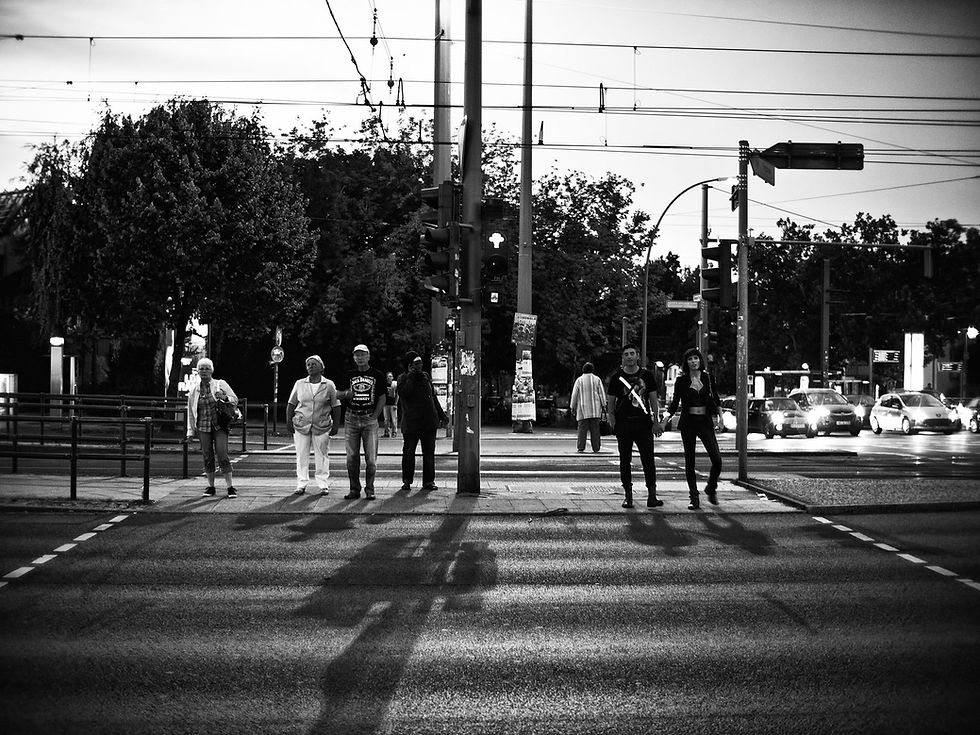
Berlin is flat and easy underfoot, but the distances add up over a full day. Comfortable shoes matter more here than a car.
Walking is what connects the sights
The reason I run a walking tour rather than a bus tour is that the space between the landmarks is where Berlin's story actually lives. Walk two minutes off the tourist line from Checkpoint Charlie and you reach Gendarmenmarkt, which is quietly one of the most beautiful squares in the country. Cross one bridge from Museum Island and you are in the Hackescher Markt courtyards. Those short detours are only possible on foot, and they are usually the moments people remember.
That is also the case for the historic core my tour covers: everything on it is close enough to walk in about 2 hours, precisely because central Berlin is built at a human pace. If you would rather plan your own route, the city's official self-guided walking tours are a good, free starting point, and the BVG journey planner will tell you when a hop is genuinely faster by train.

A short detour off the main walk: Gendarmenmarkt is about two minutes from Checkpoint Charlie and worth the turn.
So, is Berlin walkable?
For the sights almost everyone comes to see, absolutely. The central spine from the Reichstag to Alexanderplatz is flat, close-knit and far more rewarding on foot than underground. Save the trains for the long hops out to the edges, wear the right shoes, and let the walking be the sightseeing rather than the chore between it.
The one move I would make on your first day: start at the Brandenburg Gate and simply walk east down Unter den Linden. By the time you reach the Spree you will have seen half of central Berlin, you will understand how the city fits together, and you will already know which of the farther sights are worth a train. For the bigger day-one picture, the first-time visitor mistakes guide covers the logistics that catch people out.
Image credits for this article are available from the compact "Image credits" button inside the interactive tool above.