Hohenschönhausen: The Stasi Prison You Can Only See on a Tour

Most Berlin history is something you can simply walk into. The Wall memorial on Bernauer Straße, the Holocaust memorial, Topography of Terror: you turn up, the gate is open, you decide how long to stay. Visitors bring that habit out to Lichtenberg, get off at a station with the right name on it, and end up standing at a long concrete wall with nothing to do.
The former Stasi remand prison at Hohenschönhausen can only be seen on a guided tour. The exhibitions in the front building are free and the site is open daily from 10:00 to 18:00, but the cells, the corridors and the interrogation rooms sit behind a door that opens on a timetable. In English that timetable has three slots a day.
That is not an obstacle to work around. It is the reason the place is worth half a day. The tours are led by former prisoners of this building and by historians, the group is capped at 25 people, and what you get is a person walking you through rooms they were held in.

The cell corridor in the 1960 building. You only see this side of the door with a guide.
The three English tours, and what they cost
English guided tours run daily at 10:40, 12:40 and 14:40. The memorial's own tour page is the one to check before you travel, because seasonal and special tours move around it.
Price: 9 euro standard, 5 euro concession, 2.50 euro for school pupils
Length: allow about 2 hours, which includes a short introductory film before the walk
Group size: 25 people maximum per tour
Booking: individual visitors book through the memorial's ticket shop, and groups of seven or more must book ahead
Exhibitions: free, and you can see them without a tour ticket
I would book. Twenty-five places on a fixed slot in a city with this many visitors is not a lot, and a wasted trip out to Genslerstraße costs you an hour each way. The memorial recommends booking for exactly that reason.
Photography for private use is allowed on the tour. The memorial also gives an age recommendation of 14 and over, which is honest guidance and worth taking seriously if you are travelling with younger children. This is a prison where people were held in isolation, and the tour does not soften it.
What you are actually standing in
The site has three layers, and knowing them before you arrive makes the tour land better.
In 1945 the Soviet occupation turned a building put up as a large canteen into an internment camp, Special Camp No. 3. In 1947 the Soviet secret service opened the cellar under that kitchen building as a remand prison, the part prisoners called the U-Boot, the submarine: no daylight, cells below ground, water on the floor. In 1951 the Soviets handed the cellar prison to the Stasi.

The cellar level. Prisoners called it the U-Boot, and the tour goes down into it.
Then in 1960 the Stasi built a new prison on the site, and used it as the central remand prison for political prisoners until 1989. The prison was formally closed on 3 October 1990. Former prisoners campaigned for a memorial, which opened in 1994, and the site has been a foundation under public law since 2000.
The interrogation rooms are the part that stays with people. They look like a bad 1970s office: veneer desk, curtains, a telephone, a barred window painted over. Nothing about the room announces what happened in it, which is precisely the point the guides make.
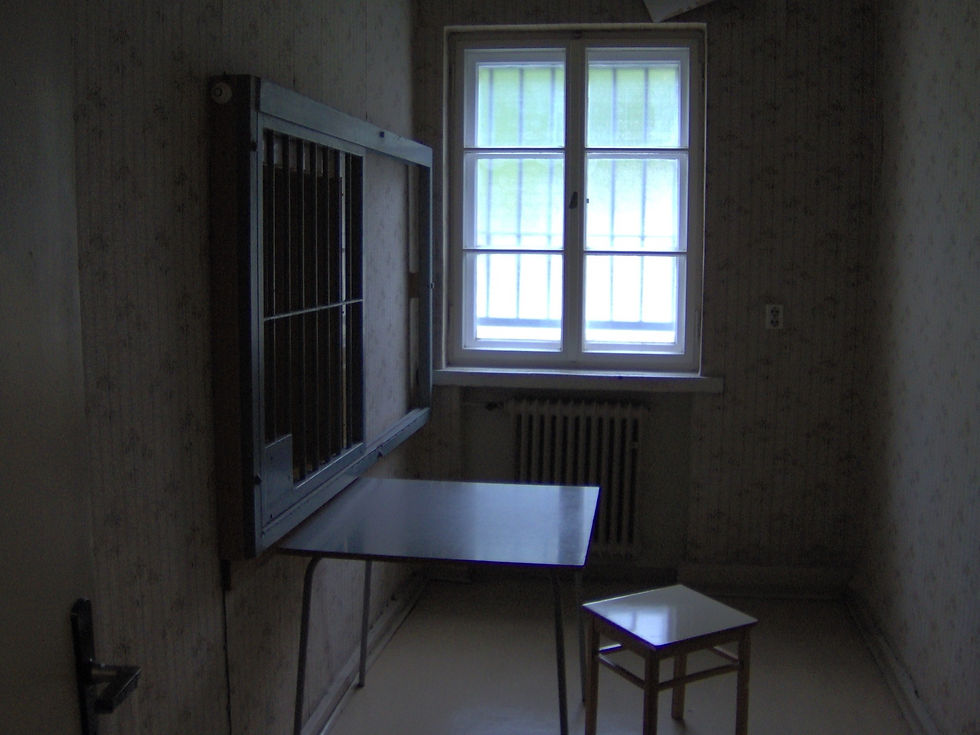
An interrogation room. The furniture is ordinary, and that is what the guides want you to notice.
Getting to Hohenschönhausen: the M5 is the answer
Here is the useful part, and the part every route app gets half right.
Genslerstraße 66 sits in a quiet block in Alt-Hohenschönhausen with no station of its own. The single best line is the M5 tram, which runs from Hackescher Markt through Alexanderplatz and out east. From Alexanderplatz that is about 33 minutes door to door with no changes at all. From Hackescher Markt it is about 39 minutes, also direct.
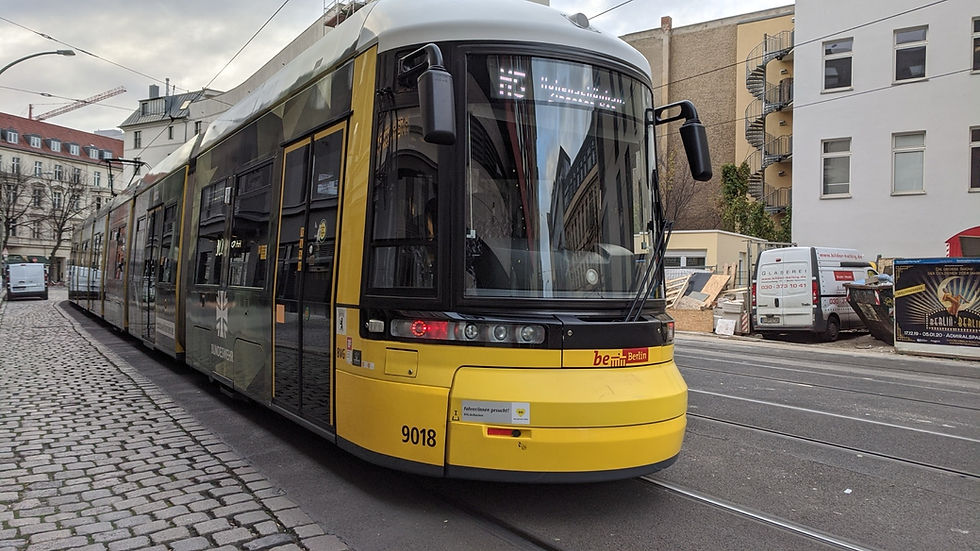
The M5 at Hackescher Markt, signed for Hohenschönhausen. From here it is one seat all the way.
A tram is slower than the S-Bahn on paper and better in practice here, because two changes on a Sunday morning cost you more than the tram ever will. If you want the tram network in general, I wrote a guide to Berlin's trams and one on how the U-Bahn, S-Bahn, tram and bus fit together. The whole trip is inside fare zone AB, so a normal single ticket covers it.
Use the board below to see the latest you can leave for each English tour from where you are staying, and what time the day gives you back.
Four stops carry the name. Only one is close.
This is where people lose twenty minutes, and it is worth spelling out.
Große-Leege-Str./Freienwalder Str., served only by bus 256, is the closest at about 280 metres
Freienwalder Str., served only by the M5 tram, is about 570 metres and is the stop the memorial itself recommends
Genslerstr., served by trams M5, M6 and 16, sounds right and is about 850 metres away, at the wrong end of a long street
S Hohenschönhausen, the S-Bahn station, is about 2.8 kilometres from the gate
The memorial's own directions carry a flat instruction about that last one: do not take the S-Bahn to S Hohenschönhausen. The station name is the district, not the address. If you are on the M5 and you see Genslerstr. come up, stay on for one more stop to Freienwalder Str. and turn into the quiet residential streets from there.

Genslerstraße. The walk in from the tram is ordinary Berlin housing, which is part of the story.

The wall and watchtower from the pavement. For forty years this block was left off the city map.
How much of your day it takes
Be honest with yourself about the arithmetic before you plan around it.
From Alexanderplatz, the 10:40 tour means leaving at about 09:52, being back in the centre around 13:13, and having lost the entire morning. From Zoologischer Garten the same tour means leaving at 09:35 and getting back around 13:30.
Take the 10:40 if you want the rest of the day free for the centre
Take the 12:40 if you are slow in the mornings and happy to write off the afternoon
Take the 14:40 only if you have nothing planned afterwards, because you will be back after 17:00 and you will not feel like a museum
My advice: pair it with the morning, not the evening. Hohenschönhausen is heavy, and I would not follow it with something that asks for the same attention. A long walk, the Ringbahn, a coffee in Prenzlauer Berg on the way back, all fine. Another memorial on the same afternoon is too much.
If Cold War Berlin is your reason for the trip, the Stasi Museum in Lichtenberg is the natural companion on a different day, and I have a shortlist of Cold War sites you can still visit that spreads them across the city sensibly.
The Berlin around it makes more sense afterwards
The thing that changes after a tour here is the centre. Marx-Engels-Forum stops being a park with statues in it. The gap between what the GDR built to be seen and what it built to be hidden becomes something you can point at.
That is the connection I would make. On my free walking tour of the historic centre I spend two hours on the visible half of that story, from the World Clock at Alexanderplatz through to Hackescher Markt, and the tram to Hohenschönhausen leaves from both ends of it. Doing the centre first and the prison second is the order I would choose, because the second one answers questions the first one raises.
Image credits
Source and licence details for the 6 photographs used in this article.
The perimeter wall and watchtower of the former Stasi prison on Genslerstrasse: Tohma, CC BY-SA 4.0, via Wikimedia Commons.
A cell corridor in the 1960 prison building at Hohenschoenhausen: JoachimKohler-HB, CC BY-SA 4.0, via Wikimedia Commons.
An interrogation room at the former Stasi prison in Hohenschoenhausen: VomMüller, CC BY-SA 4.0, via Wikimedia Commons.
The cellar corridor at the Hohenschoenhausen memorial: Z thomas, CC BY 3.0, via Wikimedia Commons.
An M5 tram at Hackescher Markt signed for Hohenschoenhausen: Clic, CC BY-SA 4.0, via Wikimedia Commons.
Residential blocks on Genslerstrasse in Alt-Hohenschoenhausen: Z thomas, CC BY-SA 4.0, via Wikimedia Commons.