Berlin Trams: The Tourist Guide to the M-Lines Nobody Explains


A yellow Flexity tram at Alexanderplatz, where the M4, M5 and M6 all pull in. Most visitors walk straight past them into the U-Bahn.
Stand at Alexanderplatz for five minutes and you will watch the same thing happen again and again. A long yellow tram glides in, a handful of Berliners step on without looking up from their phones, and the tram slides off toward Prenzlauer Berg. Meanwhile the tourists funnel down the stairs into the U-Bahn, into the dark, missing the one part of Berlin transport that actually lets you see the city go by.
Berlin trams confuse visitors more than they should. They only exist in half the city, they carry letters instead of just numbers, and nobody hands you the rules. So here is the whole thing laid out: why the trams run where they do, the ticket you need, and the handful of lines that are genuinely useful when you are here to sightsee.
Why Berlin's trams only run in the East
The first thing that trips people up is geography. Look at a Berlin tram map and it stops dead in the middle of the city, hugging the old East almost exactly. That is not an accident, it is Cold War history you can still ride.
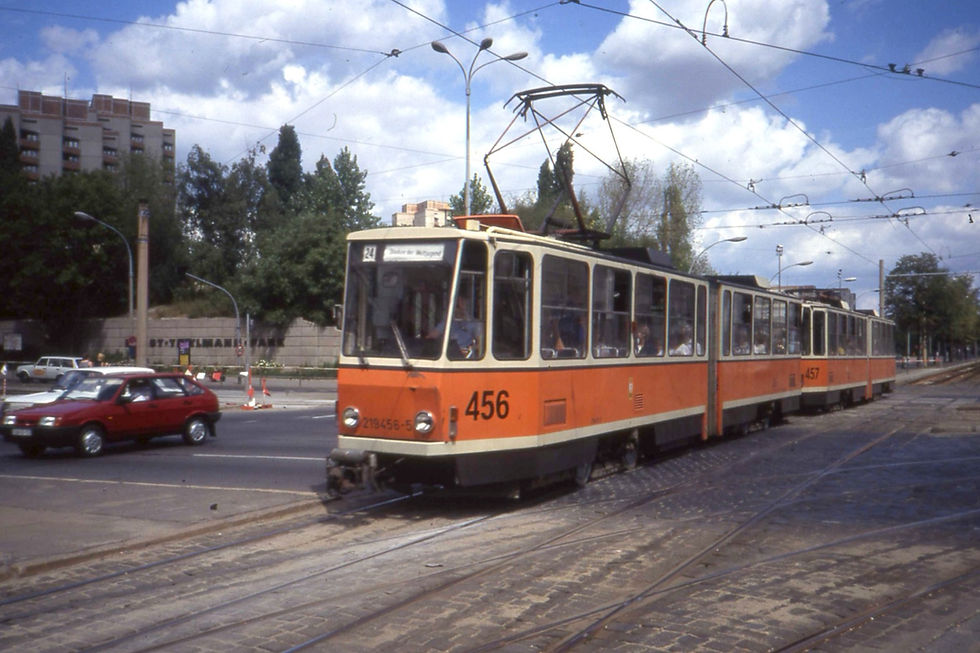
The Czech-built Tatra tram, the workhorse of the East Berlin network for decades. A few still run today.
After the city was divided, West Berlin decided in the 1950s that trams were old-fashioned. It bet on buses and on digging U-Bahn tunnels instead, and it pulled up its tracks street by street. The last West Berlin tram ran on 2 October 1967. East Berlin, short on money and fuel, did the opposite: it kept its trams and kept building.
So decades after reunification, the tram network still traces the border. Ride one and you are almost certainly in the former East, through Prenzlauer Berg, Friedrichshain or out past Alexanderplatz. Only two lines, the M10 and the M13, now reach across into the old West. It is one of the quietest, most everyday reminders of how divided this city was, and you learn it just by looking at a route map.
The tram ticket is the ticket you already have
Here is the good news: there is no special tram fare and no separate tram ticket. Berlin runs one fare system across the tram, U-Bahn, S-Bahn and bus. Whatever valid ticket you are holding already works on the tram.
For 2026 the prices you care about are:
Single AB ticket (Einzelfahrschein): 4.00 euros, good for one journey of up to two hours in one direction, changes allowed.
Short trip (Kurzstrecke): 2.80 euros, for up to six stops on the tram or bus.
24-hour AB ticket: 11.20 euros, unlimited rides for a day.
Almost every visitor stays inside zones A and B, which cover the whole city core. If you plan to ride more than twice in a day, the 24-hour ticket pays for itself fast. For the full breakdown of the zones, I wrote a separate guide to Berlin's AB and ABC ticket zones.
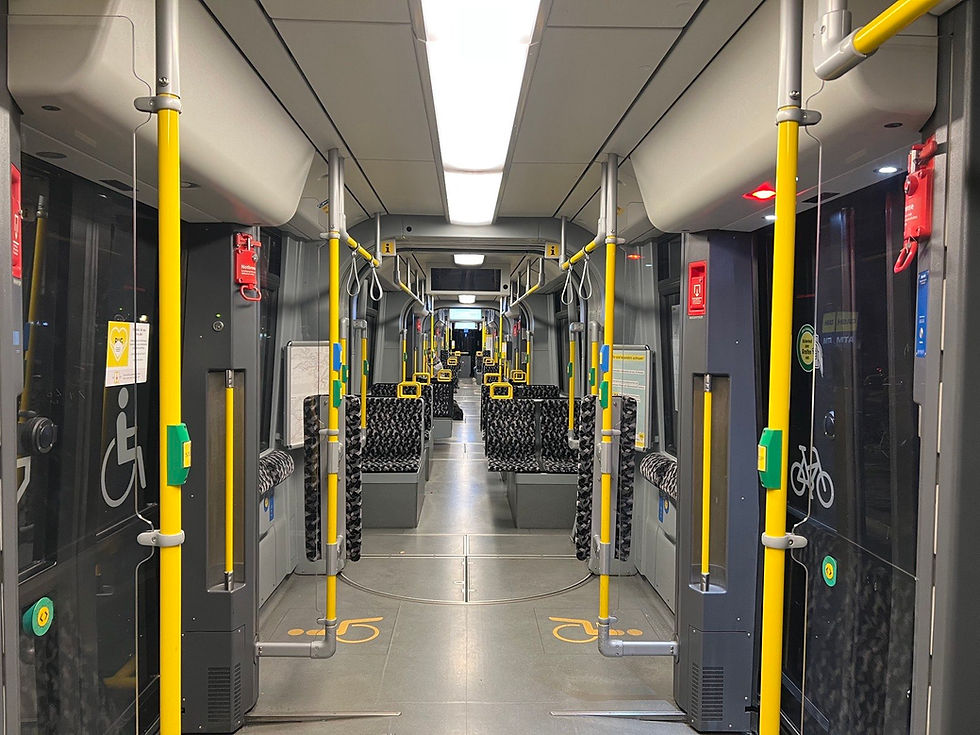
Inside a modern Flexity tram. The yellow ticket machine sits mid-carriage, and the red validation box is by the doors.
Buying and stamping on board
Unlike the bus, the tram driver does not sell tickets. You have three easy options instead:
The BVG app. Buy before you board and the ticket is valid straight away. This is the simplest route, and I explain it in buying Berlin transport tickets on your phone.
The onboard machine. There is a yellow ticket machine roughly in the middle of the carriage. Newer ones take cards and Apple or Google Pay, older ones take coins only, and the ticket it prints comes already validated.
A paper ticket bought earlier. This one is not stamped yet. The moment you step on, punch it in the small red or yellow box by the door.
That last point matters. An unvalidated paper ticket counts as no ticket at all, and the fine for riding without a valid one is 60 euros. If you are ever unsure, I covered the whole stamping question in do you really need to validate your ticket.
MetroTram or numbered line: what the "M" means
Berlin has 22 tram lines, and they come in two flavours. Once you know the difference you can read any tram stop in a second.
MetroTram lines carry an M before the number: M1, M2, M4, M5, M6, M8, M10, M13, M17. These are the frequent, reliable ones. They run 24 hours a day, every day, and turn up every few minutes in the daytime.
Regular numbered lines are just a number, like the 12, 21 or 62. They are more local, run less often, and mostly stop in the late evening.
As a visitor you almost never need the numbered lines. The M lines go where you want and come often enough that you rarely check a timetable. If you see an M on the front, you are looking at a good bet.
The Berlin tram lines actually worth knowing
You do not need to memorise the network. Four M lines cover nearly everything a visitor would use a tram for.

The M10 crossing the Warschauer Brücke in Friedrichshain. It is the closest thing Berlin has to a sightseeing tram.
The M10 is the one to ride for its own sake. It runs above ground through Friedrichshain, past the edge of Mauerpark at Eberswalder Straße, and along the back streets of Prenzlauer Berg toward the main station. It is a rolling window onto the parts of Berlin that feel most like Berlin, and it ends at Warschauer Straße, a short walk from the East Side Gallery.

The M1 at Am Kupfergraben, the one tram stop that sits right next to Museum Island.
The M1 is the most useful. It is the only tram that stops beside Museum Island, at Am Kupfergraben, and it threads from there through Hackescher Markt up into Prenzlauer Berg and the cafe streets around Kollwitzplatz. When your feet give out after the museums, the M1 is the ride to remember.
The M2 climbs straight out of Alexanderplatz up into Prenzlauer Berg, which makes it the quick way into that neighbourhood without changing trains.
The M4 is Berlin's single busiest tram. It leaves from Alexanderplatz heading east and turns up so often that if a tram is pulling in at Alex, it is frequently this one.
To match a line to what you actually want to do, use the picker below.
How to actually board a Berlin tram
Trams are simpler than the U-Bahn once you know the rhythm.
Read the front, not the stop. A tram is named by its final destination, like "Warschauer Str." or "Rosenthal Nord", not by a platform. Match that name to the direction you want.
Board through any door. Press the button to open it, step up, and validate straight away if your ticket needs it.
Watch for the boarding island. Many tram stops sit on a raised platform in the middle of the road. You wait there, not on the pavement, and traffic is meant to stop for you as you cross.
Mind the tracks if you cycle or scoot. Tram rails are slick and exactly the width to catch a bike wheel. Cross them at an angle, never ride along the groove.
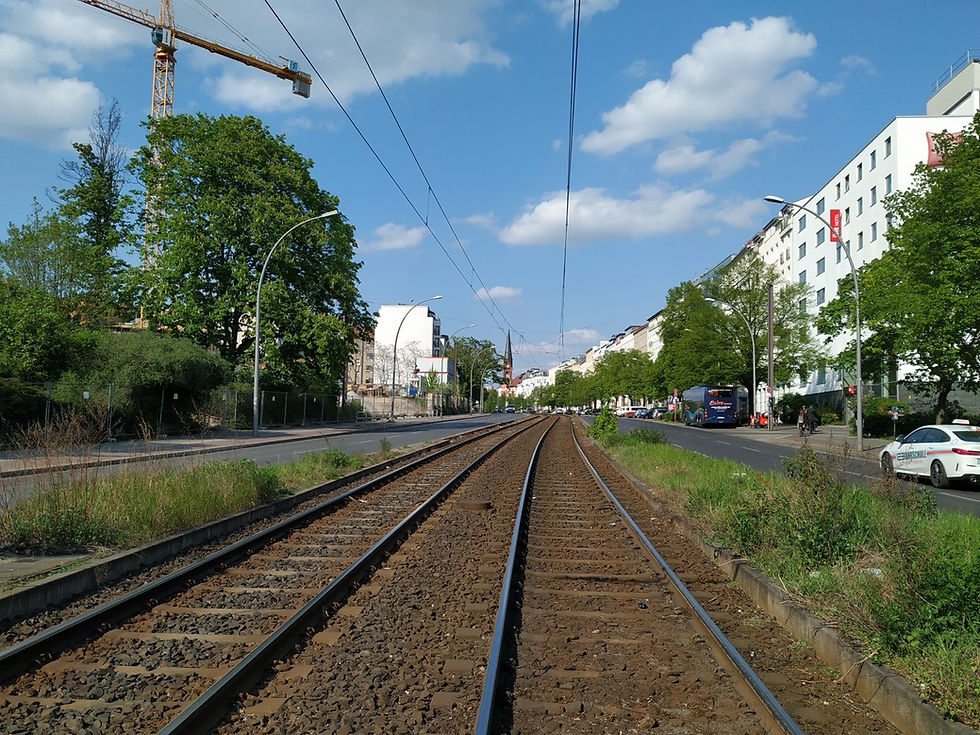
A tram on a quiet Prenzlauer Berg street. This above-ground view is the whole reason to choose the tram over the tunnel.
Where the tram fits your Berlin day
I run a free walking tour that ends at Hackescher Markt, and the tram is often the smartest way to carry on from there. The M1 pulls in right at the S-Bahn arches, so you can step off the tour and ride it up to Prenzlauer Berg for dinner, or the other way toward Museum Island. If you want ideas for the area, I put together a guide to what to do near Hackescher Markt after the tour.
My honest advice: do not treat the tram as a last resort. When the U-Bahn would only save you a few minutes, take the tram instead and watch the city go past at street level. That is the version of Berlin you came to see, and it costs exactly the same as the tunnel.
If you want the bigger picture of how trams sit alongside the U-Bahn, S-Bahn and buses, start with my Berlin public transport guide for tourists, and check live times and the nearest stop in the official BVG app.
Image credits
Cover and section photos via Wikimedia Commons: Alexanderplatz tram by Tony Webster (CC BY-SA 4.0); M10 on the Warschauer Brücke by Rob Dammers (CC BY 2.0); M1 at Am Kupfergraben by Clic (CC BY-SA 4.0); Flexity interior and Prenzlauer Allee tram by Lukas Beck (CC BY-SA 4.0); Tatra KT4 by Felix O (CC BY-SA 2.0).