Stasi Museum Berlin: The Secret Police HQ and Prison

Updated: Jul 22
If you have started reading about East Berlin, you have probably run into the word Stasi, and you may have searched for the Stasi Museum in Berlin expecting one clear place to go. It is not quite that simple. There are two very different sites, a few kilometres apart in the same eastern district, and tourists mix them up all the time. One is the old headquarters, now a museum you can walk through on your own. The other is the secret police prison, which you can only see on a guided tour. I want to explain what each one actually is, so you pick the right one for the time you have.
Berlin does Cold War history better than almost anywhere, because so much of it is still standing. If you are already planning to see Cold War Berlin in a handful of locations, the Stasi sites are the part that explains how the state watched its own people, not just where the Wall ran.
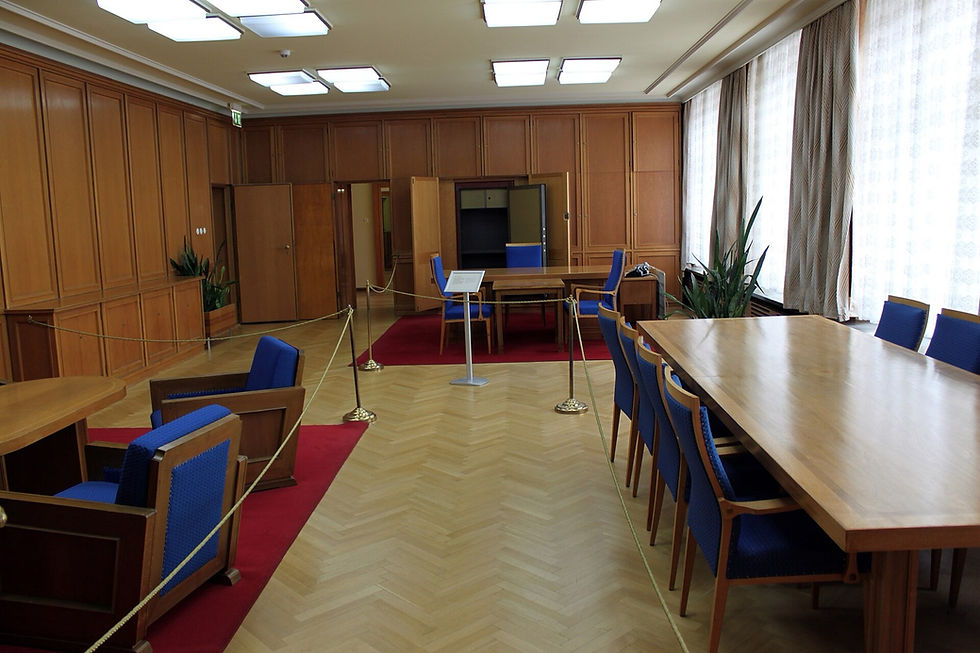
The preserved office suite of Stasi chief Erich Mielke, kept almost exactly as it was, inside House 1 of the museum.
What the Stasi Museum in Berlin actually is
The Ministry for State Security, the Stasi, was East Germany's secret police, and this museum sits inside its real nerve centre. The address is Ruschestraße 103 in Lichtenberg, and the museum fills House 1 of the sprawling ministry complex where thousands of officers once worked. This is not a reconstruction. You walk the same corridors, and the top-floor office suite of the last Stasi chief, Erich Mielke, has been left almost untouched, down to the furniture and the little details.
That authenticity is the point. If you have seen the DDR Museum near the cathedral, this is a different experience entirely. The DDR Museum is a hands-on look at everyday life in the East, and I write about whether the DDR Museum is worth it separately. The Stasi Museum is quieter, heavier, and it is about power and control rather than Trabants and wallpaper.
How to visit: tickets, hours, and getting there in 2026

The former ministry complex on Ruschestraße. The Stasi Museum is in House 1, a short walk from U-Bahn Magdalenenstraße.
Getting there is easy. Take the U5 to Magdalenenstraße, which is about 15 minutes from Alexanderplatz, then it is a 300 metre walk. If the whole idea of the U-Bahn zones and tickets is still new to you, my guide to Berlin public transport for tourists covers the basics.
Here are the practical details for 2026:
Admission is 12 euros for adults, 9 euros reduced. Teenagers and school groups pay less.
Opening hours are Monday to Friday 10:00 to 18:00, and weekends and public holidays 11:00 to 18:00.
The visit is self-guided, with English text throughout. An English guided tour runs at 15:00 on weekdays for 5 euros extra.
Give yourself about 1 to 1.5 hours. It is an indoor, calm visit that works well on a grey afternoon.
Always confirm times on the official Stasi Museum website before you travel, because opening hours can shift around holidays.
Inside: the offices and the machinery of control

A preserved anteroom in the ministry. The wood panelling and 1970s furniture are exactly as staff left them.
What stays with me here is how ordinary it all looks. The offices are wood-panelled and beige, the meeting rooms have tidy chairs and clean carpets, and yet this is where the surveillance of a whole country was organised. The permanent exhibition takes you through how the Stasi recruited informers, how it built files, and how it tried to break people quietly rather than loudly.
You also see the tools of the trade: hidden cameras built into bags and jackets, tiny microphones, steam kettles for opening private letters, and rows of recording equipment. It is a strong reminder that this was a modern bureaucracy, not a cartoon villain, which is exactly what made it so effective.
How deep the Stasi actually reached

Stasi eavesdropping and recording equipment. Ordinary technology, turned into a tool for watching an entire population.
The numbers are the part that makes people go quiet. By 1989, its last full year, the Stasi had 91,015 full-time officers and ran roughly 189,000 unofficial informers, ordinary citizens who reported on neighbours, colleagues, friends, and sometimes their own families. It held files on about a third of the East German population.
When the regime collapsed in 1989 and 1990, staff started shredding by hand. About 16,000 sacks of torn documents survive, and archivists are still slowly piecing them back together. To understand what all of this meant for a normal East German, it helps to remember how the country itself worked, which I cover in how Berlin was divided. The escape and the crossing points are their own story, and the Tränenpalast border station is a good companion visit.
The Stasi prison: Hohenschönhausen

A cell-block corridor at Hohenschönhausen, the Stasi's main remand prison. You can only see it on a guided tour.
This is the site people confuse with the museum, and it is the more emotional of the two. The Gedenkstätte Berlin-Hohenschönhausen is the Stasi's main remand prison, at Genslerstraße 66, reachable by tram M5. It is where suspects were interrogated, isolated, and worn down.
The key thing to know is that you cannot wander the prison on your own. You see the cells and interrogation rooms only on a guided tour, and many tours are led by former prisoners, which is what makes them unforgettable. The memorial is open daily 10:00 to 18:00, tours cost around 9 euros, and there are several English tours a day. Book a slot in advance on the official Hohenschönhausen website, because popular times fill up and you do not want to arrive and wait hours. This site is heavier than the Topography of Terror, which covers the Nazi era, so plan it for a moment when you have the energy for it.
Which one should you visit?
On a short Berlin trip, I would do one, not both. Pick the Stasi Museum if you want the offices, the gadgets, and a calm self-guided hour closer to the centre. Pick Hohenschönhausen if you want the human story and you are ready for something harder, and you can book a tour slot in advance.
Either one pairs naturally with a wider Cold War day in the east. If you are staying central and starting your sightseeing around Alexanderplatz, both sites are a short ride out on the U5 or the tram, and they give real weight to everything else you will see about divided Berlin.
Image credits
Photos via Wikimedia Commons: Mielke's office by Anagoria (CC BY 3.0); the ministry complex by Gunnar Klack (CC BY-SA 4.0); the preserved anteroom by Roi Boshi (public domain); surveillance equipment by Adam Jones (CC BY-SA 3.0); the Hohenschönhausen corridor by Denis Apel (CC BY-SA 2.0 DE).