Deutsches Technikmuseum Berlin: The Giant Museum With a Plane on the Roof
- Yusuf Ucuz
- 6 days ago
- 7 min read
There is a moment on the elevated U1 between Möckernbrücke and Gleisdreieck when first-time visitors reliably stop talking. Out of the window, a full-size Douglas C-47 transport plane sits on the roof of a glass building, nose pointed over the canal, as if it had just landed on Kreuzberg. That plane is the Deutsches Technikmuseum announcing itself, and it is one of the best free sights in Berlin even if you never go inside.
My advice, after sending many rained-on families here over the years: do go inside, but do not try to see all of it. This is Berlin's biggest museum complex, spread over a former railway freight yard with two separate entrances, and the average visitor lasts about two and a half hours in a place that can honestly fill a whole day. The visit works when you pick three or four halls in advance and treat the rest as a reason to come back. Here is how the tickets, the buildings and the choices actually work.

The C-47 has been parked over Trebbiner Straße since May 1999. Berliners call this type the Rosinenbomber, the raisin bomber of the 1948 Airlift.
What the Deutsches Technikmuseum actually is
The Deutsches Technikmuseum, the German Museum of Technology, opened in December 1983 on the grounds of the old Anhalter Güterbahnhof, the freight yard that once fed Berlin's grandest railway station. That location is the museum's quiet trick: the two brick roundhouses from 1874, with their outdoor turntables, are not a backdrop built for tourists. They are original railway buildings, and the locomotives inside are standing where locomotives always stood.
Around that historic core the museum grew into a small city of technology: a glass New Building for aviation and shipping, the separate Ladestraße depot for road transport, a hands-on science centre called Spectrum, and a museum park with two windmills, a historical brewery and a forge. The count today is 19 permanent exhibitions covering everything from locomotives and aircraft to printing, film, computers and sugar.

The site from above: the New Building with the rooftop C-47, wedged between the U1 viaduct, the canal and the old freight yard.
Tickets, hours and the three traps
The numbers are simple, but three details catch people. All of this is from the official site, checked in July 2026, and the exact prices live on the museum's ticket page.
Adult ticket: 15 euros online, 17 euros at the door. The door price includes a 2 euro service fee, so booking online on your phone outside the entrance still saves money. Reduced tickets are 9 euros online.
Everyone under 18 enters free. You still need to book a free 0-euro ticket for each child, which surprises people at the scanner.
One ticket covers two museums. The same day ticket includes both the Technikmuseum and the Science Center Spectrum around the corner. Skipping Spectrum with kids in your group is leaving value on the table.
The three traps: the museum is closed on Mondays, like most Berlin museums. Last admission is 17:00, which matters because Tuesday to Friday hours are 9:00 to 17:30, and weekends run 10:00 to 18:00, so a late-afternoon start is barely worth the ticket. The museum also lists bookable free Friday-afternoon admission from 13:00, but its current visitor page and its 2026 launch announcement disagree on whether that means every Friday or only the first Friday of the month. Confirm your date in the official ticket shop before you plan around it.
The museum is also covered by the Museum Pass Berlin. If you are stacking museum days, my museum pass breakdown shows when the pass beats single tickets, and this place is one of the tickets that helps the pass pay for itself.
The halls that are actually worth your time
Nineteen exhibitions is a menu, not an itinerary. These are the ones I would build a visit around.
Aviation: from balloons to the Berlin Airlift
The New Building holds more than 40 aircraft, hung through a four-storey atrium so you look at wings from above and below at the same time. The collection runs from the Jeannin Stahltaube of 1914, the oldest aircraft in the house, to a Junkers Ju 52 in Lufthansa colours that older Berliners still call Tante Ju, Aunt Ju. The museum does not romanticise this story: the wreck of a Ju 87 Stuka dive bomber is displayed exactly as a wreck, and the exhibition is direct about forced labour in wartime aircraft production.
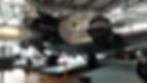
The Ju 52 in the aviation hall. Follow the atrium upward and you end at the roof terrace under the C-47.
The finale is the roof terrace itself, directly under the C-47. From up there you see the Potsdamer Platz towers, the TV Tower and the tracks that once ran to Anhalter Bahnhof, which is the right place to remember what this plane meant: during the 1948 to 1949 Airlift, aircraft like this one kept two million West Berliners fed for almost a year.

The roof terrace, one of the best free-with-ticket views in Kreuzberg. The C-47 noses out over the city it once supplied.
Rail: two real roundhouses full of trains
The rail exhibition fills both 1874 roundhouses with around 40 original vehicles arranged around the turntables. The range is absurd in the best way: an open third-class carriage from 1843, the oldest surviving Berlin horse tram from 1865, express steam locomotives, and the streamlined E 19 electric locomotive of 1938, built to run at 180 km/h. The museum also faces the darkest part of German railway history head-on, with a freight boxcar of the type used in Holocaust deportations displayed as a memorial, not a technical exhibit.

Locomotive 50 001 in the roundhouse. The building is the biggest exhibit: real 1874 engine sheds of the Anhalter freight yard.

Under the timber roof of Lokschuppen II. Even the red-and-cream S-Bahn car is the same design you see in old photos of divided Berlin.
Shipping: a hall most visitors underestimate
Upstairs in the New Building, the shipping exhibition spreads 1,100 objects over 6,500 square metres, one of the largest ship collections anywhere. The centrepiece is a wooden Kaffenkahn, a Havel river barge from around 1840 that was salvaged from the riverbed, and the steam tug Kurt Heinz, which worked Berlin's waterways until 1997. If you thought Berlin was not a harbour city, this floor argues otherwise for a full hour.

The shipping hall: three levels of boats, models and navigation, with the 1840s Kaffenkahn under sail in the middle.
Ladestraße and Spectrum: the second site people miss
Across the yard at Möckernstraße 26 sits the Ladestraße depot with the road transport exhibition On the Move, which walks through eleven rooms of cars, bikes and city traffic, from a 1914 Benz to early electric cars that look surprisingly current. The same address is the entrance to the Science Center Spectrum, a three-storey brick building with hands-on experiment zones for light, sound, electricity and mechanics. With children, my honest routing is one big hall in the main building first, then let them burn the rest of the visit in Spectrum. It is the strongest indoor-day combination in Berlin outside the Natural History Museum, and it is exactly what I mean when I recommend museum days in my rainy-day Berlin guide.
Build your visit like a train
Because the museum sits in a freight yard, I built the planner below the way a dispatcher builds a train. Pick your locomotive, which is your time budget, then couple the halls you actually care about as wagons. The board tells you when your train is longer than your day, warns you about Monday closures and the 17:00 last entry, and puts the two sites in a walking order that does not waste your legs.
Getting there, and the two-entrance detail
The museum has two addresses, and picking the right one saves a confused ten-minute walk. The main entrance is Trebbiner Straße 9; the Ladestraße and Spectrum entrance is Möckernstraße 26. Lockers exist at both, there is no cloakroom, and dogs stay home.
U-Bahn: Möckernbrücke on the U1, U3 and U7, or Gleisdreieck on the U1, U2 and U3. Both are a short walk, and the ride in on the elevated U1 is the best approach because you pass the rooftop plane.
S-Bahn: Anhalter Bahnhof on the S1, S2, S25 and S26, one stop from Potsdamer Platz. The station name is the last trace of the great terminus this freight yard once served, a story I tell in my ghost stations guide.
Car: do not bother. The museum's official pages currently disagree: its directions page says limited nearby parking becomes paid from 1 August 2026, while its visitor FAQ still describes 67 free spaces at Trebbiner Straße. Use transit rather than relying on a free space.
The location folds neatly into a bigger day: Potsdamer Platz is one S-Bahn stop or a 15-minute walk away, and the Topography of Terror documentation centre sits between the two. Indoors here, history outdoors there, and dinner back toward the centre.
The museum tells the story of how machines built this city. If you want the other half, how politics and people built it, that is the ground my free 2-hour walking tour covers through the historic centre from Alexanderplatz, and the Airlift you meet under the C-47 is the same story you can stand inside at other stops around Berlin.
Image credits
Source and licence details for the 7 photographs used in this article.
C-47 Rosinenbomber on the museum roof: 1971markus, CC BY-SA 4.0, via Wikimedia Commons.
Aerial view of the New Building and rooftop C-47: Raimond Spekking, CC BY-SA 4.0, via Wikimedia Commons.
Junkers Ju 52 in the aviation hall: Ad Meskens, CC BY-SA 4.0, via Wikimedia Commons.
Roof terrace view with the C-47 and skyline: BugWarp, CC BY-SA 4.0, via Wikimedia Commons.
Steam locomotive 50 001 in the roundhouse: Mike Peel, CC BY-SA 4.0, via Wikimedia Commons.
Lokschuppen II roundhouse interior: Leonhard Lenz, CC BY 4.0, via Wikimedia Commons.
Shipping exhibition hall: GodeNehler, CC BY-SA 4.0, via Wikimedia Commons.