Berlin Natural History Museum: The World's Tallest Dinosaur, and How to Visit
- Yusuf Ucuz

- Jul 15
- 6 min read
Updated: Jul 22
Somewhere around day two in Berlin, the history starts to press on you. You have stood at the Wall, read the memorial boards, and walked through the heavier parts of the twentieth century, and at some point you just want a room that is pure wonder. The Museum für Naturkunde, Berlin's natural history museum, is that room. It holds the tallest mounted dinosaur skeleton on Earth, and standing under it is one of the few genuinely jaw-dropping experiences the city hands you for eleven euros. I send people here on rainy afternoons and with restless kids, and it almost never misses.

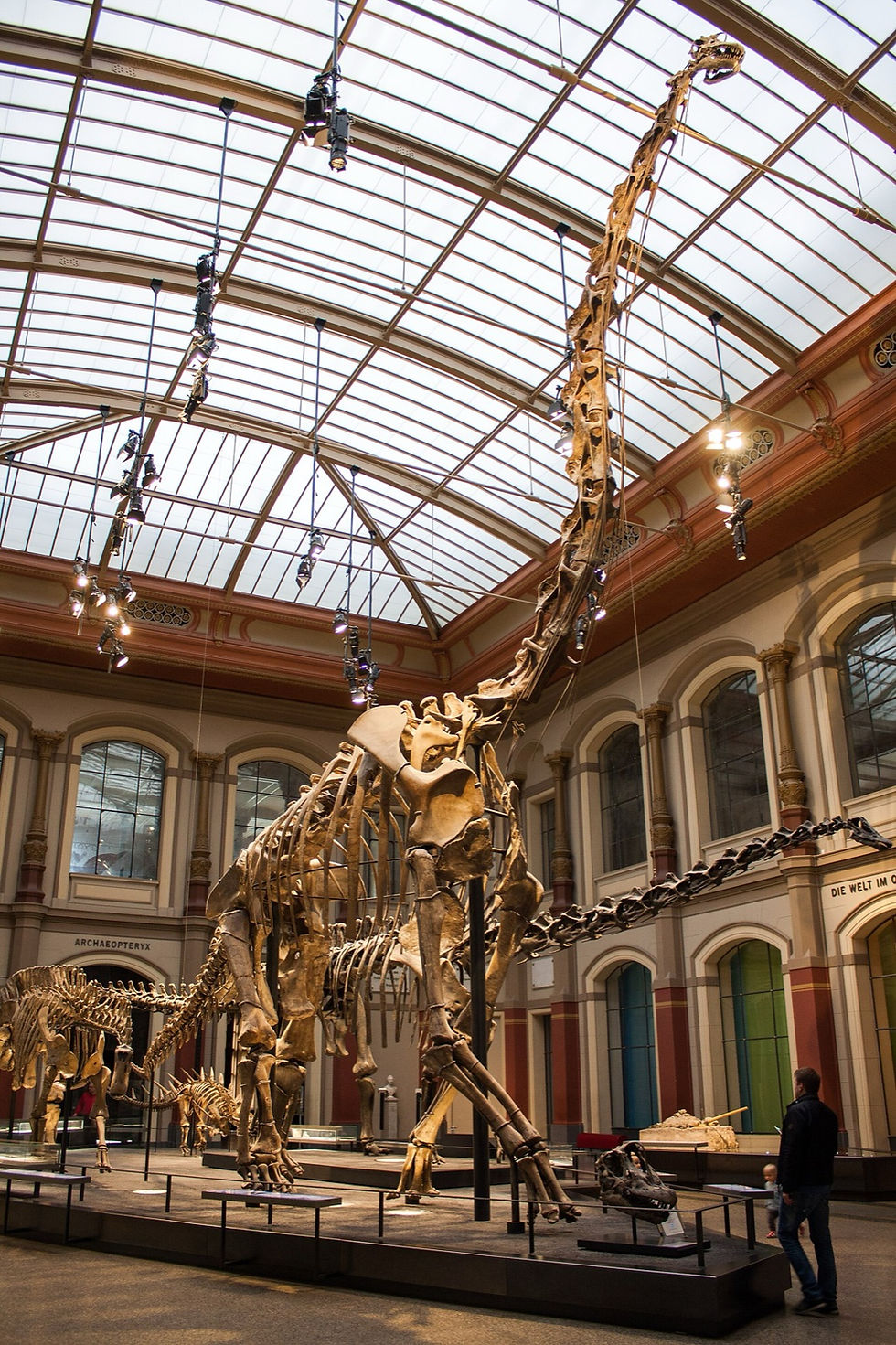
The Sauriersaal, the central dinosaur hall. The Giraffatitan on the left is the tallest mounted dinosaur skeleton in the world.
The world's tallest dinosaur, and why it stops people mid-sentence
Walk into the central hall and you meet it straight away: Giraffatitan brancai, 13.27 metres tall and 26.8 metres from nose to tail. Guinness lists it as the tallest mounted dinosaur skeleton in the world, and the number does not really land until you are standing under the ribcage looking up at a skull the size of a small car, held four storeys above your head.
What makes it special is not just the height. Much of what you are looking at is real fossil bone, not a plaster cast, which is genuinely rare at this scale. The bones came out of the ground at Tendaguru, in what was then German East Africa and is now Tanzania, during expeditions between 1909 and 1913, and the animal lived about 150 million years ago in the Late Jurassic.
My one piece of advice: go straight to the dinosaur hall first, before the museum fills up. It is the room everyone photographs, and it is far better with a bit of space around you than shoulder to shoulder with three school groups at noon.
Tristan Otto: a real T. rex, not a copy
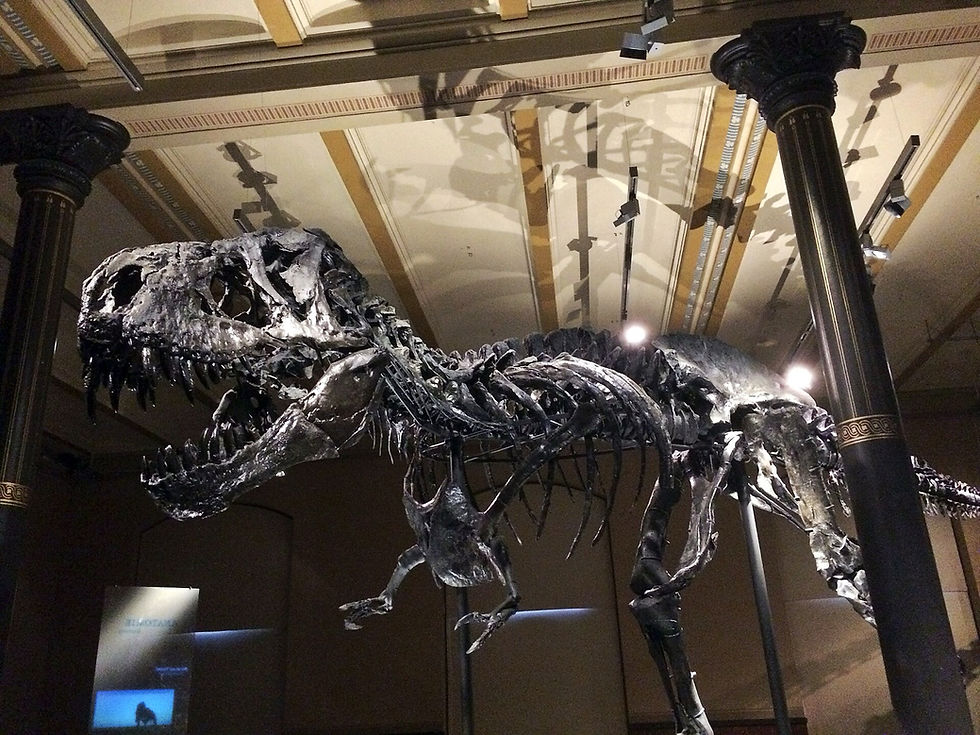
Tristan Otto, one of the only original Tyrannosaurus rex skeletons on public display in Europe.
Most Tyrannosaurus skeletons you meet in museums are casts, clever copies in resin. Tristan Otto is the real thing: an original T. rex, one of the best preserved anywhere, and one of the only genuine T. rex skeletons on display in Europe. It was dug out of the Hell Creek rock of Montana and now stands in the low-lit hall of the special exhibition Dinosaurs! Age of the giant lizards.
Kids who arrive certain that dinosaurs are just cartoons tend to go quiet in this room. The lighting is deliberately dramatic, and the skull, all curved teeth and eye sockets, is the part that sticks with people.
The Berlin Archaeopteryx: the most valuable fossil in the building

The Berlin Archaeopteryx. Look for the fine feather impressions fanning out from the arms and tail.
This one is easy to walk straight past, and you should not. The Berlin Archaeopteryx is a single slab of fine limestone holding a 150-million-year-old creature that sits exactly between dinosaurs and birds: reptile teeth and a bony tail, but with the clear imprint of feathers pressed into the stone. Staff sometimes call it the Mona Lisa of natural history, and it is often described as the most valuable fossil in the world.
It is small, and it does not roar at you like the T. rex does. Stand close, let your eyes adjust, and pick out the feathers spreading from the arms. You are looking at one of the single most important pieces of physical evidence for how evolution actually works, sitting quietly in a case in Berlin.
Before you leave the big hall, it is worth taking a second to feel the scale of that Giraffatitan properly. Thirteen metres is an abstract number until you put your own height next to it, so I built a small thing to do exactly that.
Beyond the dinosaurs

The wet collection, a wall of roughly 276,000 jars of preserved animals. One of the most photographed rooms in the building.
The dinosaurs get the postcards, but two other rooms are worth your time. The first is the wet collection, a towering glass-fronted hall of about 276,000 jars of animals preserved in alcohol, lit so the whole wall glows amber. It is strange, a little unsettling, and one of the most striking interiors in any Berlin museum.
The second thing to find is the set of Jurascope binoculars in the dinosaur hall. You point them at a skeleton and an animation puts skin, muscle and movement back onto the bones. For children, this is often the highlight of the whole visit, ahead of even the T. rex.
Be honest with yourself about the rest. A few of the side halls, the older mineral and taxidermy displays, feel dated compared with the headline rooms. This is not a criticism so much as a plan: treat the museum as three or four brilliant highlights rather than a corridor-by-corridor slog, and you will leave impressed rather than tired. For a slower, bigger museum day, Museum Island is the place for that.
How to visit the Berlin Natural History Museum: tickets, hours, and timing
The museum sits on Invalidenstraße 43, a short walk from the U6 Naturkundemuseum station.
Here is the practical part, all checked for 2026.
Tickets: 11 euros for adults, 5 euros reduced (students, pensioners, unemployed), free for children under 6. A family ticket for two adults and up to three children under 14 is 18 euros.
Opening hours: closed Mondays. Open Tuesday to Friday from 9:30, and Saturday, Sunday and public holidays from 10:00. It closes at 18:00 every open day, with last admission 30 minutes before, so do not turn up at 17:45 expecting to get in.
Booking: you can buy at the door, but on busy weekends and during school holidays it is worth booking a timed slot on the museum's own website up to two weeks ahead to skip the entrance queue.
Audio guide: there is a free digital guide you run on your own phone in eleven languages, so bring headphones.
One thing to clear up, because older guides keep repeating it: there is no free first Sunday here any more. Berlin's Museumssonntag scheme, which used to give free entry to dozens of museums on the first Sunday of the month, ran for the last time in December 2024 and has not returned for 2026. If you specifically want a big free-entry occasion, the twice-yearly Lange Nacht der Museen is the event to watch for instead. For everyday visits, expect to pay the eleven euros, and know that it is good value for what you get. If you are counting museum costs across a trip, my guide to which Berlin museums are actually free is a useful companion.
Is it worth it? My honest take
Yes, with one caveat. If you like dinosaurs, natural history, or you simply want a break from Berlin's heavier subjects, this is one of the easiest recommendations I give, and eleven euros is fair for a world-class main hall. It is a particularly strong call on a wet day, when the whole city is looking for something indoors and worthwhile, and it belongs on any shortlist of things to do in Berlin when it rains.
The caveat is scale. This is not a vast, all-day museum like the ones on Museum Island. Plan for one to two focused hours, aim for the Giraffatitan, Tristan, the Archaeopteryx, the wet collection and the Jurascope binoculars, and do not feel you have to see every case. Go in with that plan and it is a genuine highlight of a Berlin trip.
Fitting it into a Berlin day
The museum sits on Invalidenstraße, just north of the government quarter. The easy way in is the U6 to Naturkundemuseum station, a 300-metre walk from the door; it is also close to Nordbahnhof on the S1 and S2, and about 1.3 kilometres from Hauptbahnhof. If Berlin's transport map still feels like a puzzle, my plain-English guide to the U-Bahn, S-Bahn, trams and buses will sort you out.
Because of where it stands, it pairs naturally with a Berlin Wall morning: Nordbahnhof and the Wall Memorial on Bernauer Straße are one short S-Bahn hop away, so you can put a heavy, moving site and a hall full of dinosaurs into the same afternoon. It is a very Berlin kind of day.
My own free walking tour works the medieval core and the central boulevard rather than this northern corner, so think of the museum as its own separate stop rather than something on the route. If you are trying to slot everything together without over-packing the day, the Ultimate Berlin Trip Planner will build a realistic order around it.
Image credits
Central hall with Giraffatitan: Richard Mortel, CC BY 2.0, via Wikimedia Commons.
Tristan Otto Tyrannosaurus rex: Chris Alban Hansen, CC BY-SA 2.0, via Wikimedia Commons.
Berlin Archaeopteryx: H. Raab (User:Vesta), CC BY-SA 3.0, via Wikimedia Commons.
Wet collection: Tuxyso, CC BY-SA 4.0, via Wikimedia Commons.
Museum exterior on Invalidenstraße: Shadowgate, CC BY 2.0, via Wikimedia Commons.