Potsdamer Platz Berlin: Wall Trace, Skyline and What to See Today

Updated: 6 days ago
Potsdamer Platz Berlin can feel confusing if you arrive expecting a pretty old square. It is glass, traffic, offices, food halls, shopping edges and high buildings. The trick is to read the place in the right order.
Do not start with the skyline. Start with the missing city. Potsdamer Platz was once one of Berlin's busiest crossroads, then a bombed-out border zone, then a famous empty strip cut by the Berlin Wall. The modern quarter only makes sense when you notice what disappeared first.
Potsdamer Platz Berlin: the quick answer

Caption: Potsdamer Platz looks modern because this central space was rebuilt after war, division and reunification.
Potsdamer Platz Berlin is worth visiting if you want a fast before-and-after lesson in the middle of the city. It is not the most charming square in Berlin, and it is not where I would send you for old-town atmosphere. It is where you go to see how extreme Berlin's 20th century was: traffic hub, destruction, Wall, empty space, rebuild.
For most visitors, the right amount of time is 45 minutes. That gives you enough room to find the Wall trace, cross the modern quarter, look into the Sony Center roof area and decide whether the view from Panoramapunkt is worth it that day.
If you only have 20 minutes, make it a focused stop: Wall trace first, skyline second, leave before the mall eats the plan.
Start with the Wall trace, not the skyline

Caption: The Wall trace is the first layer to find. Without it, Potsdamer Platz can feel like just another glass quarter.
The most important thing at Potsdamer Platz is easy to miss because it is under your feet. Look for the line in the pavement that marks the former course of the Berlin Wall. VisitBerlin also points visitors toward a QR-based time-travel marker near the Deutsche Bahn Tower, which is useful if you want a quick on-site before-and-after view.
This matters because the buildings around you are not simply "new Berlin." They stand on land that spent decades as a border landscape. The Berlin Wall Foundation is the better place for the full Wall memorial experience, but Potsdamer Platz gives you the strange city-centre version: a place that was once central, then almost erased from normal urban life.
If you are already using my Berlin Wall map guide, Potsdamer Platz works as one short, visible stop in a larger border route.
Why the square feels so new
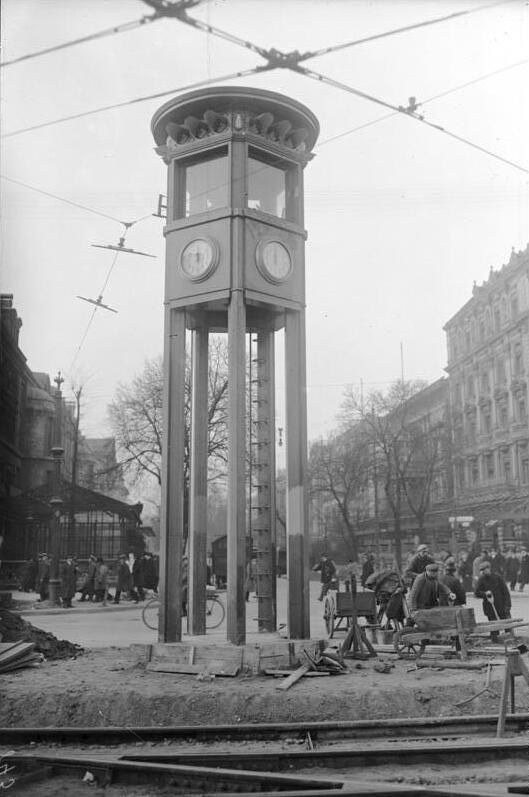
Caption: Historic Potsdamer Platz was a traffic and nightlife hub before war and division changed the city fabric.
Before the Second World War, Potsdamer Platz was one of Berlin's busiest crossroads. VisitBerlin notes the famous traffic-tower story here: in the 1920s, a traffic light system controlled the rush of trams, cars, buses and pedestrians.
Then the square was badly damaged in the war. After the city was divided, it sat near the meeting point of occupation sectors and became part of the border landscape. That is why the place can feel oddly clean and corporate today. You are not failing to find the old square. In many ways, the old square is gone.
After reunification, the area became one of Europe's largest building sites. Architects and planners had the rare chance to create an entire new city quarter in central Berlin. That explains the towers, planned blocks and sudden feeling that you have stepped into a different city.
What to see around Potsdamer Platz today

Caption: The Sony Center roof is the easiest modern visual cue, but it works best after you have read the Wall trace.
Start with the Wall trace. Then turn the modern buildings into evidence, not background. The contrast is the point.
The Sony Center roof is still the easiest visual hook. You do not need to make it a long stop, but stepping under the roof helps you feel the post-1990 confidence of the redevelopment. Leipziger Platz is useful for comparison because it reads more like a planned square, while Potsdamer Platz itself feels more like a traffic and skyline node.
Panoramapunkt, in the Kollhoff Tower, is the paid view option. On the day I checked for this guide, the official Panoramapunkt opening-hours page listed the viewing platform as open daily from 10:00 to 19:00, with last ascent at 18:30. Always check the official page before building a day around it.
If the weather is grey or the group is tired, do not force the viewpoint. You can still do the Wall trace, roof, coffee or food hall version and leave with the main idea intact.
Use the Potsdamer Platz Time-Layer Walk
The tool below turns the stop into a simple decision: 20, 45 or 75 minutes, and whether your priority is Wall history, architecture/view, or a practical rainy-day version.
The 20-minute version
Use this if Potsdamer Platz is a quick add-on between Brandenburg Gate, the Holocaust Memorial, Topography of Terror or the U2.
Start at S+U Potsdamer Platz or arrive from the Brandenburg Gate side. Find the Wall trace first. Stand still for a moment and imagine a central city square becoming a border zone. Then cross toward the modern towers and the Sony Center edge.
That is enough. The mistake is to turn a short history stop into 35 minutes of drifting around shops you did not come for.
The 45-minute version
This is the version I would recommend for most first-time visitors.
Start at the Wall trace, then walk toward Leipziger Platz and back through the modern quarter. Use the shape of the streets and buildings as part of the story: the square is no longer an old Berlin crossroads, but it is not random either. It is a deliberately rebuilt quarter on a site that became politically and physically empty.
Add the Sony Center roof area, then leave with a clear next stop. If you are heading into more Wall history, connect it with Topography of Terror or Checkpoint Charlie. If you are heading back toward the classic centre, connect it with Brandenburg Gate and the Holocaust Memorial.
The 75-minute version

Caption: The Kollhoff Tower is the Panoramapunkt landmark. Choose the viewpoint only if the weather and your schedule justify it.
Choose the longer version only if Potsdamer Platz is doing real work in your day.
On a clear day, that can mean Panoramapunkt. The view helps because you can place the city in your head: Tiergarten, Brandenburg Gate, the high-rises, the straight lines of the rebuilt quarter and the wider central geography.
On a culture day, the longer version can point you toward the Kulturforum and Neue Nationalgalerie. On a history day, it can point you toward Topography of Terror and the Berlin Wall route. The rule is simple: choose one add-on, not three.
What to skip
Skip the idea that Potsdamer Platz has to be beautiful in the old postcard sense. That expectation makes the stop worse.
Skip the mall-first version unless it is raining, someone needs a bathroom, or you genuinely want food and shelter. Shopping and food halls can be useful, but they are not the reason this place belongs in a Berlin itinerary.
Skip over-planning. Potsdamer Platz works best when it is a smart hinge between nearby sights, not the anchor of a whole day.
How it connects to a Berlin walk

Caption: From above, Leipziger Platz makes the rebuilt city plan easier to understand than it feels at street level.
Potsdamer Platz is not on my core BerlinWalk route from Alexanderplatz to Hackescher Markt. That route is about the historic centre, the royal and medieval layers, Museum Island, Unter den Linden edges and the old city logic.
But Potsdamer Platz is a strong add-on if you want to keep following the 20th-century story after the walk. You can use the BerlinWalk booking page for the 2 hours walk, then treat Potsdamer Platz as a separate before-and-after stop later in the day.
My honest recommendation: do not come here only for shopping. Come here to understand absence, rebuilding and the odd way Berlin can put a Wall trace, a luxury tower, a food hall and a memory of no-man's-land into one short walk.
Image Credits
Potsdamer Platz skyline image by Ansgar Koreng, CC BY-SA 3.0 DE, via Wikimedia Commons. Berlin Wall memorial image by Yair Haklai, CC BY-SA 4.0, via Wikimedia Commons. Sony Center roof image by Perituss, CC0, via Wikimedia Commons. Kollhoff Tower and BahnTower image by Slaunger, CC BY-SA 4.0, via Wikimedia Commons. Historic Potsdamer Platz traffic tower image by Bundesarchiv, Bild 102-00843, CC BY-SA 3.0, via Wikimedia Commons. Leipziger Platz overview image by Arild Vågen, CC BY-SA 3.0, via Wikimedia Commons.