Balcony Solar in Berlin: What Your Wall Earns Now the Grant Has Gone

There is a corner on Lübecker Straße in Moabit where six balconies in a row carry a solar panel. Some are bolted flat against the railing. Some are tilted out over the street at whatever angle the bracket allowed. One is lying almost flat among the tomato pots. Six neighbours, six different guesses about the sun, and they cannot all be right.
That corner is the whole subject. A plug-in solar kit is the one piece of the energy transition a Berlin tenant can actually buy on a Tuesday, hang up on Saturday and see on the bill. The hardware is now cheap and the rules are finally simple. What almost nobody tells you is that the number printed on the box has very little to do with the money that reaches you.
The Berlin grant is gone, and that is the real news
For three years the honest answer to "should I get one" in this city started with the subsidy. Berlin's SolarPLUS programme paid up to 500 euro towards a Steckersolargerät, which is most of a kit, and that made the arithmetic trivial.
That door is shut. The programme reopened on 8 January 2026 with a new structure, SolarPLUS S for homes and SolarPLUS L for bigger installations, and a 13 million euro budget. The balcony module was not in it. IBB Business Team, which runs the programme, states it plainly: Module E Steckersolargeräte is no longer funded, because the devices have become cheap enough to pay for themselves without help. Applications already submitted are still being processed. New ones are not accepted. (Checked on 13 September 2026.)
So the question has changed. It is no longer "is the grant worth the paperwork". It is "does this wall, at this angle, in this flat, earn back four hundred euro". That is a different question and the answer is not the same for every balcony on the block.
What the rules actually say now
The legal side got much easier and most of the confusion online is out of date.
800 watts at the inverter, 2,000 watt peak of module. Those are the two legal ceilings, and you are allowed more glass than inverter, which matters more than it sounds. One device per household.
The plug question is finally settled. The product standard DIN VDE V 0126-95 has been in force since 1 December 2025, and the Verbraucherzentrale Berlin reads it the way you want to hear: a certified device may officially go into an ordinary Schuko socket, with modules up to 960 watt peak. Above that you are into a proper feed-in socket fitted by an electrician, which is a real cost and not a formality.
You do not tell the grid operator any more. Since the Solarpaket I changes took effect on 16 May 2024 that duty is gone for plug-in devices. One registration in the Marktstammdatenregister, with a handful of fields, within a month of switching it on. The register passes your details to the network operator itself.
Your surplus is a gift. The standard arrangement for these devices is unentgeltliche Abnahme: everything you send out of the flat is taken for free. You are not paid a cent for it. Remember that sentence, because the rest of this article is built on it.
The meter is their problem. The operator has to fit a two-way meter, and an old analogue disc is swapped out at no cost to you.
Your landlord can no longer simply say no. Since early October 2024 a plug-in solar device is a privileged measure in the Bürgerliches Gesetzbuch. You still ask for consent, and the landlord or the owners' association still has to answer, but a refusal now needs a concrete reason for your specific case. Not liking how it looks is no longer one.
Berlin asks for no building permit. The Senate's own solar advice service is direct about it: under the Bauordnung Berlin no Baugenehmigung is needed for a balcony system on a rented flat. Listed buildings are the exception and need the district's Denkmalbehörde, which in Prenzlauer Berg, Mitte and large parts of Charlottenburg is a real question and not a formality.

The standard Berlin install: two modules strapped to the outside of the railing, no drilling, no electrician.
What balcony solar in Berlin really makes
I modelled it properly instead of repeating the brochure. Using PVGIS, the European Commission's solar database, I took the long-run Berlin average for every direction and mounting angle, then ran three years of hourly output through a flat to see how much of it a household actually swallows.
For 800 watt peak of module, hung unshaded in central Berlin, a full year looks like this:
Flat against a south railing: 595 kWh.
Flat against an east railing: 415 kWh. West: 403 kWh.
Flat against a north railing: 153 kWh, which is the number that ends most north-facing conversations.
Laid back at 30 degrees facing south: 810 kWh, the best case in the city.

Helene-Weigel-Platz 6 and 7 in Marzahn. The dark strips are solar panels mounted flat on a vertical wall, which is the same geometry as a panel strapped to your railing.
Two things jump out of that list. The first is that no balcony in Berlin gets near the 800 kWh a year the kits imply, unless you can lay the panels back at a proper angle. The second is that the distance between a south wall and a west wall is smaller than the distance between a good angle and a bad one.
The tool draws the whole year for your own corner. Turn the dial to the direction your balcony actually faces, pick how the panel hangs, and watch the twelve months change shape. The dark part of each bar is the only part that becomes money.
The number that decides it is not on the box
Here is the finding that changed how I read these kits.
A typical Berlin flat pulls something like 130 watts in the background while the sun is up: fridge, router, standby, a charger or two. When the panel makes more than that, the surplus leaves the flat and, as above, nobody pays you for it.
So a south-facing railing kit makes 595 kWh a year and the flat keeps 306 of them, about half. At 37.93 cents per kilowatt hour, which is what Vattenfall's Berlin basic tariff has cost since 1 April 2026, that is 116 euro off the bill in a year. Against a 400 euro kit, roughly three and a half years.
Now watch what happens when you buy more panel. Same wall, same flat, but 2,000 watt peak of module behind the same 800 watt inverter:
Production more than doubles, from 595 kWh to 1,318 kWh.
What the flat keeps rises from 306 kWh to 379 kWh.
The saving rises from 116 euro to 144 euro a year.
You spent perhaps 380 euro more on glass and brackets to gain 28 euro a year, and somewhere above 960 watt peak you also bought an electrician and a feed-in socket. The extra panels are producing beautifully at midday into an empty flat, and all of it is given away. This is the single most expensive mistake in balcony solar in Berlin, and the box will never mention it, because the box is selling watts.
The same upgrade is completely different if someone is home. Put a home office and a chest freezer in that flat, so the background draw sits nearer 320 watts, and 800 watt peak keeps 525 kWh (199 euro), while 2,000 watt peak keeps 757 kWh, 287 euro a year. Same wall, same hardware, opposite verdict, decided entirely by who is in the flat at two in the afternoon.
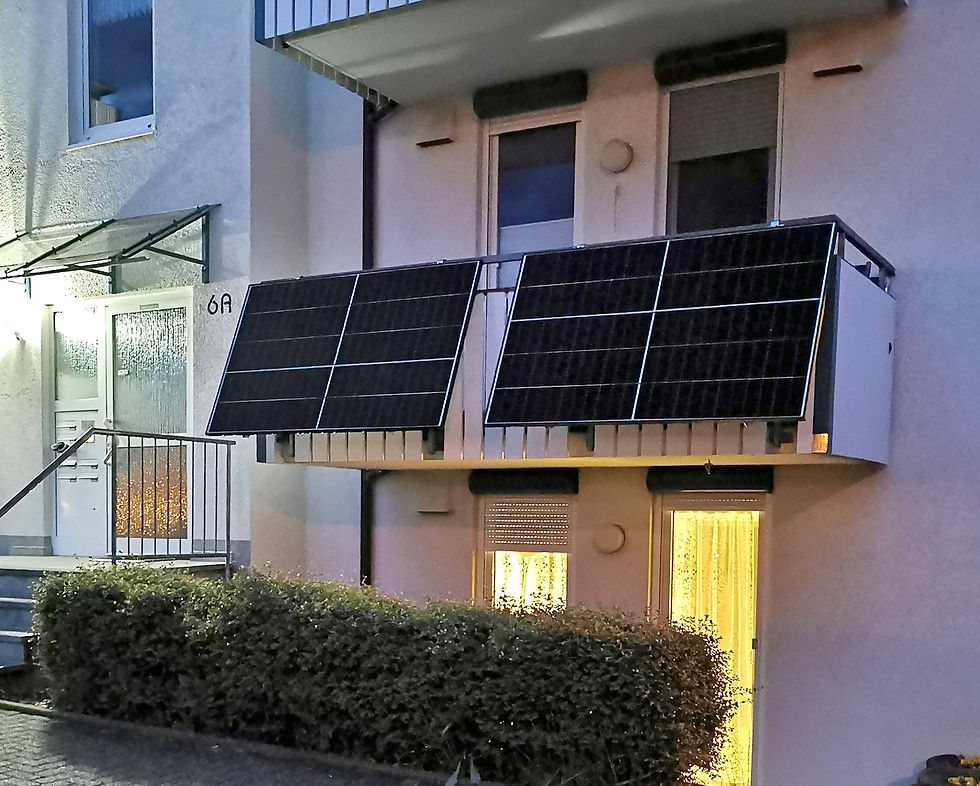
Angled out instead of flat. On a south wall this is worth about 21 euro a year to an ordinary flat, which is less than the internet arguments about it suggest.
Vertical against tilted, and the winter surprise
The forums will tell you to tilt. They are right about production and mostly wrong about money.
Flat against a south railing gives 595 kWh, laid back at 30 degrees gives 810 kWh. That is a 215 kWh gap, which sounds decisive. But the tilted panel wins most of that extra in June, at midday, when the flat is empty and the surplus walks out of the door. In kept kilowatt hours the gap shrinks to 55, worth about 21 euro a year.
And the vertical panel quietly wins the dark half of the year. Berlin monthly averages, same 800 watt peak, south facing:
November: 33 kWh vertical, 29 tilted.
December: 27 vertical, 21 tilted.
January: 29 vertical, 25 tilted.
June: 53 vertical, 103 tilted.
A vertical panel faces the low winter sun head on and shrugs at the high summer sun. Its year is flatter, and a flatter year is a better fit for a household that uses most of its electricity when the days are short. It also sheds snow, stays out of the way and does not turn into a sail in an October storm.
The real lesson of the angle is somewhere else entirely. A north balcony with the panels laid back at 30 degrees keeps 323 kWh a year, which is more than a south balcony with the panels bolted flat to the railing. A north-facing panel at a proper angle still sees a huge amount of sky. If your only balcony faces Hermannstraße on the wrong side, the angle is your way back into this, and it is a bigger lever than the compass.

A Leipzig Plattenbau, one balcony out of dozens. Berlin's own prefab estates in Marzahn and Hellersdorf look much the same and are some of the best-oriented balconies in the city.
Before you buy, five Berlin specifics
Look at what is opposite, not just which way you face. Every number in this article assumes a clean view of the sky. A ground-floor Hinterhof balcony with a five-storey building across the yard will sit far under them, and no bracket fixes that. Stand on the balcony at noon and again at five and see where the shadow line is.
Ask in writing, then wait. The privilege in the law works best when there is a dated request on file. Keep it short: what you want to hang, where, how it is fastened, and that it is a certified plug-in device inside the 800 watt limit.
Fastening is the part that has to be right. The Senate's advice service says the important thing is that the modules are attached securely enough that nobody below is put at risk. A panel coming off a fourth-floor railing onto Kottbusser Damm is not a warranty question.
Check the socket, not just the panel. A certified device on a Schuko plug is fine under the current standard up to 960 watt peak of module. In a Berlin Altbau on original circuits, with a shared hallway socket or a fuse box that has seen better decades, that is still worth one conversation with an electrician before you order.
Price it honestly. Consumer advice puts a two-module set at 200 to 300 euro plus 50 to 100 euro per module for the mounting, so a real Berlin install lands around 350 to 450 euro. Anything that promises a payback under two years is assuming a household that is never out.
My advice
Berlin is not a sunny city by European standards and it is a city of rented flats with awkward balconies, which is exactly why this works better here than people expect. A Marktstammdatenregister analysis published in March 2026 counted 24,092 registered balcony units in Berlin, roughly 6.4 watts per resident against about 16 nationally. Berlin sits near the bottom of that table, and the physics on this page say it should not.
My advice: buy the smallest kit first. Two modules, 800 watt peak, hung on whatever wall you have, at whatever angle the bracket gives you. It will cost about 400 euro and pay itself back in three to five years on almost any Berlin balcony that is not in permanent shadow. Then live with it for a winter and read your own meter. If it turns out somebody is home most days, add panels next spring, and you will add them knowing what your own flat actually swallows instead of guessing.
One more thing about timing. If you buy this week, you are buying at the bottom of the year. September still gives a south railing 63 kWh, but November, December and January together give it about 89, and your first three months will look like a mistake. They are not. Judge it in June.
If your Berlin bills are on your mind more generally, the same arithmetic thinking is worth pointing at the two documents that cost you far more than a solar panel earns: the Nebenkostenabrechnung, which is worth checking line by line before its deadline, and the heating season rules that decide what your landlord owes you once the flat goes cold. And when the panel eventually dies, it is electrical waste for a Recyclinghof, not something to leave beside the bins.
Image credits
Source and licence details for the 4 photographs used in this article.
Two solar modules mounted flat against a balcony railing on a residential block: Rudy23, CC BY-SA 4.0, via Wikimedia Commons.
Two solar modules angled out from a balcony railing at dusk, in Tauberbischofsheim: Triplec85, CC BY-SA 4.0, via Wikimedia Commons.
A single balcony solar installation on a Plattenbau facade in Leipzig: Frank Eritt, CC BY-SA 4.0, via Wikimedia Commons.
The photovoltaic facade of the twin towers at Helene-Weigel-Platz 6 and 7 in Berlin-Marzahn: Molgreen, CC BY-SA 4.0, via Wikimedia Commons.