Does Uber Work in Berlin? Ride-Hailing Apps Explained

Updated: Jul 22
You land at BER, roll your bag out past passport control, and do the thing you would do in almost any other city: you open Uber. And then you pause. The app looks familiar, but the prices, the wait times and the whole feel of it are slightly off. A lot of visitors ask me the same question in their first hour here, usually while standing at a curb: does Uber even work in Berlin?
The short answer is yes. The useful answer is that it works differently here than it does at home, and understanding that difference saves you money, time and a fair bit of standing around in the cold.
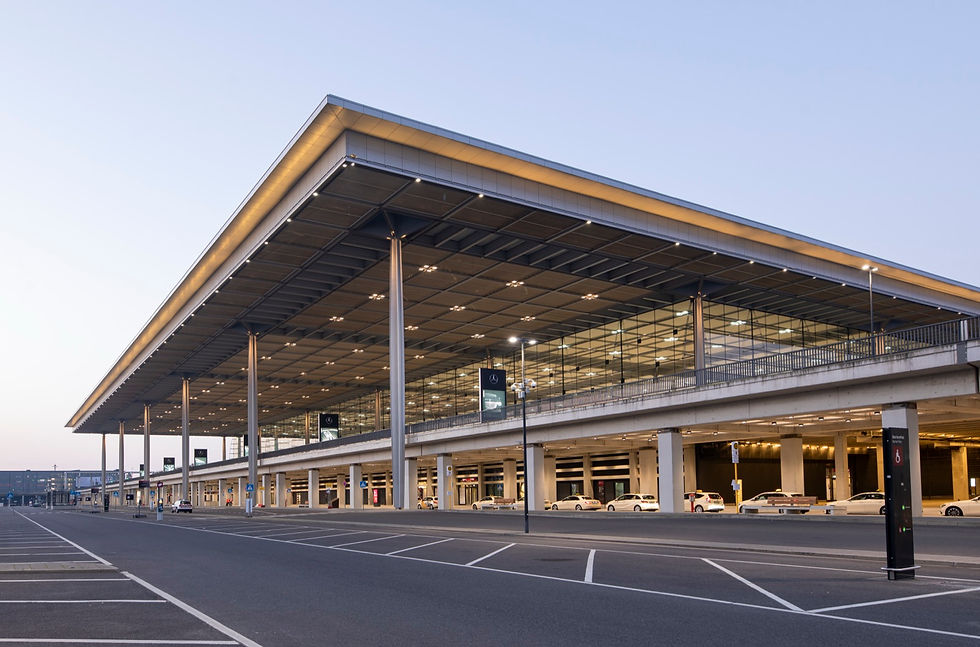
The first place most visitors reach for a ride app: the Terminal 1 forecourt at BER, where taxis and app cars share the curb.
Does Uber actually work in Berlin?
Uber runs across Berlin, and the app you already have on your phone will work the moment you land. But Germany does not let Uber operate the way it does in New York or London. Under the German passenger transport law, Uber is licensed only as a private-hire car service, not as a taxi. In practice that means a few concrete things.
There are no street hails and no Uber ranks. You cannot wave one down or find a line of them outside a club. You book in the app, and a professional driver in an ordinary, unmarked car comes to your pin. The driver holds a passenger-transport licence, so this is not the informal, anyone-can-drive model some visitors picture. Uber's own Berlin city guide lays out the service tiers, but the core idea is simple: in Berlin, Uber is an app that books you a licensed hire car.
The upside is that it is legitimate, cashless and easy if you do not speak German. The downside is the one nobody warns you about, and I will come back to it below, because it explains almost every frustrating Uber moment people have in this city.
Uber, Bolt or FreeNow: which app to open
Uber is not the only game here, and it is often not the best one. Three apps cover almost everything:
Uber is the most familiar interface for visitors and books a private-hire car.
Bolt works the same way as Uber but is usually the cheapest of the three. If price is your main concern, install it.
FreeNow is the interesting one. It mostly books real Berlin taxis through an app, so you get the regulated meter fare plus app payment, live tracking and no language barrier. When you actually need a car quickly, FreeNow is often the most reliable, because it is calling on taxis that are already out driving.
That last point matters more than it sounds. A FreeNow ride is usually a normal cream-coloured Berlin taxi, the same car you would find at a rank outside a station.

A FreeNow booking usually sends one of these: a standard Berlin taxi on the regulated meter, not a private-hire car.
My habit, and the one I suggest to guests, is to keep two apps installed and compare the live quote before booking. Bolt for the cheapest fare, FreeNow when you want a car that is definitely coming. If you want the wider picture of every way to move around the city, our guides to Berlin public transport for tourists and the various alternative transport options in Berlin put ride-hailing in context. And if you prefer a traditional cab, the separate guide to taking a taxi in Berlin covers the meter tariff in detail.
The hidden rule that explains the waiting
Here is the thing that catches everyone out. German law makes private-hire cars return to their base after every single ride, rather than cruising the streets looking for the next fare the way taxis are allowed to. It is called the return-to-base obligation, and it quietly shapes your whole experience.
Because Uber and Bolt cars cannot just circle waiting for you, the pool of available cars is thinner than you expect, especially late at night, in bad weather, and anywhere outside the central districts. That is exactly when you open the app and see surge pricing, a long wait, or the dreaded "no cars available". It is not a glitch and it is not bad luck. It is the law working as designed.

Late at night, a taxi already waiting at a rank often beats an app car that has to be dispatched from its base across town.
This is why my advice flips after midnight. For a late-night ride home, a taxi physically sitting outside the club or at a station rank will usually get you moving faster than an UberX that may be twenty minutes away, if it comes at all. If you are planning a big night out, it is worth reading how night transport in Berlin works first, because on Friday and Saturday the U-Bahn runs all night and can beat any car.
Getting a ride from BER Airport
BER is the single most common place people try to summon an Uber, so it deserves its own note. All three apps, Uber, Bolt and FreeNow, serve the airport. The Ride App Pick Up zone is at Terminal 1, ground level, and the app shows you the exact meeting point once you book. There is also a normal taxi rank right outside the terminal, so you are never stranded.

Follow the signage down to Terminal 1 ground level. The ride-app pickup zone and the taxi rank both sit just outside the arrivals doors.
But here is my honest take: from the airport, a car is rarely the smart choice. A ride into central Berlin runs roughly 50 to 80 euros by app depending on demand, and Uber's own BER airport page confirms it dispatches from that Terminal 1 zone. The Airport Express (FEX) and the S-Bahn cover the same trip in about 30 to 45 minutes for a few euros on a single ticket, because BER sits in fare zone C. I walk through the cheapest, least stressful version of this in the guide to getting from Berlin airport to Alexanderplatz, and the Berlin AB/ABC ticket zones explainer covers which ticket you actually need. Save the car for a late arrival with heavy bags, and even then, check FreeNow first.
What a ride costs, and how you pay
Two different pricing systems are in play, and knowing which one you are looking at helps you judge whether a fare is fair.
Uber and Bolt quote a fixed price before you book. You see the number, you accept it, and that is what you pay, even if traffic is bad. The catch is that the number moves with demand, so the same trip can cost noticeably more in the rain or at 3am.
A taxi (including most FreeNow rides) runs a regulated meter, starting around 4.30 euros and climbing with distance and time. It is more predictable, but a short central hop can feel expensive per kilometre.
As rough 2026 figures: a short ride across the centre is about 10 to 18 euros, and the airport-to-centre trip is the 50-to-80-euro range above. Payment is cashless in the apps by card, which is a relief in a city that is still surprisingly cash-friendly for everyday spending. Tipping is optional but appreciated: rounding up by about 5 to 10 percent is normal, the same convention covered in the general guide to tipping in Berlin. No one will chase you for it.
To make the choice concrete, I built a small tool for the five situations where people actually reach for an app. Pick your scenario and it shows what Uber, Bolt, a FreeNow taxi and the smart local option really cost, and what the catch is with each.
So, should you use Uber in Berlin?
Yes, but less often than you think. Uber, Bolt and FreeNow are genuinely useful for the airport run with heavy luggage, a late-night trip when the trains have stopped, travelling with small children, or any moment when carrying bags up and down station stairs is the real problem. For those, an app car earns its fare.
For ordinary sightseeing, though, Berlin's public transport quietly wins on both price and speed. A 5-kilometre trip across the centre is 3.80 euros on the U-Bahn and usually faster underground than crawling through traffic above it. That is not me being purist. It is just what the numbers keep showing, and it is why most of the first-time visitors I meet end up using their transport ticket far more than any ride app. If you want to avoid the classic pitfalls, the roundup of first-time visitor mistakes in Berlin is a good next read.
There is also a simple truth I tell every group: the best of central Berlin is walkable. The historic core, from the Brandenburg Gate to Museum Island, is a compact stretch you can cross on foot in well under an hour. That is exactly the ground my free Berlin walking tour covers, and once you have walked it, you will have a much better sense of when a car is worth booking and when it is money you did not need to spend.
Image credits
BER Terminal 1 at dusk: photo by Arne Müseler, Wikimedia Commons, CC BY-SA 3.0 DE.
BER Terminal 1 interior signage: photo by Roy Zuo, Wikimedia CommonsFlughafenBERTerminal1.jpg), CC BY-SA 4.0.
Cream Mercedes Berlin taxi: photo by Johann H. Addicks, Wikimedia Commons, CC BY-SA 3.0.
Friedrichstraße at night: photo by Sascha Kohlmann, Wikimedia Commons.jpeg), CC BY-SA 3.0.