Two of Everything in Berlin: The East and West Twins and Which One to Visit
Stand on the platform at Bahnhof Zoo and you are standing in what was, for forty years, West Berlin's main station. Stand at Ostbahnhof and you are standing in East Berlin's, which actually carried the name Hauptbahnhof from 1987. Neither of them is Berlin's main station now. That job went to a building on empty land between them in May 2006.
This happens all over the city. Berlin was two cities from 1945 until 1990, and each half built the things a capital is supposed to have. Then the two halves were put back together and nobody demolished the spares. So today you get two zoos, two opera houses, two big concert halls, two planetariums, two state library buildings, two city halls and two universities, sitting on opposite sides of a border you cannot see.
For a visitor this is mostly a trap. You read a list of Berlin highlights, you pick things off it, and you end up crossing the whole city twice in one afternoon because half your list is in Charlottenburg and half is in Mitte.
Why the divided city built everything twice
The pattern is always the same. Something important ends up in the wrong sector, and the other side builds its own.

Berlin's two towers in one frame, seen from the Drachenberg. The Funkturm on the right is West Berlin's landmark. The thin spike on the left horizon is the Fernsehturm, in the East.
Zoo Berlin, opened in 1844, finished the war inside the British sector. So the GDR opened the Tierpark in Friedrichsfelde in 1955, roughly five times the size, in an old palace park. If you only want one of them, I have written the full comparison of Zoo Berlin and the Tierpark separately.
The Staatsoper Unter den Linden was in the East, so West Berlin built the Deutsche Oper on Bismarckstrasse and opened it on 24 September 1961, six weeks after the Wall went up. The Berlin Philharmonic had no home, so Hans Scharoun built the Philharmonie a few hundred metres from the death strip and it opened in October 1963. East Berlin answered by rebuilding Schinkel's bombed theatre on Gendarmenmarkt as the Konzerthaus, reopened in October 1984.
Even the universities split. Students expelled from the old university in the Soviet sector founded the Freie Universitaet out in Dahlem in December 1948, which is why Berlin has both a Humboldt on Unter den Linden and an FU an hour away by U-Bahn.
It even reached the sky. West Berlin opened the Planetarium am Insulaner in 1965, on a hill made out of war rubble. East Berlin answered in October 1987 with the Zeiss-Grossplanetarium in Prenzlauer Berg, a 23 m dome put up for the city's 750th birthday and one of the last big GDR buildings. Both now belong to the same foundation.

The Zeiss-Grossplanetarium in Prenzlauer Berg, finished in 1987. Its western twin sits on a rubble hill in Schoeneberg, twelve kilometres away.
If you want the political story behind all this, that is a separate piece: how Berlin was actually divided.
The tower nobody sends you to
Everyone goes up the Fernsehturm. Almost nobody goes up the other one.
The Funkturm is West Berlin's tower, built in 1926 out at the exhibition grounds in Charlottenburg. Its platform is at 126 m against 203 m at the Fernsehturm, so it loses on height. It wins on everything else:
Open Tuesday to Sunday, 11:00 to 21:00, according to the operator's own page.
The lift takes about 33 seconds, and there is usually no queue at all.
The view faces back across the whole city, so the Fernsehturm is in your photograph instead of underneath your feet.
Nearest stations are U2 Kaiserdamm and S41/S42 Messe Nord.
My advice: if the Fernsehturm is already on your list, keep it, and treat the Funkturm as the thing you do on a second visit or on a day when the Alexanderplatz queue is out the door. I have compared the whole set in the Berlin observation decks guide.
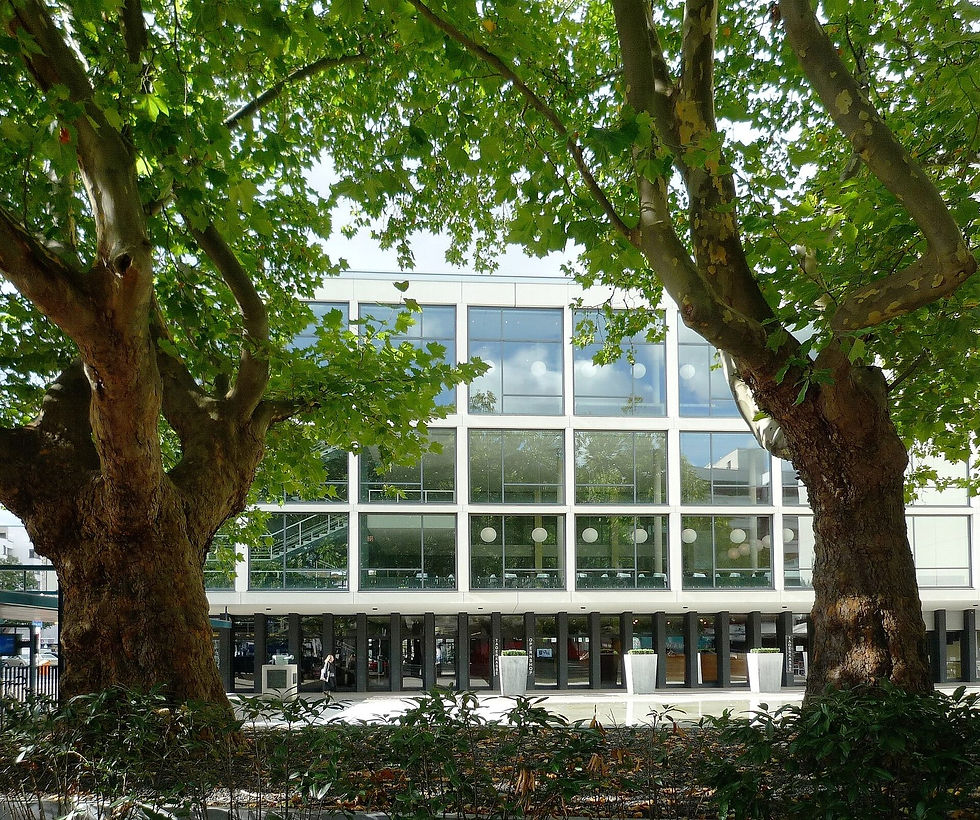
The Deutsche Oper on Bismarckstrasse. The blank concrete wall facing the street is deliberate. It went up in 1961 as West Berlin's only opera house.
One library, two houses, and the clearest border you can walk into
The Staatsbibliothek zu Berlin is the case I always point at, because it is one institution that still lives in two buildings for no reason other than the division.
The old Prussian library on Unter den Linden opened in 1914 and stayed in the East. The holdings were divided between two separate institutions, one in each half of the city, so the West built a second house at the Kulturforum on Potsdamer Strasse, again by Scharoun, and opened it in 1978. Since reunification the two are one library with two houses.
The Potsdamer Strasse reading room is the one worth walking into. It is a terraced landscape of desks under a floating ceiling, and it is the room the angels listen in during Wings of Desire. You can go in and look without a reader card.

The Scharoun reading room at the Staatsbibliothek on Potsdamer Strasse, finished in 1978. Its twin, the 1914 house, is twenty minutes east on Unter den Linden.
The pair that rings a bell at twelve
Rathaus Schoeneberg was West Berlin's seat of government from 1949 until 1991. Kennedy said the Ich bin ein Berliner line from its balcony in June 1963, and if you want that story properly told, the jelly doughnut myth is worth five minutes.
The detail that makes the trip worthwhile is in the tower. A replica of the American Liberty Bell, paid for by donations from more than sixteen million Americans and given to Berlin in 1950, hangs up there and rings every day at noon. Get to U4 Rathaus Schoeneberg by about 11:50 and you hear it in the square. Turn up at two in the afternoon and it is an office building.
Its twin is the Rotes Rathaus behind the Neptune Fountain, which took the whole city back in 1991 and which you will walk past anyway.

Rathaus Schoeneberg. West Berlin governed itself from this building for forty-two years, and the Freedom Bell is in the tower.
The twins the city already settled for you
Three of the pairs are finished, and knowing that saves you a booking mistake.
Main station. Bahnhof Zoo and Ostbahnhof both lost their long-distance trains when Berlin Hauptbahnhof opened in May 2006. Book to Hauptbahnhof unless your hotel is genuinely closer to one of the old two. More on the whole network in my Berlin train stations guide.
Airport. Tempelhof closed in 2008 and Tegel in 2020, both in the West. East Berlin's airport was at Schoenefeld, which is not even inside Berlin, and it kept going as BER's Terminal 5 until it closed for good in 2022. The one surviving airport is the far one, so allow a full hour back into town. Details in the Berlin airports guide.
Museum quarter. The Prussian collections were split, and for decades Nefertiti was in the West at Dahlem while the Pergamon collections stayed on the island. She moved back to the Neues Museum in 2009. Start with Museum Island and leave the Kulturforum for a second visit.

Ostbahnhof in Friedrichshain. It was called Hauptbahnhof from 1987 to 1998, and today most long-distance trains pass it without stopping.
Two of everything in Berlin: pick a side, not one of each
Here is the practical part, and it is the reason I built the map below.
The historic centre is the eastern half. Museum Island, the Staatsoper, the Konzerthaus, the Rotes Rathaus, Humboldt-Universitaet and the Fernsehturm all sit inside about a fifteen minute walk of each other. The western twins are spread from Charlottenburg to Dahlem to Schoeneberg, and each one costs a U-Bahn ride.
So the mistake is not picking the wrong twin. The mistake is picking one of each and then discovering your day is a series of thirty minute transfers. I have done exactly that with a visiting friend, chasing the Philharmonie in the afternoon after a morning on Museum Island, and we spent more of the day at Potsdamer Platz station than anywhere else.
Group your day by side. Eastern picks in one block, western picks in another, and put the single outlier at the very start or the very end.
The tool below plots both halves of every pair on a real map of the 1989 sectors. Tap the one you would actually go to and it draws the day you have just made, including how far apart your choices really are.
Where this fits with a walk
My free walking tour covers the eastern set almost by accident, because that is where the old centre is: the World Clock, the TV Tower, the Rotes Rathaus, the Marienkirche, Museum Island, the Humboldt Forum, and out to Hackescher Markt. Eleven stops, sixteen places, about 3 km, roughly 2 hours. That is the reason it starts at Alexanderplatz and not at the Brandenburg Gate.
Do the eastern half on foot with someone explaining it, then spend a separate afternoon on the western twins, when you already know what they were built against. That order makes the Funkturm and the Deutsche Oper mean something. In the other order they are just buildings a long way from your hotel.
Image credits
Source and licence details for the 6 photographs used in this article.
The Funkturm and the distant Fernsehturm seen from the Drachenberg: Leonhard Lenz, CC BY-SA 4.0, via Wikimedia Commons.
The Deutsche Oper Berlin on Bismarckstrasse seen from the east: Manfred Brückels, CC BY-SA 3.0, via Wikimedia Commons.
The terraced reading room of the Staatsbibliothek on Potsdamer Strasse: Gunnar Klack, CC BY-SA 4.0, via Wikimedia Commons.
The dome of the Zeiss-Grossplanetarium seen from the park in Prenzlauer Berg: Joe Mabel, CC BY-SA 4.0, via Wikimedia Commons.
Rathaus Schoeneberg and its clock tower: Georg Slickers, CC BY-SA 3.0, via Wikimedia Commons.
Berlin Ostbahnhof seen from the street at dusk: A.Savin, Free Art License 1.3, via Wikimedia Commons.