Treptower Park & the Soviet War Memorial: Berlin's Most Overwhelming Monument

Updated: Jul 22
Most visitors spend their whole Berlin trip inside a small circle around Brandenburg Gate and Alexanderplatz, and never cross the Spree to the southeast. That is a shame, because one of the most overwhelming things in the whole city is sitting quietly in a park out there. Treptower Park holds the Soviet War Memorial, the largest Soviet monument in Germany and the grave of around 7,000 Red Army soldiers who died taking Berlin in 1945. It is free, it is almost never crowded, and photos do not prepare you for the scale of it.
I send history-minded guests here all the time, usually with one piece of advice: do not just wander in and look at the big statue. The memorial was built to be walked in a straight line, in a set order, and it only makes sense when you read it that way. Here is what Treptower Park is, how to get there, and how to walk it so it actually lands.
What Treptower Park actually is

The whole memorial on one axis. The two red flags sit halfway down, and the statue stands on the mound in the far distance, with the TV Tower on the horizon.
Treptower Park is a large public park on the River Spree, laid out in the 1870s, in the Alt-Treptow area of southeast Berlin. For Berliners it is a normal summer park with lawns, a riverbank and boats. But in the middle of it, the Soviet Union built something on a completely different scale.
The Soviet War Memorial (Sowjetisches Ehrenmal Treptow) was built between 1946 and 1949 and opened on 8 May 1949, four years to the day after the war in Europe ended. It commemorates the roughly 80,000 Red Army soldiers who fell in the Battle of Berlin, and about 7,000 of them are actually buried on the site. It was designed by the architect Yakov Belopolsky, with the central statue by the sculptor Yevgeny Vuchetich. It is the biggest Soviet memorial in Germany and one of the largest anywhere outside the former Soviet Union.
The important thing to hold onto is that this is a war cemetery, not a viewpoint. People are buried under the lawns. That single fact changes how you move through it.
Getting there and when to go
Treptower Park is easy to reach and genuinely quick from the centre. Take the S-Bahn to S Treptower Park, which is on the S8, S85, S9, S41 and S42 lines, then walk about 10 to 15 minutes into the park to the memorial. It is roughly 20 minutes by train from Alexanderplatz, so it is not a big expedition. If you are still working out the difference between the coloured lines, my guide to the Berlin S-Bahn and U-Bahn explains which is which.
A few timing notes:
Go in daylight. The reliefs, the carvings and the long view down the axis need light. Early morning or late afternoon in summer is calm and beautiful.
It is always open and always free. There is no gate, no ticket and no closing time, but there is also no visitor centre, so arrive ready to just walk.
8 and 9 May are different. On Victory Day the site is used for commemorations and can be busy with flowers, flags and crowds. Any other day it is quiet.
Walk it in the right order
This is the part people get wrong. The memorial is not a statue with some stuff around it. It is a single straight axis, and every piece is placed in sequence so you understand loss first and triumph last. Walk it in order rather than making a beeline for the big statue.
Use the walk-through below to see the five stops the way you actually pass them before you go, then follow the same order on the ground.

Mother Homeland (Mutter Heimat) sits just inside the entrance, mourning, and faces the graves rather than the visitors.
Just inside the entrance you meet Mother Homeland (Mutter Heimat), a stone mother sitting alone with her head bowed. She is the first human figure, and she is grieving, not celebrating. She faces the graves, not the entrance, which tells you exactly what the designers wanted you to feel before anything else.
The two red flags and the granite myth

The two lowered flags are carved from deep red granite, each with a kneeling bronze soldier. They form the gateway into the field of graves.
Past the mother, two enormous flags carved from deep red granite bow inward across the path, each with a kneeling bronze soldier beneath it. They are the formal gateway into the main field, and they are the single most photographed part of the memorial.
Here is a myth worth clearing up before someone tells it to you as fact. You will read, in blog posts and hear from guides, that this red granite was torn from the ruins of Hitler's Reich Chancellery and reused here as a symbolic act. It is a great story. It is also not true: the stone was quarried for the memorial. I like a good Berlin legend as much as anyone, but this is one to enjoy and then set aside, the way I do with the Marx and Engels statues and a lot of other GDR-era tales.
The field of the fallen

Each of the 16 sarcophagi carries a carved war scene and a Stalin quotation in Russian and German.
From the flags the path drops into a long, sunken green field lined with 16 white stone sarcophagi, one for each Soviet republic that existed at the time. This is where the roughly 7,000 soldiers are buried, so the lawn you are looking at is a grave.
Each block carries a carved relief of a war scene and a quotation from Stalin, in Russian on one side and German on the other. Walk down one side slowly and read one or two. This is the calmest, heaviest stretch of the whole memorial, and it is the moment to keep your voice down and let people pass in silence.
The soldier on the hill
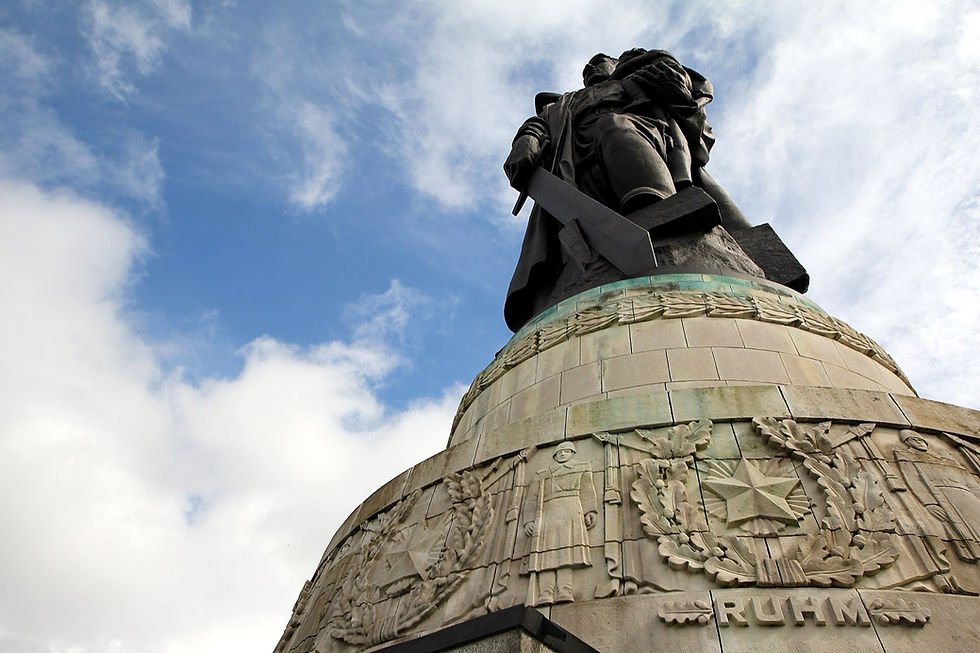
The Liberator (Der Befreier) stands 12 metres tall on the mausoleum mound, a rescued child in one arm and his sword resting on a broken swastika.
At the far end, on a mound, stands the Liberator (Der Befreier): a bronze soldier 12 metres tall and about 70 tonnes, with a rescued German child in one arm and his sword resting on a shattered swastika. Underneath his feet is a small domed hall. The child comes from an account of Sergeant Nikolai Masalov, said to have carried a German girl to safety during the fighting, which is why the conquering soldier is shown protecting a German child rather than in victory.
Climb the steps up the mound, then turn around. From up here you look straight back down the entire axis you just walked, past the sarcophagi and the flags to the tiny figure of the mother in the distance. That view back is the best in the park, and it is the moment the whole design clicks into place. If you like earning a view on foot, I have a longer list of the best views in Berlin you can reach on foot.
Make it a half day by the Spree
The memorial takes about 30 to 45 minutes to walk properly, but Treptower Park is worth the trip on its own, especially in summer. After the memorial, walk down to the Spree riverbank, where you can rent a small boat or cross the footbridge to the little Insel der Jugend island with its café. It is a genuinely relaxed spot to sit after something as heavy as the memorial.
Two nearby things are worth knowing about before you plan around them. The old Spreepark amusement park, in the neighbouring Plänterwald, is being completely rebuilt and is due to reopen in spring 2027, with construction-site tours running from April 2026 in the meantime, so you cannot just wander the famous abandoned rides. The Archenhold Observatory, once home to the longest movable refracting telescope in the world, is closed for renovation, so check ahead before making a special trip. You can confirm current details on the official visitBerlin and Berlin.de pages, and the Spreepark site for reopening news.
How it fits a Berlin trip
Treptower Park sits naturally at the end of an East Berlin day. It pairs well with the East Side Gallery, which is a short hop away along the Spree, or with a wider Cold War Berlin route. If the whole East and West question is still fuzzy, my plain-language guide to how Berlin was divided is a good primer to read on the train out.
On my own free walking tour I tell the divided-city story in the historic centre, where the Wall once cut the city in two, over about 2 hours. Treptower Park is the kind of place I point people toward for an afternoon of their own afterwards: it is too far east to fold into the walk, but it makes the story you heard in the centre feel real at full scale. Go on a clear day, walk it in order, and give it the quiet it asks for.
Image credits
Memorial axis: photo by Marek Śliwecki, CC BY-SA 4.0, via Wikimedia Commons.
Two red flags and kneeling soldiers: photo by Virtual-Pano, CC BY-SA 4.0, via Wikimedia Commons.
Mother Homeland statue: photo by Schwarz7201, CC BY-SA 4.0, via Wikimedia Commons.
Sarcophagus relief: photo by Skelanard, CC BY-SA 4.0, via Wikimedia Commons.
The Liberator statue: photo by Tim Rademacher, CC BY 4.0, via Wikimedia Commons.