Taking Photos in Berlin: Where the Rules Actually Change
There is a moment on Museum Island that I see almost every week. Someone walks up to the door with a camera bag over one shoulder and a small tripod strapped to a backpack, having planned this shot for months, and the person at the entrance points quietly at the cloakroom. Nothing has gone wrong. The rule was always there. It was just never written on the page they read.
Taking photos in Berlin is easy in the sense that almost nothing in the historic centre is off limits from the street. It gets complicated the moment you step through a door, because the rule then belongs to that building, that floor, and sometimes that single room.
My advice: stop asking whether Berlin allows photography and start asking who owns the floor you are standing on. That one shift answers almost every question you will have during a day in the centre.
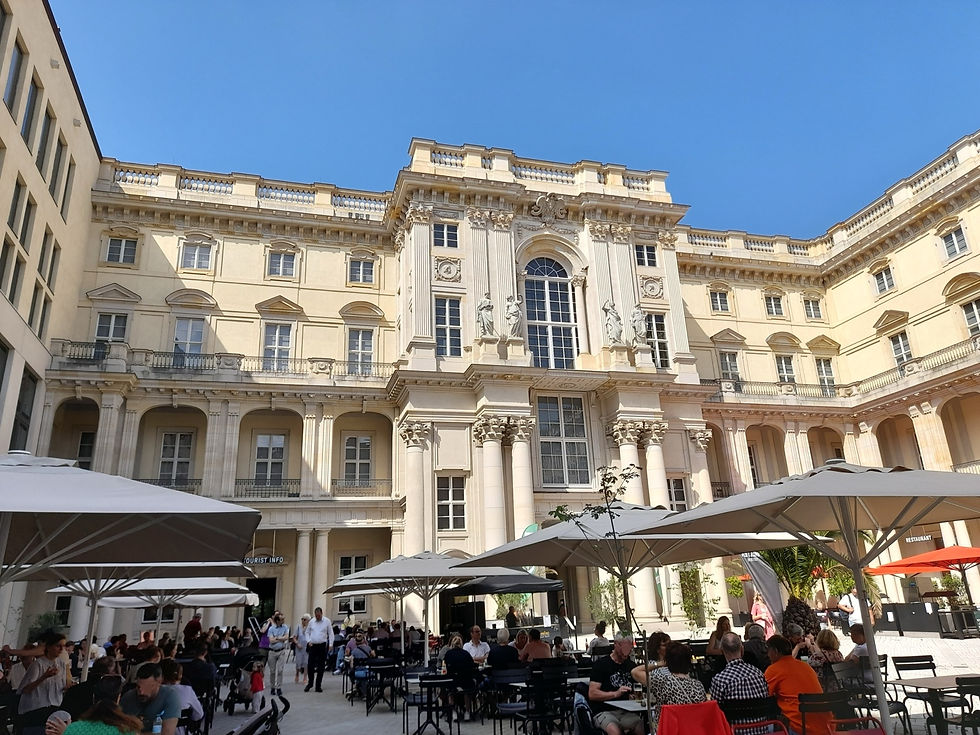
The Schlüterhof at the Humboldt Forum. Out here you may use a tripod and a flash. Two floors up, one exhibition bans photography completely.
Outside, the law is on your side
Start with the good news, because it covers most of a walking day.
German copyright law contains what is usually called panorama freedom. Section 59 of the Urheberrechtsgesetz permits you to reproduce, distribute and make available to the public works that are permanently located on public paths, roads or open spaces. For buildings, that permission covers the façade.
In plain terms: standing on the public pavement, you may photograph the Berliner Dom, the Rotes Rathaus, the Neptune Fountain, the World Clock, the Marx and Engels statues, the East Side Gallery and the Field of Stelae, and you may post those pictures. The permission is tied to the public ground you are standing on, so the safe reading is simple. Feet on the pavement, camera pointed outward, no problem.
That is why the entire route of my free walking tour, eleven stops and sixteen places across the historic centre in about two hours, is photographable from start to finish. Every complication in this article happens indoors.
Taking photos in Berlin gets strange inside the Humboldt Forum
If one building explains the whole problem, it is the Humboldt Forum on Schlossplatz. Its own published guidelines, approved by the foundation board on 8 August 2022, set four different rules inside one address.
The outdoor areas (the Schlüterhof, the Passage, the Spreeterrasse) allow photography for commercial and non-commercial purposes, and they explicitly allow tripods and flash.
The foyer, the staircases, the roof terrace and the foundation's own exhibitions allow private, non-commercial photography. Tripods are not permitted indoors, and objects on display are light-sensitive, so no flash.
The Ethnologisches Museum and the Museum für Asiatische Kunst on the second and third floors allow you to photograph for your own private use.
Two exhibitions on the first floor ban photography outright. In the Humboldt Lab "After Nature", all photography and filming is prohibited, private or commercial. In BERLIN GLOBAL, the Stadtmuseum exhibition, all photographic and film recordings are strictly prohibited for private and commercial purposes alike, because of third-party rights the museum does not control.
So you can shoot a tripod long exposure in the courtyard, walk in, climb to the roof terrace and shoot the view handheld, come back down to the first floor, and be told to put the phone away entirely. Same ticket, same building, same afternoon.
My advice: at the Humboldt Forum, treat the first floor as camera-off by default and everything else as camera-on. If you want the picture that people come here for, it is the roof terrace looking down Unter den Linden, and that one is allowed.
There is more on how the building works, and why it argues with itself, in my guide to the Humboldt Forum.

The great domed hall of the Bode-Museum. Private photography here is normal. What stops people at the door is usually the bag.
Museum Island: the cloakroom is the real checkpoint
The five houses on Museum Island and the rest of the Staatliche Museen zu Berlin share one set of museum regulations, ratified in July 2018 and in force since 1 November 2018. Read them once and the pattern is obvious. Private photography is not the thing they are worried about. Objects near delicate exhibits are.
What those regulations actually say:
Bulky or sharp objects must go to the cloakroom or a locker. The list names camera cases, tripods, umbrellas, and backpacks and bags larger than 30 x 20 x 10 cm. That is a small bag. A normal day rucksack is over the line.
Selfie sticks are prohibited, alongside laser pointers.
Only pencils may be used in the exhibition rooms, which catches sketchers more than photographers but is worth knowing.
Any commercial use of photographs or film taken in the museums needs written permission from the museum management board.
The management board may impose a general photography ban in particular exhibitions and rooms. This is the clause that matters most, because it means a temporary show can be camera-free even when the permanent collection beside it is not.
There is one more sentence that catches people out: storage is limited, and the museums cannot take anything bigger than carry-on luggage. If you have come straight from a station with a suitcase, the museum is not your first stop. My guide to luggage storage in Berlin covers where to leave it instead, and there is a fuller version of the bag question in Berlin museum bag rules.
My advice: pack the small bag on a museum day and leave the tripod in the room. On Museum Island a tripod buys you almost nothing anyway, because the rooms are bright and the crowds move.
The TV Tower turns your bag away, and there are no lockers
The Fernsehturm is the one place in the centre where the bag rule has real teeth, because there is no fallback.
The tower's own visitor information is blunt about all of it. Private photos are permitted. Tripods and drones are not. Security is airport-style, with a metal detector and a bag check for everyone. Suitcases, large bags and shopping bags may not go up, and a backpack has to fit inside 45 x 35 x 20 cm.
And then the line that undoes a lot of afternoons: there are no lockers. Prams have a free storage spot at the wardrobe, but bags do not. If your bag is too big, you are solving that problem out on Alexanderplatz with a timed ticket burning.
My advice: if the TV Tower is in the plan, make it the stop you carry least to. There is more on whether the ticket earns its price in my honest guide to the Berlin TV Tower.

The Field of Stelae is open day and night and free, and photography there is legal. That is a different question from whether a particular photograph belongs there.
At the memorials, legal and appropriate are two separate questions
The Memorial to the Murdered Jews of Europe sits between Brandenburg Gate and Potsdamer Platz. The Field of Stelae is open around the clock, admission is free, and 2,710 concrete stelae stand across just over 19,000 square metres. Photographing it from the surrounding streets and paths is exactly the panorama-freedom case described above.
The Information Centre underneath is a different space with its own conditions. It opens Tuesday to Sunday, 10:00 to 18:00, with last admission 45 minutes before closing and a full closure on Mondays. You enter through a security gate, and the foundation states plainly that suitcases and small bags may not be taken into the exhibition. Lockers are at Friedrichstraße and Potsdamer Platz stations, not on site. On its visitor page the foundation asks for appropriate behaviour in the exhibition, and leaves it at that.
I think that restraint is deliberate, and I read it the way it is meant. Nobody will stop you taking a picture among the stelae. The question the memorial puts to you is a different one, and each visitor answers it for themselves. What I say to my own groups is short: photograph the place, not a performance in it.
The same distinction applies at Sachsenhausen, at Hohenschönhausen and at the Stolpersteine in the pavement all over the city.
Drones: the honest answer for central Berlin is no
People ask me about this more than any other camera question, usually while looking at the river.
Germany maps its drone restrictions on one official platform, dipul, run under the Federal Ministry of Transport. It publishes the geographical zones defined in section 21h(3) of the Luftverkehrs-Ordnung. Four of those zones sit directly on top of the historic centre.
Government and authorities. Flying over, or within 100 metres of, property that houses constitutional bodies of the Federation or the states, top-level federal or state authorities, diplomatic missions and consular offices, or police and security authorities requires explicit consent from that body. Unter den Linden and the government quarter are lined with exactly these.
The river. Flying over, or within 100 metres of, federal waterways is restricted. The Berliner Spree and the Spreekanal, the two channels that make Museum Island an island, are listed as federal waterways in the annex to the Bundeswasserstraßengesetz. The classic drone shot of Museum Island is a flight over a federal waterway.
Roads and railways. The same 100-metre rule covers federal trunk roads and railway installations, which takes out most of what runs through the centre.
Residential property. Flying over residential property needs the owner's consent, with narrow exceptions.
Individual sites add their own bans on top. The TV Tower names drones explicitly.
My advice: leave the drone in the case for the centre. If it is already in your luggage, check the dipul map before you plan anything, and expect the honest answer to be that the good shot is also the illegal one. The view you actually want is available legally from the observation decks anyway.

A wide shot of a Berlin square with people crossing it is the ordinary case, and German law treats it as one. Close portraits of strangers are the case that changes.
Other people in your frame
This is the part of German picture law that surprises visitors, and it is worth two minutes.
Section 22 of the Kunsturhebergesetz says that portraits may only be distributed or publicly displayed with the consent of the person depicted. Notice what is being regulated. It is the publishing, not the pressing of the shutter.
Section 23 then lists the exceptions, and one of them covers most holiday photography: pictures in which the persons appear only as an incidental part of a landscape or other locality. A wide frame of Alexanderplatz with people crossing it falls there. So do images of assemblies and processions taken of people who were taking part. A final clause pulls it back where publication would harm a legitimate interest of the person.
My advice: the practical line is distance and intent. A square with people in it is fine. A stranger's face filling the frame, posted with a caption about them, is the case the law is written for. If you want the portrait, ask. Berlin is a city where people will usually say yes or say no clearly, which is one of the things I like about it. There is more on that directness in why Berliners are not rude.
What I would actually carry for a day in the centre
If you are walking the historic core and want pictures without friction, this is the kit that never causes a conversation:
A phone or a small camera, worn, not bagged.
A bag under 30 x 20 x 10 cm, so no museum cloakroom is needed.
No tripod, no selfie stick, no drone.
Everything larger left at your accommodation or in a station locker.
That covers Museum Island, the Humboldt Forum's open floors, the TV Tower, the memorials and every street in between.
My advice: check the sign at the door of each room before the first shot, because the sign beats anything you read online, including this article. Museums may impose a ban on a single exhibition at any time, and a temporary show is exactly where that happens.
If you want the historic centre explained while you photograph it, that is what I do. My walking tour runs about two hours through eleven stops and sixteen places, all of it outdoors and all of it in the easy category above.
Image credits
Source and licence details for the 4 photographs used in this article.
The view from the Humboldt Forum roof terrace over the Lustgarten, Altes Museum and Berliner Dom: A.Savin, Free Art License 1.3, via Wikimedia Commons.
The Schlüterhof courtyard at the Humboldt Forum: Aagnverglaser, CC BY-SA 4.0, via Wikimedia Commons.
The great domed hall of the Bode-Museum: Dosseman, CC BY-SA 4.0, via Wikimedia Commons.
People crossing Alexanderplatz with the Rotes Rathaus tower behind: Sami Mlouhi, CC BY-SA 4.0, via Wikimedia Commons.