St. Mary's Church: The Medieval Survivor in the Shadow of the TV Tower
- Yusuf Ucuz

- Feb 28
- 9 min read
Updated: Jul 1
Most visitors arrive at Alexanderplatz looking up.
That is natural. The TV Tower is designed to win the skyline. It is 368 metres high, visible from across the city, and impossible to ignore when you step out of the station.
But one of the most important buildings in this part of Berlin asks you to do the opposite.
Look lower.
Just beside the open space near the TV Tower stands St. Mary's Church, or Marienkirche: a medieval brick church that looks almost stranded in the modern city. It is not the biggest church in Berlin. It is not the most decorated from the outside. It does not shout for attention.
That is exactly why it matters.
St. Mary's Church is one of the clearest places to understand old Berlin, the vanished Marienviertel, the GDR redesign of the city centre, and the strange way Berlin layers 700 years of history in one view.
Where Is St. Mary's Church?
St. Mary's Church stands near Alexanderplatz, between the TV Tower, the Rotes Rathaus and the open Rathausforum.
If you are walking from the World Clock toward Museum Island, you pass very close to it. Many people photograph the TV Tower, cross the square and never really notice the church. That is a shame, because Marienkirche is not just a pretty old building.
It is one of the oldest surviving anchors of Berlin's historic centre.
Berlin.de's guide to the medieval trading center explains that Berlin and Cölln emerged as merchant settlements on both sides of the Spree by the end of the 12th century. Cölln is first documented in 1237, Berlin in 1244, and the first documentary reference to St. Mary's Church dates from 1292.
That date matters because it places the church inside Berlin's earliest urban story, long before Prussia, long before Brandenburg Gate became a symbol, long before the Wall, and very long before the TV Tower.
When you stand there, you are not simply looking at a church near Alexanderplatz.
You are looking at a survivor from the city before modern Berlin.

Why It Feels So Strange Today
The first thing to understand about St. Mary's Church is that its setting is misleading.
Today it stands in open space. There are broad paths, lawns, traffic, the TV Tower, the Neptune Fountain, the Rotes Rathaus and long sightlines. The church can look like a decorative monument placed in a park.
That was not the original city.
St. Mary's once stood inside the Marienviertel, a dense old quarter of streets, houses, courtyards, shops and everyday life. The church was not isolated. It was embedded in a neighborhood.
That difference changes everything.
A church inside a neighborhood feels like a centre. A church alone in open space feels like a survivor.
The open space around St. Mary's Church is the result of several layers of damage and planning. The area suffered in the Second World War. Some parts had already been affected by Nazi-era clearance plans. Then, in the late 1960s, GDR planners removed what remained of the old Marienviertel street pattern while creating a new socialist capital landscape around the TV Tower.
For that wider story, I wrote a separate guide to Berlin's lost neighborhood.
This is why the church feels so powerful to me.
It is not only old.
It shows what is missing.
A Medieval Church Beside a Socialist Skyline
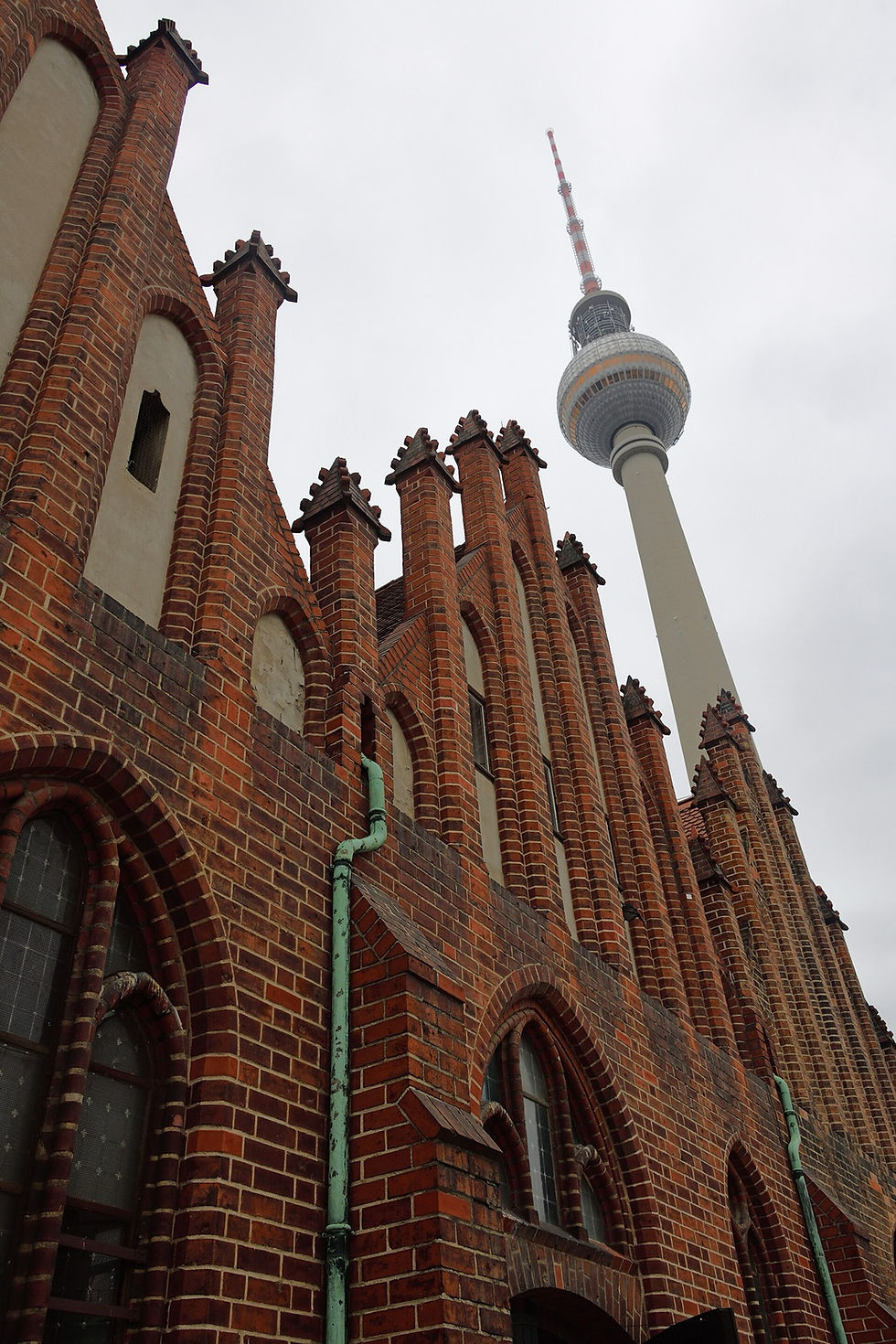
The famous view is the obvious one: red-brick church, sharp spire, huge silver TV Tower behind it.
It is one of the most Berlin views in Berlin.
The reason is not just visual contrast. The view compresses two political and architectural worlds into one frame. St. Mary's Church belongs to the medieval trading town. The TV Tower belongs to East Berlin's 1960s socialist city centre. They are separated by centuries, but today they stand almost beside each other.
That is not a normal old-town view.
In Prague or Krakow, a medieval church often sits inside a preserved old urban fabric. In Berlin, the medieval church sits in a landscape reshaped by war, ideology and postwar planning.
That makes the view less romantic, but more honest.
Berlin does not give you a sealed old town. It gives you fragments and contradictions.
St. Mary's Church is one of the best fragments.
For the TV Tower side of the story, read my guide to how the Berlin TV Tower was built. For the wider old-town question, see why Berlin does not have a beautiful old town.
What to Notice Outside
Start with the shape.
St. Mary's Church is a brick Gothic church, and that already tells you something about northern Germany. Medieval Berlin did not build in the same stone language as cathedral cities farther west or south. Brick was the practical material of this region, and it gives many old churches around the Baltic and northern German plain their strong red-brown character.
Then notice the tower.
The tower is what makes the church visible from a distance, but the building does not feel monumental in the imperial sense. It feels older, more urban and more practical. It belonged to a town of merchants and craftspeople before Berlin became a capital city.
The official VisitBerlin page for Marienkirche describes it as the oldest parish church in Berlin still in religious use. That wording is useful. Nikolaikirche is also medieval and is often described as Berlin's oldest church, but today it functions as a museum. St. Mary's is still an active church.
So when you look at it from outside, do not treat it only as an old object.
It is still part of the city.
That living role is easy to miss because the surroundings are so open and modern. But the church has not become a stage prop. It still holds services, concerts, visitors, memory and art.
What to See Inside
Inside, the most famous thing is the Totentanz, the Dance of Death.
VisitBerlin describes the fresco as more than 22 metres long and about 2 metres high, located in the tower area of the church. Various sources date it to around 1484, a year associated with a plague epidemic in Berlin.
That alone makes it one of the most remarkable medieval survivals in the city.
The Totentanz shows Death leading people from different social ranks in a final dance. Religious leaders, rulers, townspeople and ordinary people all face the same end. The message was simple and hard: nobody escapes.
The fresco is faint now. It sits behind protective glass. You should not expect a bright museum restoration. You should expect something more fragile and, in a way, more moving.
The official Marienkirche Totentanz page explains the church's own preservation focus around the fresco. The church's English visitor information also points visitors toward donations connected to preserving its art treasures, especially the Totentanz.
The point is simple: medieval Berlin is not guaranteed to survive. People keep choosing to protect it.
Inside the church, also look for the baroque pulpit associated with Andreas Schlüter, the high vaulting and the quieter feeling of the nave after Alexanderplatz. The contrast is strong. Outside, trams, traffic and the TV Tower dominate. Inside, the city suddenly slows down.

The Totentanz Is Not Just a Spooky Detail
The Dance of Death is easy to treat as a dark curiosity.
That sells it short.
The fresco matters because it gives Berlin a medieval voice. Most visitors meet Berlin through the 20th century: Hitler, the Wall, the Cold War, the fall of the Wall, reunification. Those stories are essential, but they can make Berlin feel younger than it is.
The Totentanz corrects that.
It reminds you that people were living, fearing, praying, trading and dying here long before Berlin became the symbolic city of modern Europe.
This is one reason I like St. Mary's Church so much. It does not compete with the TV Tower by being taller or louder. It wins by being deeper.
It takes the most modern-looking part of the old East Berlin centre and quietly says: the story began before all of this.
How the War and the GDR Changed the View
St. Mary's Church survived the 20th century, but the city around it did not survive in the same way.
The Second World War damaged central Berlin heavily. After the war, the historic centre lay in the Soviet sector, later East Berlin. The GDR did not simply rebuild the old street pattern around St. Mary's. It created a new representative centre, with broad spaces, major traffic routes and the TV Tower as a defining symbol.
That is why the church looks so exposed today.
It is not only that a modern tower was built nearby. It is that the old urban fabric around the church was removed. The scale changed. The relationship between building and street changed. A medieval parish church became a landmark in a socialist open space.
This does not make the area bad or uninteresting.
It makes it legible.
Once you understand the story, the empty space around St. Mary's stops looking accidental. It becomes evidence.
You are seeing not only a building that survived, but a neighborhood that did not.
How to Visit St. Mary's Church
St. Mary's Church is easy to visit because it sits right in the tourist centre.
The address listed by VisitBerlin is Karl-Liebknecht-Straße 8, close to Alexanderplatz, the TV Tower and the Rotes Rathaus. Entry is usually free, but it is an active church, so opening times can change for services, events, concerts or restoration work.
My practical advice is simple:
Do not rush past it on the way to the TV Tower. Give the church at least ten minutes.
Look at it from the outside first. Notice how isolated it feels in the open space.
Step inside and let your eyes adjust. The Totentanz is pale and needs patience.
Be respectful. This is a working church, not only a sightseeing stop.
Connect it with nearby places. The Rotes Rathaus, Nikolaiviertel, Neptune Fountain and Museum Island all help explain the same old centre.
If you only have time for one mental exercise, do this:
Stand outside the church and imagine the opposite of what you see now. Imagine narrow streets, houses close to the walls, shopfronts, courtyards and daily life around the church.
That imagined city is the key to understanding the real one.
Nearby Places That Complete the Story
St. Mary's Church makes most sense when you connect it to the surrounding landmarks.
The TV Tower: the GDR skyline marker that dominates the view.
Rotes Rathaus: Berlin's red-brick city hall, built in the 19th century but standing on older civic ground nearby.
Neptune Fountain: a palace-era fountain moved into the socialist city-centre landscape.
Nikolaiviertel: the reconstructed old-town quarter built by the GDR for Berlin's 750th anniversary in 1987.
Museum Island: the royal and museum layer of the city, a short walk away.
Liebknecht Bridge: one of the best places to see how the Spree, Museum Island, Humboldt Forum and TV Tower connect visually.
For more context, read Alexanderplatz then and now, Rotes Rathaus, Liebknecht Bridge, and my more focused guide to the Totentanz inside St. Mary's Church.
Why This Stop Matters on a Walking Tour
St. Mary's Church is not a place where the story announces itself.
That is why a guide helps.
If you walk past quickly, you see an old church near the TV Tower. If you stop and read the space, you see medieval Berlin, wartime loss, GDR planning, religious art, an erased neighborhood and one of the best visual contrasts in the city.
It also changes how you understand Alexanderplatz.
Alexanderplatz can feel chaotic, commercial and modern. St. Mary's Church proves that the area is older than it looks. The problem is not that old Berlin was never here. The problem is that old Berlin is hidden, fragmented and partly missing.
That is a much more interesting story.
What Not to Misunderstand
There are two common mistakes with St. Mary's Church.
The first is to treat it as a simple "old versus new" photo.
That photo is real, and it is beautiful. But the church is not only interesting because it looks small beside the TV Tower. It is interesting because the empty space around it records a huge urban change. The contrast is not just medieval church beside modern tower. It is medieval neighborhood erased, socialist capital planned, tourist city inherited.
The second mistake is to think the church survived unchanged.
No building in central Berlin has passed through the last 700 years untouched. St. Mary's has been repaired, restored, altered and reinterpreted many times. The point is not purity. The point is continuity. Even with all those changes, the church still anchors a piece of Berlin's medieval city that most visitors would otherwise miss.
That is a healthier way to read Berlin in general.
Do not look only for perfect originals. Look for survivors, fragments, scars and reused places. Berlin often explains itself through what remains after everything else changed.
See St. Mary's Church on My Berlin Walking Tour
St. Mary's Church is one of the places where my route slows down.
It helps connect the World Clock, the TV Tower, the lost Marienviertel, the Rotes Rathaus, Nikolaiviertel and the deeper medieval city under modern Alexanderplatz.
My free, tip-based Berlin walking tour starts near Alexanderplatz, covers 12 stops and takes about 2 hours, ending around Hackescher Markt.
If you want to understand why this quiet church matters so much, book your spot on my free walking tour here.
Main sources: Berlin.de guide to the medieval trading center, VisitBerlin's Marienkirche page, the official Marienkirche page on the Totentanz, and the church's English visitor information.