The Altes Museum: How One Building Made Berlin a Cultural Capital
- Yusuf Ucuz

- Mar 1
- 11 min read
Updated: Jun 15
If you stand in the Lustgarten and face the long row of columns, the Altes Museum can look almost too calm.
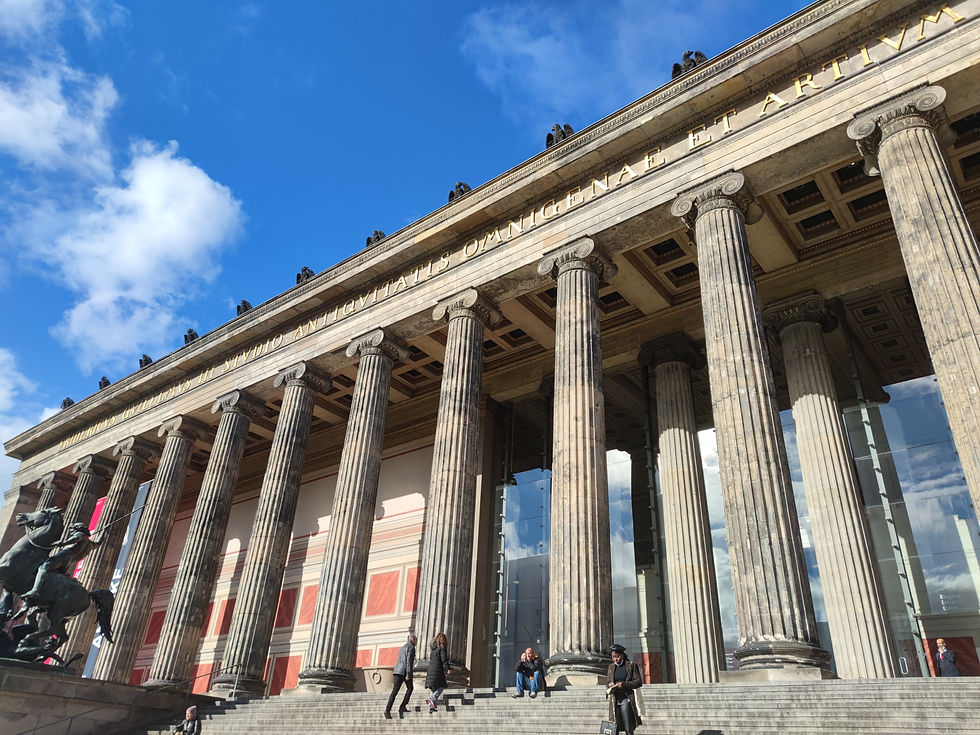
Eighteen Ionic columns. A wide staircase. A Latin inscription in gold. A rotunda hidden behind the facade. People sitting on the steps as if the whole building were simply a very elegant city bench.
But this was one of the most radical buildings Berlin ever put in public view.
When the Altes Museum opened in 1830, Berlin was not yet the museum capital visitors know today. Museum Island did not exist as a completed ensemble. The Pergamonmuseum, Bode-Museum and Alte Nationalgalerie were still future ideas. The city had palaces, churches, military buildings and royal collections, but it did not yet have a great public museum facing the people.
The Altes Museum changed that.
It took the language of temples and royal architecture and placed it in front of a public collection. It told Berliners that art, antiquity and education should have a monumental home in the centre of the city. That is why this building matters more than a quick photo suggests.
It is not just the "old museum." It is where Berlin started learning how to present itself as a cultural capital.
Where Is the Altes Museum?
The Altes Museum stands on Museum Island, directly on the north side of the Lustgarten. If you face it from the grass, the Berliner Dom is on your right, the rebuilt Berlin Palace and Humboldt Forum are behind you, and the Spree is only a short walk away.
This position is not accidental.
The official Museumsinsel Berlin page explains that the museum added art as a fourth element to a symbolic rectangle of power: politics at the Berlin Palace, military authority at the Armory, church authority at Berlin Cathedral and culture at the museum.
That is the key to reading the whole square.
The Altes Museum was not tucked away in a scholarly corner. It was placed beside royal and religious power, facing a public garden. Berlin was making culture visible in the same urban language as monarchy, army and church.
Today that can feel normal because Museum Island is famous. In 1830, it was a statement.
Schinkel's Big Idea
The architect was Karl Friedrich Schinkel, one of the central figures in Berlin architecture.
Schinkel did not design the Altes Museum as a neutral storage box for objects. He designed a public building with a clear civic message. The official Altes Museum profile calls it one of the most important buildings of the Neoclassical era and highlights the eighteen Ionic columns, the atrium, the sweeping staircase and the rotunda inspired by Rome's Pantheon.
That architectural language matters.
For centuries, grand architecture had usually served rulers, churches and aristocratic collections. The Altes Museum borrowed that grand language for a public museum. The building says: entering a museum is not a private favour from a court. It is a civic act.
The staircase makes you climb slowly. The columns make the entrance ceremonial. The rotunda creates a moment of pause before the galleries. Even if you never go inside, the facade tells you that art and antiquity deserve public seriousness.
That is why I like this building so much.
It looks restrained, but it is quietly democratic by Berlin standards of the time.
The Inscription Above the Columns
Look closely at the gold inscription across the portico.
The official profile translates its meaning as King Friedrich Wilhelm III dedicating the museum to the study of all antiquities and the free arts in 1828.
That date is useful because it shows the building's intellectual ambition before the museum opened to the public in 1830. This was not only a place for beautiful things. It was meant as a place of study, comparison and education.
That idea fits the Enlightenment mood behind the museum project. Berlin wanted royal collections to become more accessible and more systematic. Objects from antiquity were not only trophies. They were teaching tools for taste, history, architecture and civic identity.
Of course, it was still a royal Prussian project. It was not modern public culture in today's sense. Access, class, education and power all mattered.
But the direction had shifted.
The museum put learning in public view. That was a major step for Berlin.
Why the Columns Matter
The facade is famous for its 18 Ionic fluted columns.
They are not just decorative.
They turn the museum into a kind of secular temple. From the Lustgarten, the building looks less like an ordinary institution and more like a gateway into the ancient world. The columns prepare you for Greece and Rome before you see a single object inside.
Schinkel understood that a museum teaches through space as well as through labels.
The facade teaches first. It tells visitors to slow down, look up and enter a different mental mode. In a busy city, that is powerful.
There is also a practical Berlin detail: the steps have become part of everyday life. People sit there, eat snacks, wait for friends and check phones. I do not think that weakens the building. It proves the public idea worked.
The building is still monumental, but it is not sealed off from the city.
It belongs to Museum Island and to ordinary Berlin at the same time.

The Rotunda: Berlin's Pantheon Moment
The Altes Museum's most important interior surprise is the rotunda.
From outside, the building is a long rectangular temple front. Inside, the rotunda creates a circular, domed space explicitly linked to the Pantheon in Rome. The official profile points to the rotunda, surrounded by antique sculptures, as a place for collecting one's thoughts.
That phrase is important.
The rotunda is not just a dramatic room. It is a transition between the city and the collection. You leave the Lustgarten, climb the stairs, pass the columns and enter a space that slows the visit down.
In a good museum, architecture changes your pace.
The Altes Museum does that beautifully. It turns the visit into a small ritual without making it feel heavy. You do not need to be an architecture expert to sense it. Your body understands the message before your brain names it.
That is Schinkel at his best.
What Is Inside Today?
Today the Altes Museum houses the Antikensammlung, the Collection of Classical Antiquities.
The official Altes Museum home page describes the permanent exhibition as Ancient Worlds. Greeks, Etruscans and Romans. The collection page adds the practical breakdown: Greek art on the main floor, ancient coins from the Münzkabinett, and Etruscan and Roman art upstairs.
That means the museum fits its building very directly.
The exterior prepares you for classical antiquity. The galleries continue the theme with Greek vases, sculpture, ancient coins, Etruscan objects, Roman portraits and precious finds such as the Hildesheim silver.
The current official event description for Ancient highlights in the Altes Museum names highlights visitors may encounter, including the so-called Praying Boy, the Berlin Goddess, Athena, Zeus, Caesar and Cleopatra.
That gives you a useful visitor filter.
Do not enter expecting Nefertiti. That is the Neues Museum. Do not enter expecting the full Pergamon Altar. The Pergamonmuseum has its own long renovation story. The Altes Museum is about ancient Greek, Etruscan and Roman worlds in a building that itself performs a conversation with antiquity.
For the right visitor, that is exactly the charm.
Why It Made Berlin a Cultural Capital
The title of the old post was right about the big claim: one building really did help make Berlin a cultural capital.
Not alone, of course.
Berlin's museum landscape grew over generations. The Neues Museum followed, the Alte Nationalgalerie rose behind the colonnades, the Bode-Museum shaped the northern tip of the island and the Pergamonmuseum became the famous heavyweight of archaeology and ancient architecture.
But the Altes Museum was the first move.
It created the public museum axis that later buildings could extend. It turned the Lustgarten from palace foreground into museum foreground. It gave Berlin a model for using architecture, collection and urban planning as one statement.
This is why the building still matters even if you never buy a ticket.
Standing in front of it, you can see Berlin deciding to compete culturally with older European capitals. The message was not subtle: Berlin wanted to be taken seriously as a city of art, education and historical knowledge.
That ambition eventually became Museum Island.
The 19th-Century Setting Around It
Try to picture the Altes Museum before the later Museum Island ensemble was complete.
The Lustgarten was a central stage. The palace still stood nearby. The cathedral site carried religious weight. The Armory stood for military power. The museum faced all of it with a different kind of authority.
The public did not yet walk through a neat UNESCO museum quarter. They saw a new cultural building inserted into the heart of Prussian power.
That makes the Altes Museum a useful place to understand Berlin's old centre.
The building is not isolated architecture. It is part of an argument about what should stand at the centre of a capital. Palace, army, church and museum all compete in the same sightline.
Modern Berlin has changed the pieces. The palace is now the Humboldt Forum. The GDR left and removed its own palace layer. The Lustgarten became grass again after serving as parade and rally ground. The cathedral was rebuilt after war damage.
The Altes Museum sits there through all of it, holding the earliest museum idea in place.
World War II Nearly Ended the Building
The calm facade hides a brutal twentieth-century rupture.
The official Museumsinsel Berlin building page says the Altes Museum burned out almost completely shortly before the end of World War II. It was restored between 1958 and 1966.
That sentence is easy to read too quickly.
Burned out almost completely means this was not a lightly damaged old building with a few scars. The museum survived as an architectural shell that had to be brought back after fire, war, political division and changing museum priorities.
When you look at the clean columns today, remember that they are part of a recovery story.
Museum Island often looks older than its modern reconstruction history. That is one of its tricks. The buildings make continuity visible, but continuity here required repair, replacement and decisions about what Berlin wanted to remember.
The Altes Museum is a restored Neoclassical building, not a simple untouched survivor.

East Berlin, Reunification and the Return of Antiquity
After the war, the building stood in East Berlin.
The Museumsinsel page notes that up to reunification, the building served as a museum for contemporary art of the GDR. That is an odd but revealing chapter: a Neoclassical temple for antiquity became a socialist-era museum space in the divided city.
After reunification, the Collection of Classical Antiquities gradually moved back.
The same official page says the Antiquarium, the minor arts collection of the Antikensammlung, returned to the historical site in 1998 from separate locations in Charlottenburg and the Pergamonmuseum.
That is why the Altes Museum's modern identity feels like a return.
The building was designed around antiquity. War and division interrupted that purpose. Reunification and Museum Island planning helped reconnect the architecture with the collection.
Again, the story is not simply "old museum stays old." It is: old idea, violent interruption, political reuse, gradual return.
Berlin does this again and again.
What to Notice Outside
You can understand a lot without entering.
Start on the Lustgarten side and look for five things.
The 18 columns: they are the first lesson in the museum's classical language.
The wide staircase: it turns entry into a slow public ascent.
The inscription: it links the building to study, antiquity and the free arts.
The granite bowl in front: the huge 19th-century stone bowl connects the museum steps to Berlin's taste for engineering spectacle.
The sightlines: turn around and notice the Berliner Dom, Humboldt Forum and Lustgarten sharing one urban stage.
That last point is the most important.
The Altes Museum is not only a facade. It is one side of a city room.
If you want the wider square story, my guide to the Lustgarten explains how this peaceful lawn became palace garden, parade ground, Nazi rally site, GDR square and public park again.
Should You Go Inside?
Yes, but with the right expectation.
Go inside if you like architecture, ancient sculpture, Greek vases, Roman portraits, coins, quieter galleries and the feeling of being in Berlin's first museum building.
Skip it or save it for later if your only Museum Island priority is Nefertiti, large Egyptian galleries or the full Pergamonmuseum experience.
For many first-time visitors, I would rank the decision like this:
Architecture lover: definitely consider the Altes Museum.
Ancient Greece and Rome fan: yes, it is a natural fit.
One-hour casual tourist: enjoy the facade and Lustgarten, then choose carefully.
Nefertiti-focused visitor: go to the Neues Museum.
Big archaeology spectacle seeker: check current Pergamon-related options before planning.
The Altes Museum is not the loudest Museum Island attraction. That is part of its appeal.
It rewards visitors who like clear architecture, focused collections and a calmer museum rhythm.
Tickets, Hours and 2026 Visit Notes
Always check the official pages before visiting, because Berlin museum schedules change.
As of the current official listing I checked, the SMB exhibition page for Founded on Antiquity lists the Altes Museum ticket at EUR 14, reduced EUR 7. The same page lists the Museum Island ticket at EUR 24, reduced EUR 12.
The same official page lists opening hours as:
Monday closed
Tuesday to Friday: 10:00 to 17:00
Saturday and Sunday: 10:00 to 18:00
The Museumsportal Berlin listing shows the same regular pattern and adds public holiday exceptions such as 24 December and 31 December closures.
For most tourists, the practical question is whether to buy a single ticket or a Museum Island day ticket. If you plan only the Altes Museum, the single ticket is enough. If you want two or more Museum Island museums on the same day, the day ticket may make more sense, depending on your pace and current time-slot rules.
Do not overpack the day.
Museum Island looks compact on a map, but museum fatigue is real. Two serious museum visits can already feel full. Three is possible only if you are selective.
How the Altes Museum Fits a Walk Through Berlin
The Altes Museum is one of the best places to understand Berlin on foot because it explains the city before you enter any gallery.
From one spot in the Lustgarten, you can read several Berlin layers at once:
the old palace axis,
the Prussian museum idea,
the church and imperial cathedral layer,
the war and reconstruction layer,
the GDR use of central space,
the modern tourist city.
That is why I point people toward this area even when they are not planning a museum visit.
On my BerlinWalk route, the public story is usually about how Berlin's centre keeps rebuilding itself around missing pieces. Museum Island is perfect for that. It lets you see culture, power, damage and reconstruction in one compact place.
If you want nearby context, read the guides to Museum Island before and after WWII, the Neues Museum, the Alte Nationalgalerie, the Berliner Dom and Friedrichsbrücke.
Together, they make Museum Island feel less like a checklist and more like a story.
My Simple Recommendation
If you have never been to Berlin, do not treat the Altes Museum as only another museum option.
At minimum, stand in the Lustgarten for five minutes and read the building from outside. Notice the columns, the staircase, the inscription, the rotunda shape behind the facade and the way the building faces the city.
If the subject pulls you in, buy a ticket and give it proper time.
If your schedule is tight, the outside still gives you one of Berlin's clearest lessons: this city did not become a cultural capital by accident. It built that ambition in stone, placed it beside power and opened the doors to the public.
That is why the Altes Museum still works.
It does not shout.
It stands there and lets the whole idea of Museum Island begin.
Sources and Further Reading
See the Altes Museum in Context
The Altes Museum is easiest to understand on foot, because the building only makes full sense when you see the Lustgarten, Berliner Dom, Humboldt Forum and Museum Island together.
I connect these layers on my free tip-based Berlin walking tour from Alexanderplatz to Hackescher Markt. It runs about 2 hours, covers 12 stops, and helps you read central Berlin as a story of ambition, damage and rebuilding rather than as a list of sights.