Night Trains from Berlin: Six Places You Can Wake Up Tomorrow

Around eight in the evening, the lower platforms of Berlin Hauptbahnhof change character. The commuter crowd thins out, the departure boards start showing cities that belong to other countries, and a long train with curtained windows rolls in at track level minus two. People board it with pillows visible through the doors. At 20:11 it slides out towards Dresden, and the people on it wake up in Vienna or Budapest.
Berlin is one of the best-connected night-train cities in Europe right now, and most visitors have no idea. Six sleeper routes leave the city this season, two of them every single night, and this year the map changed twice: the Paris route swapped operators in March, and the Stockholm train changed hands literally today.
My advice: treat the night train as a free hotel night that also moves you 700 kilometres. But check the details before you build a plan on it, because the trains leave from two different stations, on different nights of the week, and one popular idea, the sleeper to Prague, is quietly a mistake. Everything below was checked on 1 September 2026.
Where the night trains from Berlin actually go
This season's board looks like this:
Vienna and Budapest: one EuroNight/Nightjet train, every night around 20:11 from Berlin Hbf, via Dresden and Prague. It splits during the night; you reach Wien Hbf at 07:00 or Budapest Nyugati at 08:29.
Basel and Zurich: the Nightjet at 20:48 from Berlin Hbf, every night, arriving Basel 07:21 and Zurich 09:05.
Paris: the European Sleeper at 17:25 from Berlin Gesundbrunnen on Monday, Wednesday and Friday, arriving Paris Nord 11:28 the next day.
Brussels and Amsterdam: the same operator's older train, 23:01 from Gesundbrunnen on Tuesday, Thursday and Sunday, reaching Amsterdam early morning and Brussels mid-morning.
Stockholm, the fast way: the RDC EuroNight at 18:39 from Berlin on Monday and Friday, into Stockholm at 09:45.
Stockholm, the cheap way: Snälltåget at 21:09 most nights, via Hamburg and Copenhagen, into Stockholm at 13:17.
There is no proper sleeper to Warsaw; the day EC trains cover that route in about five hours. And exact minutes shift with autumn trackwork, so read the final times off your actual booking.

The Paris night train at Berlin Hauptbahnhof in April 2026, a route that came back to life this spring.
The Paris train is back, but it leaves from Gesundbrunnen
The Paris story is the newest chapter. The ÖBB Nightjet that linked Berlin and Paris stopped running in December 2025 after France ended its funding for the route. For three months the map had a hole in it. Then the Dutch-Belgian startup European Sleeper picked the route up, and since 26 March 2026 the Paris night train runs again, three times a week, now calling at Hamburg on the way.
Here is the detail that catches people: both European Sleeper trains skip Hauptbahnhof and use Berlin Gesundbrunnen instead. Gesundbrunnen is a proper long-distance station on the Ringbahn, one S-Bahn stop from the northern centre, but it is smaller and quieter than people expect for an international departure, and if you stand under the big glass hall at Hauptbahnhof at 17:20 with a Paris ticket, you have already missed your train. Give yourself the extra fifteen minutes; my guide to Berlin's stations explains how the pieces fit together.
The 17:25 departure time also shapes your day. The Paris train is the one sleeper that costs you a Berlin evening, so plan a morning programme, collect your bags by mid-afternoon, and buy dinner before boarding. The Brussels and Amsterdam train is the opposite case: at 23:01 you keep the entire day and evening, which makes it the most tourist-friendly departure on the whole board.

Leaving Berlin at dusk: the Paris sleeper crossing the city as the Budapest Nightjet passes in the other direction.
Vienna, Budapest, and the Prague trap
The workhorse of the Berlin night network is the 20:11 train from Hauptbahnhof. It looks like one train and behaves like two: during the night it splits, one portion running as a Nightjet to Vienna, arriving 07:00, the other as the Hungarian EuroNight to Budapest, arriving 08:29. It runs every night of the year, with proper sleeping cars, couchettes and seats, and booked a couple of months ahead it is startlingly cheap: couchettes from about 59 euro, a bed in a two-person sleeper from about 99 euro.
Now the trap. This train runs via Dresden and Prague, and every week someone books it as a comfortable way to reach Prague. It passes Prague at around half past midnight. You pay for a bed and get woken three and a half hours into the night, in the dark, at the wrong end of the city. For Prague, take a normal day EC train, watch the Elbe valley from the window, and arrive at a human hour. Save the sleeper for the cities where the arrival time is the whole point: Vienna at 07:00 means coffee near Stephansplatz before the museums open.

The morning payoff: stepping off the Nightjet at Wien Hauptbahnhof with the whole day ahead.
Two ways to Stockholm, and one changed hands today
Stockholm is the surprise on the board: Berlin has two competing night trains to Sweden, and they solve different problems.
The RDC EuroNight is the fast one. It leaves Berlin at 18:39 on Monday and Friday and puts you in Stockholm at 09:45, a real working-morning arrival. This is the former SJ train, and the reason I say "checked today" out loud: the Swedish state railway withdrew when its funding ended, and the German operator RDC took the service over commercially on 1 September 2026, exactly today, selling tickets at nachtexpress.de. Only two Berlin departures a week means this train dictates your itinerary; fix the Monday or Friday night first and build the rest of the trip around it. The Wednesday run starts in Hamburg instead of Berlin.
Snälltåget is the relaxed one. It leaves Berlin Hbf at 21:09 most nights except Saturday, rolls through Hamburg and Copenhagen, and arrives in Stockholm at 13:17 the next day. You lose half a day of Stockholm and save real money: seats start at 499 SEK, and there are private-compartment deals from about 1,999 SEK for two. It runs on this rhythm until early November, thins out in the winter timetable, and pauses completely from early January until after Easter.
Pick where you want to wake up on the board below. It shows which nights each train runs this week, when it leaves, and how your night maps out hour by hour:
Beds, prices, and when to book
A night train sells the same journey at very different comfort levels, and the vocabulary is worth thirty seconds:
Seats are the cheapest way and the hardest night. Fine for one determined budget traveller, rough for two, a mistake for the 18-hour Paris ride.
Couchettes are flat bunks in a shared compartment of four to six, with blanket and pillow. This is the sweet spot for most visitors: from about 59 to 69 euro on the Budapest train when booked early.
Sleepers are real beds in compartments of one to three, with a washbasin, breakfast included on the Austrian trains, and on the newest Nightjet cars private mini cabins and compartments with their own shower.
Three booking rules carry the whole topic. First, book two to three months ahead if you can: Nightjet and EuroNight fares open about six months out and climb like airfares, and European Sleeper's compartments genuinely sell out. Second, book on the operator's own site or at bahn.de, and check which Berlin station is printed on the ticket. Third, know what your existing tickets do NOT cover: the Deutschlandticket is worthless on every train in this article, and an Interrail pass still needs a paid berth reservation for each night train, so the pass alone does not put you on board.
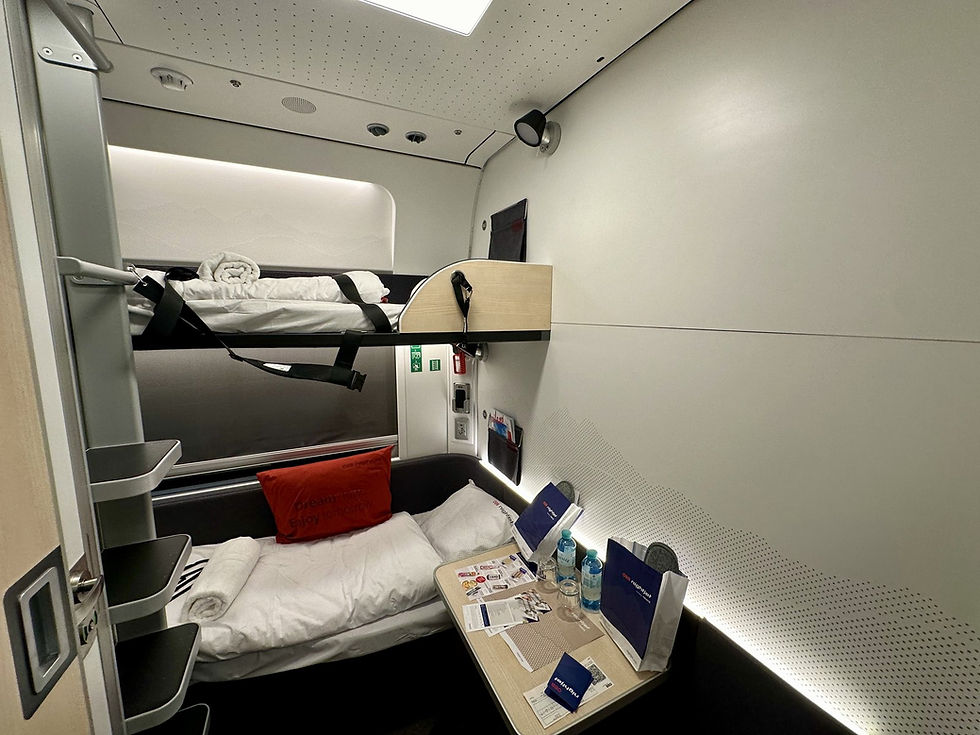
A sleeper cabin on the newest generation of Nightjet cars: a real bed, and breakfast before Zurich.
How to spend the last Berlin day before a night train
The night train gives you something a morning flight steals: a complete final day in Berlin. Nearly every departure on the board leaves after 18:30, so the shape of a good last day is simple.
Check out in the morning and deal with the bags first. Hauptbahnhof and Gesundbrunnen both have lockers, and my luggage storage guide lists the fallbacks for the days when the station lockers are full. Then spend the day in the historic centre with your hands free. I walk that ground on my free tour, about 2 hours from the World Clock at Alexanderplatz to Hackescher Markt, and it fits a departure day well: you can check the calendar and book a spot, or follow the same line on your own with the route story map. Either way you end at Hackescher Markt in the late afternoon, one S-Bahn ride from either departure station.
Then eat before you board. Dinner on board ranges from a decent Austrian menu to a minibar basket depending on the train, and the area around Hackescher Markt feeds you far better for less. Collect the bags, be at the platform twenty minutes early, and let the train do the hotel's job.
One simple move to close: pick the city you want to wake up in, then let that train's timetable choose your Berlin dates, especially for Stockholm and Paris where the train only runs three nights a week. That order of decisions is the difference between a sleeper trip that feels effortless and one that fights you.

The Snälltåget from Berlin pausing in Hamburg on its way north to Malmö and Stockholm.
Image credits
Source and licence details for the 5 photographs used in this article.
The European Sleeper night train to Paris at Berlin Hauptbahnhof: Bvcmz248.5, CC0 1.0, via Wikimedia Commons.
Evening view from the Paris sleeper as it meets the Budapest Nightjet on the Berlin Stadtbahn: Bvcmz248.5, CC0 1.0, via Wikimedia Commons.
A Nightjet train at the platform at Wien Hauptbahnhof: abbilder, CC BY 2.0, via Wikimedia Commons.
A sleeping cabin on the newest generation of Nightjet cars: TheFrog001, CC0 1.0, via Wikimedia Commons.
The Snälltåget night train from Berlin to Stockholm at Hamburg Hauptbahnhof: Bvcmz248.5, CC0 1.0, via Wikimedia Commons.