How to Order at a Berlin Bakery: The German Words and Habits That Get You Served
There is a specific moment that catches almost every visitor in Berlin. You walk into a warm Bäckerei on your first morning, the case is full of golden rolls and glazed pastries, and then someone behind the glass looks straight at you and says "Der Nächste, bitte!" Your turn. And suddenly you have no idea what any of it is called, whether you pay now or later, or why the person next to you just said a word that is not in any phrasebook.
I have watched this happen more times than I can count, usually right before my walking tour when people grab a quick breakfast near Alexanderplatz. The good news: a German bakery order is short, it follows the same pattern every single time, and you only really need one sentence to get through it. Learn the shape of the exchange once and the counter stops being intimidating for the rest of your trip.

The glass case does most of the work. If a word deserts you, you can always point at what you want.
Where you will actually be standing
Berlin has two kinds of bakery, and knowing which one you walked into changes how you order.
The first is the traditional counter Bäckerei: someone serves you from behind a glass case, you say what you want, and they hand it over. The second is the chain or self-service style, names like Kamps, Back-Factory or the bakery counter inside a supermarket, where you sometimes take a tray and tongs and help yourself before paying at a till. In Mitte you will often find both styles close together. The counter version is where the German matters, so that is the one worth rehearsing.

A classic Berlin corner Bäckerei with a café. The blackboard usually lists the day's specials in German only.
One habit to get right before you say anything about bread: greet first. A quick "Hallo" or, before midday, "Guten Morgen" is the normal courteous start. Walking up and launching straight into an order can read as abrupt here. It costs you one word and it changes the whole tone of the exchange.
The words for what is in the case
You do not need the full German bakery dictionary. You need the six or seven things you are most likely to want, plus one Berlin quirk that trips up even people who studied German at school.
Start with the plain bread roll. Across Germany it is a Brötchen. In Berlin, locals call the same thing a Schrippe, a proper piece of Berlin dialect that you will see on price labels and hear from the person in front of you. Both work at the counter, but if you want to sound like you have been here a while, ask for a Schrippe.

Brötchen, or Schrippen in Berlin. Sesame, poppy seed and multigrain versions usually cost a few cents more than the plain one.
Now the quirk. The round, sugar-dusted, jam-filled doughnut that the rest of Germany calls a Berliner is, in Berlin, simply a Pfannkuchen (the same pastry, different regional name). Ask for "einen Berliner" here and you will get a small, knowing smile before they hand you exactly what you meant. If you want it with no confusion at all, say Pfannkuchen. (Yes, this is the pastry behind the old JFK "I am a jelly doughnut" story, which I get into in the Ich bin ein Berliner myth post.)

In Berlin this is a Pfannkuchen, not a Berliner. The jam sits in the middle; the sugar goes on top.
Then there is the lye-baked family, the Laugengebäck: the classic pretzel (Brezel) and the softer, easier-to-eat Laugenstange, a salted stick that is my usual pick when I want something savoury on the move. A belegtes Brötchen is a roll already filled at the counter with cheese, ham, egg or salami, which makes it the fastest real meal in the case. And the swirled, buttery, cinnamon Franzbrötchen is a Hamburg import that has quietly taken over Berlin bakeries and is worth trying once.

The Laugengebäck family: pretzels and salted lye sticks, best eaten the same morning they are baked.

A belegtes Brötchen is a filled roll made up at the counter. Point at the filling you want if you are not sure of the word.
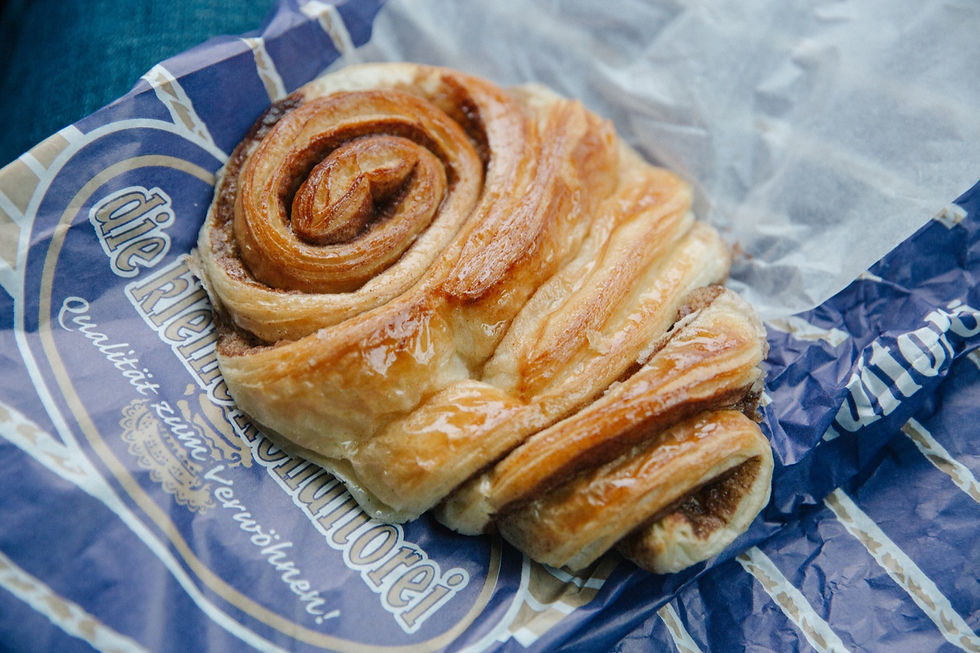
The Franzbrötchen: caramelised, cinnamon-scented, and better warm. A good "I have no idea what to pick" choice.
How to order at a Berlin bakery, one sentence at a time
Here is the whole thing. Every counter order opens with the same three words:
"Ich hätte gern..." (ish HET-uh gairn), which means "I would like...". Then you name what you want, and finish with "bitte" (please).
So a full order sounds like: "Ich hätte gern eine Schrippe und einen Pfannkuchen, bitte." That is it. You do not need perfect grammar, and nobody expects an accent. If you can say those three opening words and point at the rest, you will be served.
The widget below lets you build a real order and hear the shape of it before you are standing in a queue with people behind you. Tap what you want, and it writes the correct German sentence for you, then walks you through the two or three questions the counter will ask back.
The questions they will ask back
This is the part that surprises people. You say your line, and then the person behind the counter asks you something, and the pressure jumps. Most replies fit one of these three questions:
"Noch etwas?" or "Sonst noch etwas?" means "Anything else?" Answer with "Nein, danke, das ist alles" (no thanks, that is everything), or just name the next thing.
"Zum Hieressen oder zum Mitnehmen?" means "To eat in or take away?" You will hear this the moment the bakery has tables. Say "zum Mitnehmen" (to take away) or "zum Hieressen" (to eat in). Take-away sometimes changes the price slightly, and in a sit-down café it can mean a plate versus a paper bag.
"Bar oder Karte?" means "Cash or card?" Answer "Karte" or "bar".
That last one matters more than you would think. Some small bakeries in Berlin are still cash-only or set a card minimum. Many chains and café-bakeries take cards, but payment still varies by branch. Glance for a card symbol on the door or the till before you commit, and keep a little cash as a backup. If you want the wider picture on paying in the city, I wrote a full guide to using cards and cash in Berlin.
If your German runs out mid-sentence
It will happen, and it is completely fine. The bakery counter is the most forgiving place in Berlin to fumble a few words, because the whole transaction is standing right there in the glass.
My advice: when the sentence deserts you, stop fighting it and point. "Einmal das, bitte" (EYE-mal das, "one of those, please") while pointing at what you want will get you served anywhere in the city. Add "und einen Kaffee" if you want coffee with it. You lose nothing by keeping it simple, and you will still have used more German than most visitors ever try.
If you want a couple more everyday phrases for cafés and restaurants, the Berlin restaurant phrases guide and the piece on reading a German menu without panicking both pick up where this one stops. For the coffee side of the counter, Kaffee versus coffee explains what you actually get when you order.
A good first stop before the tour
A bakery is the easiest soft landing into Berlin. You practise a real exchange, you get a cheap breakfast, and you are standing in a normal neighbourhood scene rather than a tourist trap. I often suggest people grab a Schrippe or a Pfannkuchen near Alexanderplatz before my free walking tour starts, so the first German word of the day is already behind them. If you want to know where locals actually eat their first meal, the breakfast in Berlin guide is the companion to this one.
Order once, get it slightly wrong, and by day two the counter feels routine. That is the whole trick.
Image credits
Source and licence details for the 7 photographs used in this article.
Bakery counter display in Berlin: Chemipanda, CC0 1.0, via Wikimedia Commons.
Basket of fresh Brötchen: 3268zauber, CC BY-SA 3.0, via Wikimedia Commons.
Berliner Pfannkuchen, whole and cut: Sebastian Koppehel, CC BY 4.0, via Wikimedia Commons.
Pretzels and Laugengebäck on a board: Sundar1, CC BY-SA 3.0, via Wikimedia Commons.
Bäckerei and café in Berlin-Kreuzberg: JoachimKohler-HB, CC BY-SA 4.0, via Wikimedia Commons.
Belegte Brötchen, filled rolls: Benjamin Jopen, CC BY-SA 2.0, via Wikimedia Commons.
Franzbrötchen cinnamon pastry: Ben Meyer, CC BY-SA 4.0, via Wikimedia Commons.