Holocaust Memorial Berlin: How to Visit Respectfully and What to Know

The Holocaust Memorial Berlin is one of those places many visitors reach too quickly. You leave Brandenburg Gate, cross a street, see the first grey blocks, and it can look like an outdoor photo stop before you have understood where you are.
My advice: do not treat it as a shortcut between sights. The official name is the Memorial to the Murdered Jews of Europe, and that name matters. Give the field a few quiet minutes first, then decide whether you have enough attention for the underground Information Centre.

The Holocaust Memorial Berlin is open from the street, but it deserves more than a quick crossing.
Holocaust Memorial Berlin: first understand what you are visiting
The Memorial to the Murdered Jews of Europe is Germany's central Holocaust memorial. It sits in the middle of Berlin, just south of Brandenburg Gate, with a field of concrete stelae designed by Peter Eisenman and an underground Information Centre below the site.
The official foundation page describes the place as a memorial for the up to six million Jewish victims of the Holocaust. That is why I would use the full name at least once in your mind before you walk in. `Holocaust Memorial Berlin` is the search term most tourists use; the real title tells you what the place is trying to hold.
The field is free and accessible at all times. The Information Centre is also free, but it has opening hours, security checks and a much heavier exhibition. As of 4 July 2026, the Stiftung Denkmal reopening note says the Information Centre is open again after renovation, with regular hours Tuesday to Sunday, 10:00 to 18:00. Always check the official Information Centre page on the day, because last admission and closure days matter.
Do not judge the memorial from the edge
From the street, the stelae can look almost too simple. Grey blocks, straight paths, open sky. That first impression is misleading.
Walk slowly into the field and the ground changes. The blocks become taller, the city sound drops away, and the straight lines begin to feel less stable than they looked from outside. You do not need to invent a single meaning for it. The memorial is abstract on purpose. The useful thing is to give yourself enough time to feel how the space changes.
My rule is simple: if you only have 10 minutes, walk in quietly and leave without pretending you have done the whole site. If you have 45 to 90 minutes, add the Information Centre.
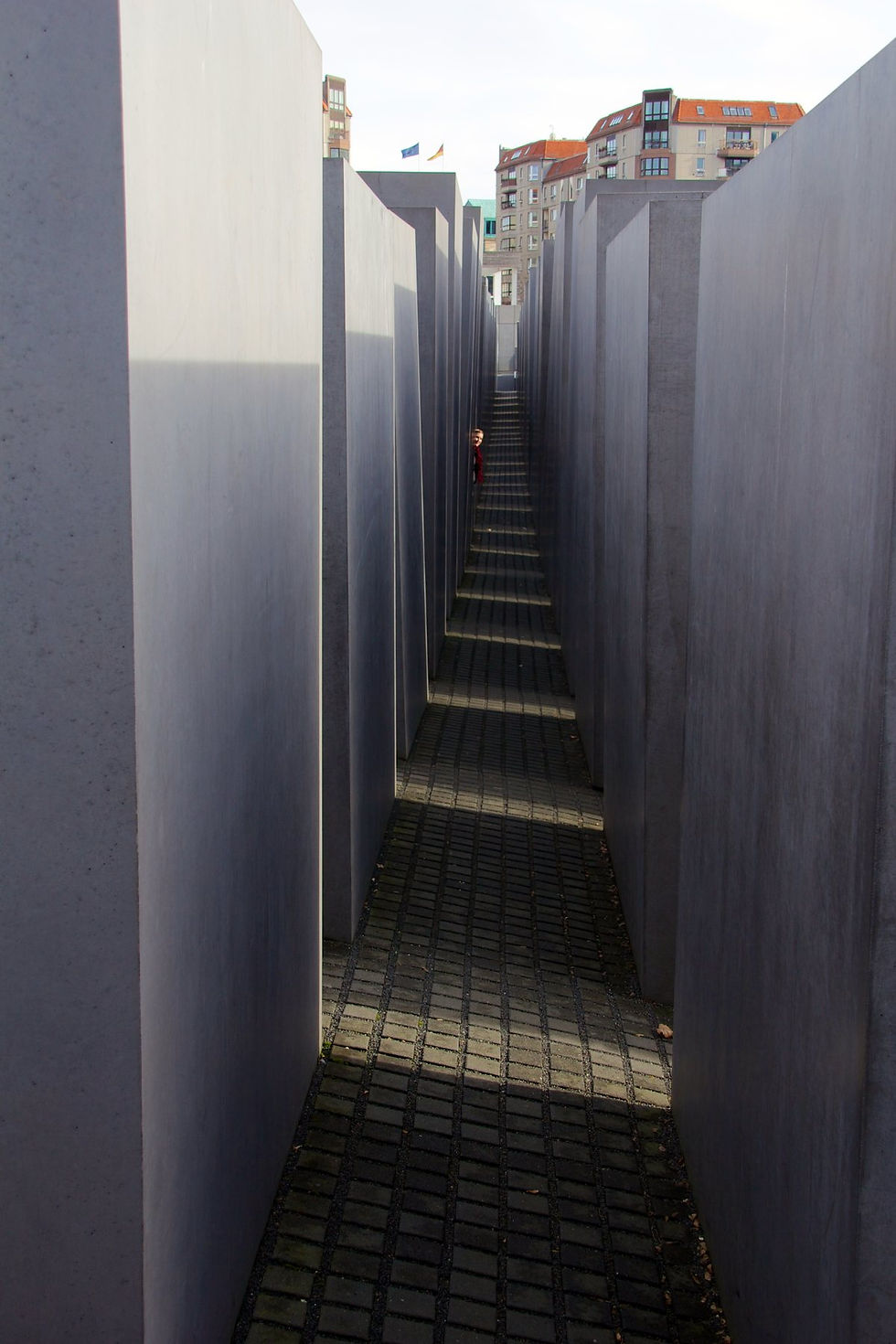
The memorial changes once you are inside it. The city feels much farther away than it looked from the pavement.
How long you need
For the Field of Stelae only, 20 to 30 minutes is a good first visit. That gives you time to enter from one side, move into the deeper part, pause, and come out without rushing.
For the field plus the Information Centre, plan at least 75 to 90 minutes. The foundation recommends about one hour for the exhibition, or around 90 minutes if you use the audio guide. That does not include possible waiting time at security.
I would not squeeze the Information Centre into a packed sightseeing hour between a Reichstag dome slot and a lunch reservation. It is not hard because of logistics. It is hard because the exhibition gives names, families, letters, rooms and places to a history that the field leaves abstract.
If your day already includes Sachsenhausen from Berlin or a long visit to Topography of Terror, be careful. Technically you can stack these sites. In practice, you may understand less because you are moving from one heavy place to another without room to think.
Etiquette: the simple rule is slow and quiet
The official visitor rules for the Field of Stelae are direct: cross it on foot and slowly. Do not make noise, do not jump from stele to stele, do not bring pets, do not store bikes or equipment there, and do not smoke or drink alcohol in the field.
That is not just a rule list. It is the mood of the place.
Photos are possible in the field, but use judgment. A wide image of the stelae is different from climbing, posing, dancing or treating the memorial like a maze made for content. I have seen visitors make that mistake before, and it changes the whole space around them.
My advice: take one respectful photo if you need it, then put the phone away. The best memory of this place is usually not the picture.

From the edge, the site can look like part of the city grid. Inside, the mood changes quickly.
The Information Centre is where the names return
The underground Information Centre is the part many visitors miss because it is less visible than the field. Do not miss it if you have the time and attention.
The exhibition explains the persecution and murder of European Jews through rooms focused on dimensions, families, names and places. It is not a big museum in the normal tourist sense. It is compact, but dense.
The practical details matter. Entrance is free. There is a security check. Large bags and suitcases are not allowed inside; the foundation notes that luggage lockers are nearby at Potsdamer Platz, Friedrichstraße and Hauptbahnhof. The official FAQ also says phones should be turned off inside the exhibition out of consideration for other visitors.
For families, the foundation recommends the exhibition for young people from 14. That is useful to know. The field itself is public space, but the exhibition is not light background history.

A slow walk gives the memorial human scale without turning it into a normal sightseeing stop.
Accessibility and arrival
The easiest public transport stop is usually S+U Brandenburger Tor. From there, it is a short walk south. Buses around Behrenstraße, Wilhelmstraße and Ebertstraße can also be useful depending on where you are coming from.
The Field of Stelae can be crossed by wheelchair on marked corridors. The foundation lists 13 marked axes with suitable access and notes that the Information Centre has lift access with staff support. If this matters for your visit, check the official accessibility details before you go and speak to staff at the entrance stairs for the lift.
The surface can feel uneven even if you are walking without mobility concerns. Wear normal shoes, move slowly, and do not make this the part of the day where you rush to a timed booking.
What to combine it with
The memorial sits in one of Berlin's densest sightseeing areas. That is convenient, but it also creates a planning problem: visitors try to turn everything around Brandenburg Gate into one quick loop.
The better route depends on your attention, not only the map.
If you want a light nearby pairing, combine the field with Brandenburg Gate and a short walk through Tiergarten. If you want political context, add the Reichstag area, but remember that the Reichstag dome needs advance registration through the Bundestag system.
If you want deeper Nazi-era documentation, pair the Information Centre with Topography of Terror on a separate half day, not as a rushed checklist. If you are heading east along Unter den Linden, save room for Bebelplatz and the Bebelplatz book-burning memorial, but do not force every memorial into one afternoon.

Brandenburg Gate is next door, but the mood changes sharply when you walk south into the memorial field.
Map and directions
The Holocaust Memorial Berlin is easiest to find from Brandenburg Gate, but the entrances are open from several sides. Use the map first, then open the direction that matches where you are actually standing.
Open directions: from Brandenburg Gate · from Reichstag · from Potsdamer Platz.
If you are visiting before or after my walking tour
My BerlinWalk tour starts at Alexanderplatz and lasts about 2 hours. The core route explains old Berlin, Museum Island, Prussian power, GDR planning and the shape of the historic centre. The Holocaust Memorial is not on that exact core route, but it pairs naturally with the western end of Unter den Linden, Brandenburg Gate and the Reichstag area.
My advice: if you come before the tour, do not arrive emotionally overloaded. A quiet walk through the field is fine. The full Information Centre may be better after the tour or on another day, when you can give it proper attention.
If you come after the tour, walk west from Museum Island through Unter den Linden only if you still have room for a serious stop. Berlin rewards slow understanding more than box-ticking.

Tiergarten also holds other memorials to victims of National Socialism. Do not turn them into a checklist; choose what you can actually absorb.
The plan I would use
If this is your first time in Berlin, I would keep it simple.
Go to Brandenburg Gate first if you need the orientation. Then walk south to the Field of Stelae. Put the phone away for a few minutes. Cross slowly. If you have enough time and mental room, enter the Information Centre and let the exhibition give names and places to the abstract field above.
Then stop. Do not immediately chase the next heavy site just because it is close. Get air, walk through Tiergarten, or sit near the edge of the city for a moment. That pause is part of a better Holocaust Memorial Berlin visit.
Image Credits
Images by Superchilum, Mike Peel, Dietmar Rabich and User:(WT-shared) Jolove55 via Wikimedia Commons. Licenses: CC BY-SA 4.0 and public domain.