Bebelplatz Berlin: Book-Burning Memorial, Empty Library and What Tourists Miss

Most people reach Bebelplatz Berlin while walking Unter den Linden. They see the State Opera, the cathedral dome, the university buildings and the open square. Then the most important thing is easy to miss because it is under their feet.
That is the reason I would not treat Bebelplatz as a quick photo stop. Give it a few quiet minutes. Look down first, then look around. The square is beautiful, but the memory here is not decorative.

Bebelplatz looks formal and calm from the edge of the square, which is exactly why the memorial is easy to miss on a fast walk.
What to know before you stop at Bebelplatz
Bebelplatz Berlin is a central square just off Unter den Linden, between Museum Island and Brandenburg Gate. It is surrounded by the State Opera, St. Hedwig's Cathedral, Humboldt University buildings and the Old Library facade.
The reason tourists should stop here is the memorial to the Nazi book burning of 10 May 1933. Berlin.de describes the event as the burning of more than 20,000 books on this square, in front of an audience. The authors targeted included Heinrich Heine, Erich Kästner, Thomas and Heinrich Mann, Lion Feuchtwanger, Karl Marx and Else Lasker-Schüler.
The memorial is called the Empty Library. It was created by Micha Ullman and unveiled in 1995. You see it through a glass panel in the paving stones: a white room below ground with empty shelves, symbolically sized for around 20,000 books.
First, look down for the Empty Library
The mistake I see visitors make at Bebelplatz is simple: they arrive from Unter den Linden, photograph the buildings, then leave without finding the memorial. The Empty Library is not a statue. It does not rise above the square. It asks you to notice the ground.
Find the glass panel near the middle of the square. Stand close enough that you can see the white shelves below the pavement. In bright daylight, reflections can make it harder to see inside, so shift your angle instead of giving up after one glance.

The Empty Library sits below street level, so the most important part of Bebelplatz is visible only when you slow down and look through the glass.
Do not rush this part. The memorial works because the shelves are empty. It does not show fire, crowds or spectacle. It shows absence. That makes it quieter than many Berlin memorials, but not lighter.
If you are using Bebelplatz as part of a longer walk, pair it with my Unter den Linden Berlin guide. The boulevard is useful only when you read the stops, not when you treat it as a pretty road between two famous points.
What happened here on 10 May 1933
On 10 May 1933, Nazi students and professors burned books on this square, then known as Opernplatz. The target was not only paper. It was public intimidation: writers, ideas, political opponents and Jewish voices were marked as enemies in the centre of the city.
VisitBerlin notes that the book burning followed blacklists and that Erich Kästner watched his own books being burned while standing unrecognized in the crowd. That detail matters because it makes the scene less abstract. This was not a distant battlefield. It was a public ritual in a cultural square.
There is also a plaque near the memorial with Heinrich Heine's warning that where books are burned, people will be burned in the end too. I would read it there, on the square, rather than turning it into a slogan before you arrive.

The plaque gives words to the warning, but the empty shelves below the square carry the strongest visual weight.
This is where Berlin's surface can mislead you. Bebelplatz is elegant. The opera house and cathedral make it feel official, polished and safe. But the memorial forces the opposite reading: culture can be used as a stage for exclusion if people let it.
Read the square around the memorial
After you have found the memorial, turn slowly and read the edges of the square. The State Opera faces one side. St. Hedwig's Cathedral stands nearby. Humboldt University buildings connect the square to the intellectual world around Unter den Linden. The Old Library facade adds another layer of symbolism, even if most interiors around the square were rebuilt or modernized after wartime damage.

The Old Library facade helps explain why this square feels so formal before the history turns darker.
Berlin.de points out that the area goes back to Frederick the Great's Forum Fridericianum plan in the 18th century. That is useful context, but for a visitor the practical move is easier: do not separate the architecture from the memory. Look at the institutions around you, then look back down into the empty room.
This is also why Bebelplatz is a good route stop after Museum Island or before Brandenburg Gate. It sits between power, culture and memory. If you only have one central Berlin walk, it helps you understand how close those layers are.
How long to spend at Bebelplatz
For most tourists, 15 to 25 minutes is enough if you use the time well. That means:
Look down into the Empty Library. Read the plaque. Walk one slow loop around the square. Notice the State Opera, St. Hedwig's Cathedral, Humboldt University and the Old Library facade. Then decide whether your next move is Museum Island, Brandenburg Gate, Gendarmenmarkt or a longer Unter den Linden walk.
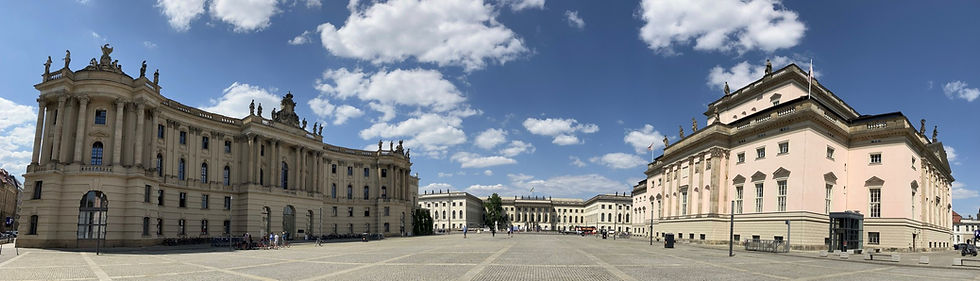
A wide view helps you understand Bebelplatz as a square, but the memorial itself needs a closer, slower visit.
If you have only five minutes, still stop. I would rather spend five honest minutes here than take ten more unfocused photos on Unter den Linden.
How to fit Bebelplatz into a Berlin route
Bebelplatz works best as a pause inside a route, not as a standalone destination that eats half a day. The easiest route is:
Start at Museum Island or the Humboldt Forum, walk west toward Unter den Linden, stop at Bebelplatz, then continue toward Brandenburg Gate. If you want a practical walking structure, use the Unter den Linden Walk Planner before you go.
If your day is more history-heavy, connect Bebelplatz with the Topography of Terror later in the day. The two places are very different, but together they show how Berlin handles memory in both quiet and direct ways.
If it is your first Berlin day, I would keep the route simple: Museum Island, Bebelplatz, Unter den Linden and Brandenburg Gate. You do not need to see everything at once. That is the mistake that turns meaningful places into a checklist.
Practical details: address, transport and best time
The address is Bebelplatz, 10117 Berlin. The most useful nearby U-Bahn stations are Museumsinsel on U5, Unter den Linden on U5/U6 and Hausvogteiplatz on U2. The Staatsoper bus stop is also directly nearby, with routes including 100 and 300.
The square is open and free to enter. There is no ticket, queue or timed entry for the memorial. The glass panel can be harder to read when glare is strong, so late morning, late afternoon or overcast light can be easier than harsh midday sun.
If you join my BerlinWalk route, the tour lasts about 2 hours and gives context for Museum Island, old Berlin and the city layers around the historic centre. Bebelplatz is an easy before-or-after addition if you want a quiet stop on Unter den Linden.
My honest advice
Do not try to make Bebelplatz dramatic. The place already does its work if you let it.
Stand still. Look down. Read the plaque. Then look at the buildings around the square and ask why this act happened in a cultural centre, not in a hidden corner. That question is the point of the stop.
For official background, check Berlin.de's Bebelplatz page and visitBerlin's memorial page before or after your walk.
FAQ
Image Credits
Images in this guide: Bebelplatz square by GFreihalter, CC BY-SA 4.0; Bebelplatz panorama by We Like Sharing / B. de los Arcos, CC BY 2.0; Empty Library memorial by Kemmi.1 (Stefan Kemmerling), CC BY-SA 3.0; book-burning memorial plaque by Mike Peel, CC BY-SA 4.0; Old Library facade by Ansgar Koreng, CC BY 3.0 DE. Images were cropped and resized for layout.