Unter den Linden Berlin: How to Walk the Grand Boulevard Without Missing the Point

Updated: 6 days ago
Unter den Linden Berlin looks simple on a map. It is the grand line between Brandenburg Gate and Museum Island, the sort of street first-time visitors naturally drift onto because everything seems to be there: the gate, the opera house, Humboldt University, Neue Wache, the German Historical Museum, Schlossbruecke, the Humboldt Forum and the edge of the museums.
But this is also the problem. Many visitors treat Unter den Linden as a pretty corridor between two bigger sights. They take a photo at Brandenburg Gate, hurry east, glance at a few pale facades and arrive at Museum Island without really understanding what they just crossed.
That is a waste. Unter den Linden is not just a boulevard. It is one of the easiest places in Berlin to see power, education, memory, war damage, rebuilding and tourism all pressed into one walk. You do not need a full day. You do need to slow down in the right places.
Is Unter den Linden Berlin Worth Visiting?
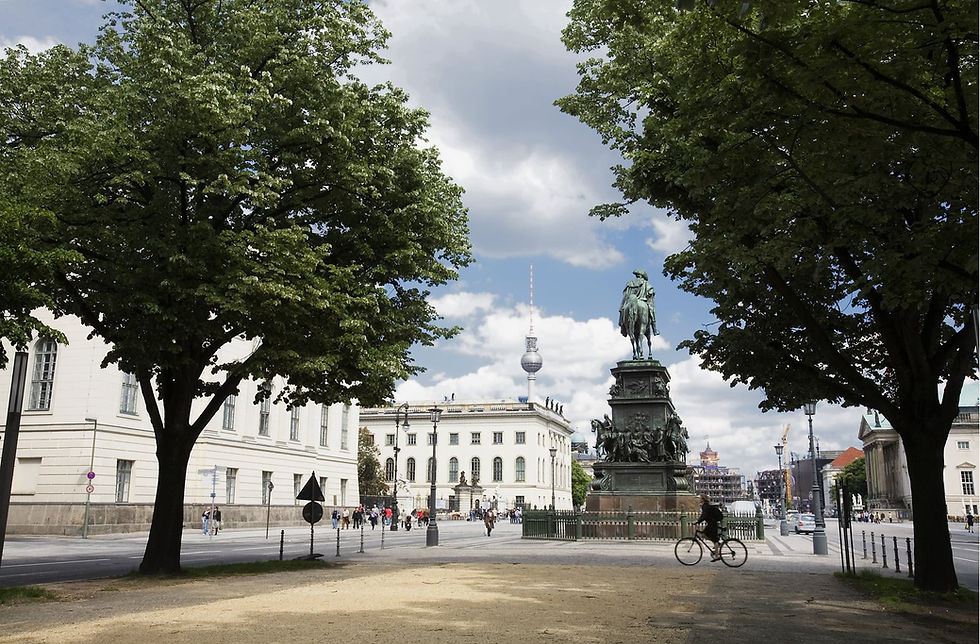
Caption: Unter den Linden works best when you slow down and read the street as a sequence, not just a corridor between bigger sights.
Yes, especially on a first visit. The official tourism site describes Unter den Linden as the historic boulevard that takes you from Brandenburg Gate to Schlossbruecke and the Humboldt Forum, passing landmarks such as Humboldt University, Staatsoper, Neue Wache and the Zeughaus along the way.
That is the tourist answer. The better answer is this: Unter den Linden is worth visiting if you walk it as a sequence, not as a checklist.
At the western end, Brandenburg Gate gives you the big symbolic Berlin: Prussia, Napoleon, division, reunification, tourist crowds. In the middle, Bebelplatz and Humboldt University show the city of culture and public knowledge, but also the memory of the 1933 book burning. A few minutes later, Neue Wache compresses mourning and state memory into one quiet room. At the eastern end, Schlossbruecke, the Humboldt Forum and Museum Island pull the street back toward old Berlin, royal Berlin and the museum city Prussia wanted to build.
That is why I would not skip it. I would just walk it with a plan.
The Best Direction to Walk Unter den Linden
For most first-time visitors, the easiest direction is west to east: start at Brandenburg Gate and walk toward Museum Island.
This gives you the famous photo first, then lets the boulevard become more layered. The street gets quieter after the first tourist crush, and the final approach to Schlossbruecke and Museum Island feels like a real ending. If you are planning a museum visit, this direction also leaves you exactly where you need to be.
The opposite direction can be even better if you already know Brandenburg Gate or if you are joining a historic-centre walk from the east. Start around Museum Island or the Humboldt Forum, then walk west. In that direction, the story builds from old Berlin and Prussian culture toward the symbolic gate. It is a stronger narrative walk, but slightly less obvious for a first-timer.
If you want the simplest rule, use this:
First time in Berlin: start at Brandenburg Gate.
History-focused walk: start at Museum Island.
Bad weather: start wherever the U5 makes the day easiest.
How Long Does the Walk Take?
Unter den Linden is about 1.5 km long. You can walk it in roughly 20 to 25 minutes if you only need to move from one end to the other. But that is not a useful way to experience it.
Plan 60 to 90 minutes if you want the street to make sense. That gives you time for Brandenburg Gate, Bebelplatz, Humboldt University, Neue Wache, Schlossbruecke and a first look toward Museum Island. If you want to enter a museum, visit the Humboldt Forum properly, or sit for coffee, the boulevard becomes a half-day anchor rather than a quick walk.
My practical split:
35 minutes: quick photo walk, best if you are short on time.
75 minutes: the ideal first-visit version.
2 hours: slow route with one indoor stop or a cafe break.
Stop 1: Brandenburg Gate and Pariser Platz
Brandenburg Gate is the obvious western anchor. It is also where many visitors accidentally spend too much energy. Take the classic photo, look through the gate toward Tiergarten, then turn around and notice what the boulevard is doing behind you.
Unter den Linden begins to feel formal here. Pariser Platz is polished, controlled and highly photographed. That matters because Berlin is not usually a polished city. The formality tells you this is a symbolic entrance, not just a traffic square.
If you want a deeper practical guide to the gate itself, use my Brandenburg Gate visitor guide separately. For this walk, the gate is the opening scene, not the whole story.
Stop 2: Bebelplatz

Caption: Bebelplatz is where the boulevard stops being only beautiful and starts asking harder questions.
Bebelplatz is the first place where Unter den Linden stops being only beautiful.
The square sits just off the boulevard beside Staatsoper, St Hedwig's Cathedral, the Alte Bibliothek and Humboldt University. It is one of Berlin's most elegant public spaces, but it is also tied to one of the city's most disturbing public rituals: the Nazi book burning of 1933.
Do not rush this stop. Look at the architecture first, then look for the memorial in the ground. The contrast is the point. Berlin often hides its hardest memory in plain sight, and Bebelplatz is one of the clearest examples.
If you only have time for one pause between Brandenburg Gate and Museum Island, make it this one.
Stop 3: Humboldt University and Staatsoper

Caption: Staatsoper adds the cultural-power layer to Unter den Linden, just across from Humboldt University and Bebelplatz.
Humboldt University gives Unter den Linden its education-and-knowledge layer. The main building sits directly on the boulevard, opposite Bebelplatz, so the street briefly becomes a campus edge rather than only a procession of monuments.
Across the square, Staatsoper Unter den Linden adds the cultural-power layer. VisitBerlin notes that the opera house was commissioned by Frederick the Great and built between 1741 and 1743. That date matters because it places this part of the boulevard firmly inside Prussian ambition: culture was not just entertainment, it was representation.
You do not need an opera ticket to understand the street. Just notice how close the institutions sit to each other: university, opera, library, church, memorial. Unter den Linden works because Berlin keeps stacking functions on the same short walk.
Stop 4: Neue Wache
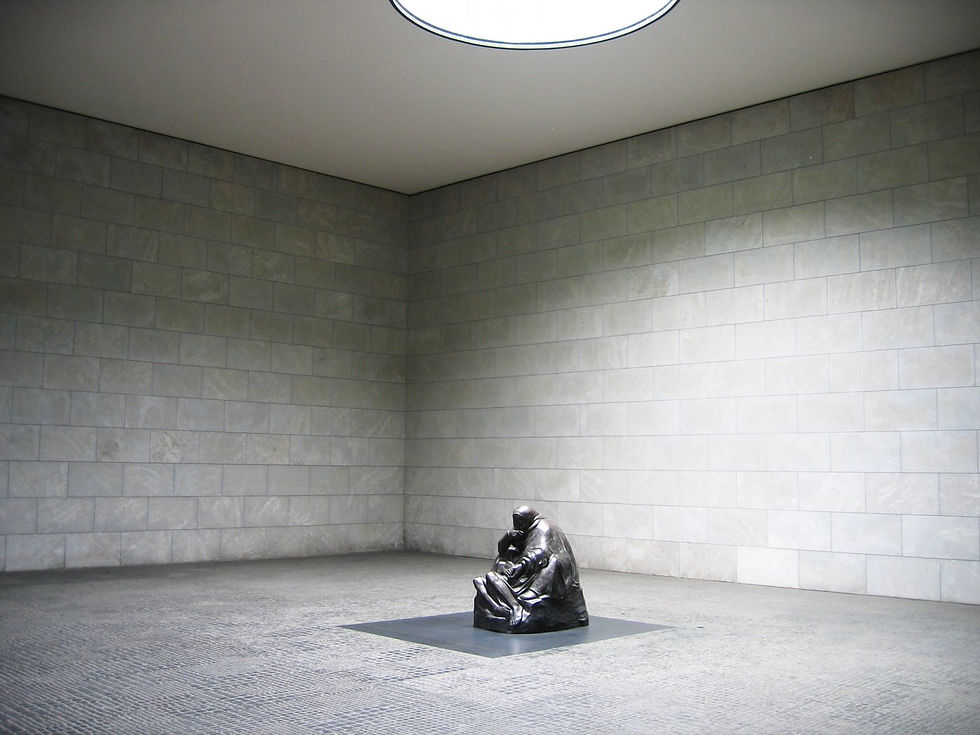
Caption: Neue Wache is a quiet stop, but it is one of the most important pauses on the boulevard.
Neue Wache is small, severe and easy to miss if you are chasing only big landmarks.
Do not miss it. Berlin.de identifies it as the Central Memorial of the Federal Republic of Germany for the Victims of War and Dictatorship. The building was designed by Karl Friedrich Schinkel and built between 1816 and 1818; since 1993 it has served as Germany's central memorial in this form.
Inside, the room is deliberately bare. The sculpture is an enlarged version of Käthe Kollwitz's Mother with her Dead Son. If the weather is grey, the space can feel even more intense, because light falls from above into the centre of the room.
This is where Unter den Linden becomes quiet. Give it a few minutes.
Stop 5: Zeughaus, Schlossbruecke and the Turn Toward Museum Island
After Neue Wache, the street begins to pull you toward the old royal and museum centre. The Zeughaus, now tied to the German Historical Museum, reminds you that this was also a street of state power and military display. Schlossbruecke then carries the line toward the Lustgarten, the Humboldt Forum and Museum Island.
This eastern end is where I would slow down again. Look back west once before you cross fully into the museum landscape. From here, Unter den Linden stops feeling like an isolated boulevard and becomes part of the historic centre.
If you are choosing what to do next, my Museum Island guide is the natural follow-up.
When to Use U5 Instead of Walking the Whole Street
The U5 is the useful rescue line for Unter den Linden. Brandenburger Tor covers the western end, Unter den Linden station covers the Friedrichstrasse crossing, and Museumsinsel covers the eastern end near Museum Island and the Humboldt Forum.
Use it if:
You are short on time.
The weather changes.
Someone in your group is tired.
You already walked a lot earlier in the day.
You want to split Brandenburg Gate and Museum Island into two separate visits.
Bus 100 is also useful for orientation, but it is not a replacement for this walk. BVG openly describes lines 100, 200 and 300 as sightseeing-friendly routes without commentary. That makes them good for overview, not for reading the details. If you want that option, see my Bus 100 guide.
Common Mistakes on Unter den Linden
The first mistake is starting too late in the day and treating the boulevard as a tired transfer between attractions. If your feet are already done, you will see buildings, not a story.
The second mistake is spending too long at Brandenburg Gate and too little time in the middle. The gate is famous, but Bebelplatz and Neue Wache often do more to explain Berlin.
The third mistake is trying to combine everything. Unter den Linden plus Museum Island interiors plus Reichstag dome plus a boat tour can become a beautiful but exhausting day. Choose one main indoor add-on, then leave space.
The fourth mistake is ignoring the street's contradictions. Unter den Linden is grand, damaged, rebuilt, ceremonial, commercial and sometimes oddly ordinary. That mixture is not a failure. It is Berlin.
How It Connects With the BerlinWalk Route
BerlinWalk does not simply copy the Brandenburg Gate to Museum Island axis. My walking tour starts at Alexanderplatz because that gives the older and eastern layers of Berlin more room to breathe before the city turns into postcard symbolism.
That said, Unter den Linden fits naturally before or after the tour. If you walk it before, it gives you the grand official Berlin first. If you walk it after, the stories from the historic centre make the boulevard easier to read.
The tour itself lasts about 2 hours and runs from Alexanderplatz through Berlin's historic centre toward Hackescher Markt. You can see the route structure on the Berlin walking tour route page, or book the next available free, tip-based walk on the BerlinWalk booking page.
My Best Simple Plan
If this is your first time, do this:
Start at Brandenburg Gate in the morning or late afternoon. Take the photo, then walk east. Pause properly at Bebelplatz and Neue Wache. Do not force every side attraction. Finish at Schlossbruecke and Museum Island, then decide whether you want one museum, the Humboldt Forum, a river walk or coffee around Hackescher Markt.
That is enough. Unter den Linden Berlin is not a street to conquer. It is a street to let Berlin contradict itself in public.
For the next step, my practical Berlin guides to the Hohenzollern story behind Berlin can help with the next practical detail.
Image Credits
Images used in this draft come from Wikimedia Commons/open-license sources: Unter den Linden boulevard by Jorge Royan, CC BY-SA 3.0; Bebelplatz/Staatsoper by Jorge Láscar, CC BY 2.0; Neue Wache interior by Johann H. Addicks, CC BY-SA 3.0; Staatsoper Unter den Linden by Photogoddle, CC0. Full source URLs and visual quality notes are saved in the local visual sources file.