German Courses in Berlin: What a Lesson Costs and Why the Rules Change at B1
Every autumn the same thing happens in Berlin. The evenings get shorter, a letter arrives that you cannot read, and you decide that this is finally the year you fix your German. Then you open three school websites, see 349 euro, 800 euro and 1,280 euro for things that all look like the same course, and the decision quietly moves to next year.
The prices are not random. Most of them are set by rules you can read, and the rules are stranger than the marketing. Up to B1 a Volkshochschule course in Berlin is capped by a federal number that has nothing to do with Berlin at all. Above B1 that cap disappears and a completely different set of discounts switches on. The same 45 minutes of teaching can legally cost you nothing, 80 cents, 2.98 euro or 10 euro, and which one you pay depends less on the school than on two facts about you.
The price of a German lesson in Berlin is set by a rule, not a school
Everything in this article is priced in Unterrichtseinheiten, teaching units of 45 minutes. Every regulation, every funding programme and every school price list in Berlin is written in that unit, so it is the only honest way to compare a 349 euro monthly course against a 1,603 euro federal one.
Berlin's twelve Volkshochschulen, one per district, do not invent their fees. The Senate publishes an ordinance that sets a Basiswert, a base value per teaching unit, and every course has to be priced between 50 and 250 per cent of it. That base value rose from 2.76 euro to 3.20 euro on 1 August 2026, which is a 16 per cent jump six weeks ago that nobody announced to you. So a normal Volkshochschule course now sits somewhere between 1.60 euro and 8.00 euro a unit.
German courses are the exception, and the exception is where the money is.

Wassertorstraße 4 in Kreuzberg, one of the twelve district Volkshochschulen. The building is listed, the fee table behind the counter is the same one used in Spandau.
Up to B1, your course is capped by a number from Nuremberg
Here is the rule almost nobody reads. For German as a second or foreign language, Berlin sets the fee at no less than 25 per cent of the base value and no more than 130 per cent of the contribution the Federal Office for Migration and Refugees charges for its integration courses.
That federal contribution is currently 2.29 euro per teaching hour. So the ceiling on a Berlin Volkshochschule German course up to B1 works out at 2.98 euro a unit, and the floor at 80 cents. A hundred teaching units, which is exactly the size of one integration-course module, costs you somewhere between 80 and 298 euro.
There is a catch attached, and it stings the people who expect it least. On this rung, the individual 50 per cent reductions do not apply. Your Berlin-Ticket S, your student card, your Bürgergeld notice: none of them move the price of an A1, A2 or B1 course at the Volkshochschule. The fee is already held down for everybody, so it is not discounted again for anybody.
At B2 the rules swap over and your student card starts working
The special cap is written to stop at the end of B1. From B2 upwards, a Volkshochschule German course goes back to the normal band, between half and two and a half times the 3.20 euro base value, so 1.60 euro to 8.00 euro a unit. That looks like bad news until you read the second half of the sentence: above B1, the 50 per cent reductions come back.
Who gets that half price is a longer list than most people assume:
Holders of a valid Berlin-Ticket S entitlement
People on Bürgergeld, Sozialhilfe, Wohngeld, Kinderzuschlag, Arbeitslosengeld or Kurzarbeitergeld, and members of their household
Full-time students at a state or state-recognised university, with a student card or enrolment certificate
Apprentices with proof, though a Volontariat does not count
School leavers without a place, for up to twelve months after finishing
People doing Bundesfreiwilligendienst or a voluntary social, cultural or ecological year
Holders of the Ehrenamtskarte Berlin-Brandenburg
If you are a student in Berlin sitting on B1 and wondering why you should bother with the paperwork, that is your answer. Your card is worth nothing on the A2 course and worth half the fee on the B2 one. I have watched people book the expensive version of exactly this decision because the two rules sit in different paragraphs.

Volkshochschule City West, Pestalozzistraße in Charlottenburg. Doors A and B, and above B1 a student card halves what you pay behind them.
Two routes where the course can cost you nothing
The cheapest German in Berlin is not a discount. It is a funding programme you have to be let into, and there are two.
The Integrationskurs is the federal one: 600 teaching units of language plus a 100-unit orientation course, ending at B1. At 2.29 euro a unit the full 700 units comes to 1,603 euro, and you pay it in blocks of 100, not in one payment. Two things are worth more than the headline figure. You can be exempted from the contribution entirely on Bürgergeld, Sozialhilfe or a low salary, and if you pass the final test within two years you get half your contribution back, which turns 1,603 euro into roughly 800. The exemption has a hard edge: apply for it before your course starts, because it is only backdated as far as your first module.
The Berufssprachkurs, the job-related German course, is the one Berlin professionals miss most often. It runs above B1, in blocks of 400 units from B1 to B2 and 400 units from B2 to C1, and participation is free in principle. You only pay if you are employed and your taxable income is over 20,000 euro a year, or 40,000 for a jointly assessed couple, and then it is 2.56 euro a unit, so 1,024 euro for a 400-unit course. Half of that comes back when you pass. Your employer is allowed to pay it for you, and a surprising number will if you ask in the right month.
Both routes need a Berechtigungsschein, a document that says you are entitled to a place. That is the real gate, and it is the reason so many people who could be learning for free are paying 10 euro a lesson instead.
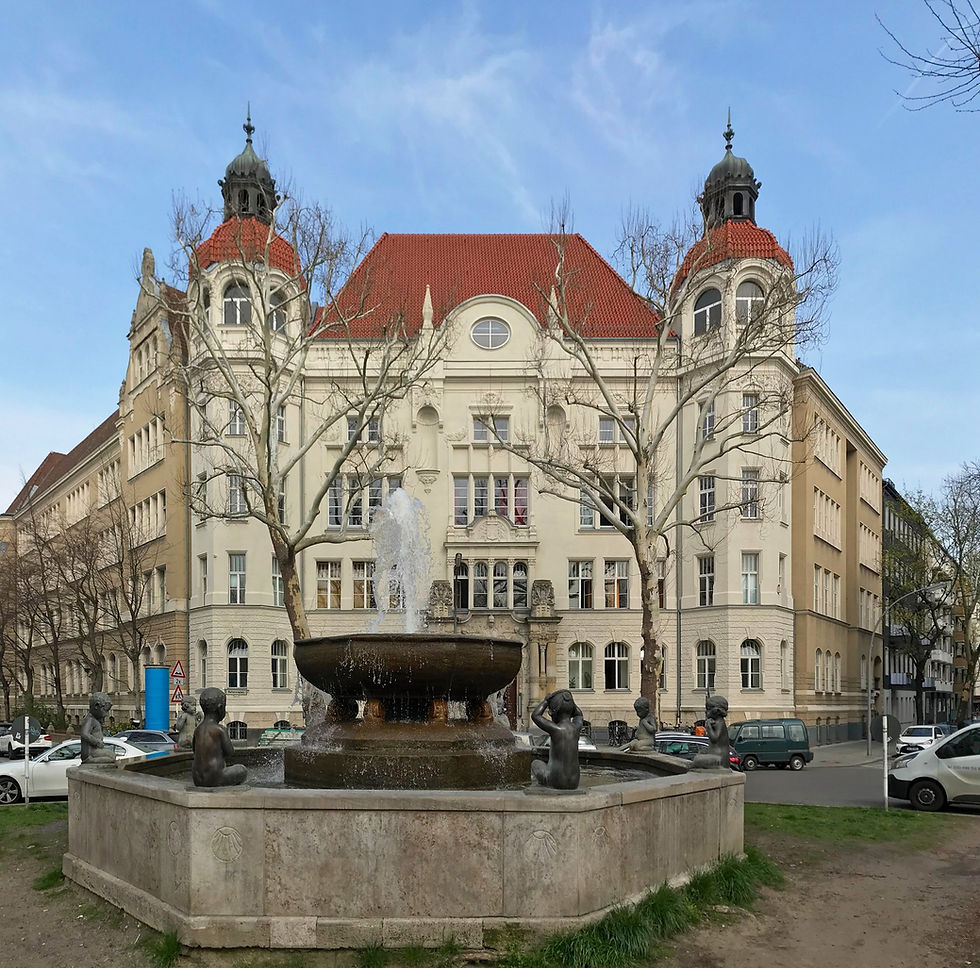
Barbarossaplatz in Schöneberg. The Albert-Einstein-Volkshochschule sits behind the fountain, and its German counter runs on the same fee ordinance as every other district.
What a private school charges for the same 45 minutes
Private schools are not villains here. They start earlier, they run all year, they take you without a Berechtigungsschein and they will put you in a class on Monday. That convenience has a published price.
At the cheaper end of the well-known Berlin schools, an intensive course starts at 349 euro for four weeks: 64 teaching units, three hours a day from Monday to Thursday, with a class capped at thirteen people. That is 5.45 euro a unit, roughly double the Volkshochschule ceiling below B1.
At the other end, a school selling by the week charges 200 euro for 20 units, which is 10 euro a unit, falling to 7 euro if you commit to twenty weeks. Then read the small print: 35 euro registration, 20 euro of materials every four weeks, and a 30 euro weekly summer surcharge between the end of June and the end of July. A single summer month at the weekly rate lands near 950 euro for the same B1 content the Volkshochschule caps at 298 euro per hundred units.
Compare German courses in Berlin before you pay for one
The tool below puts every route on one scale: what one 45-minute unit costs you, from the free programmes to the weekly private rate. Set your current level and the one fact about your situation that changes the money, and the bars redraw. The greyed rows are the routes that do not run at your level yet, which is usually the most useful thing on the screen.
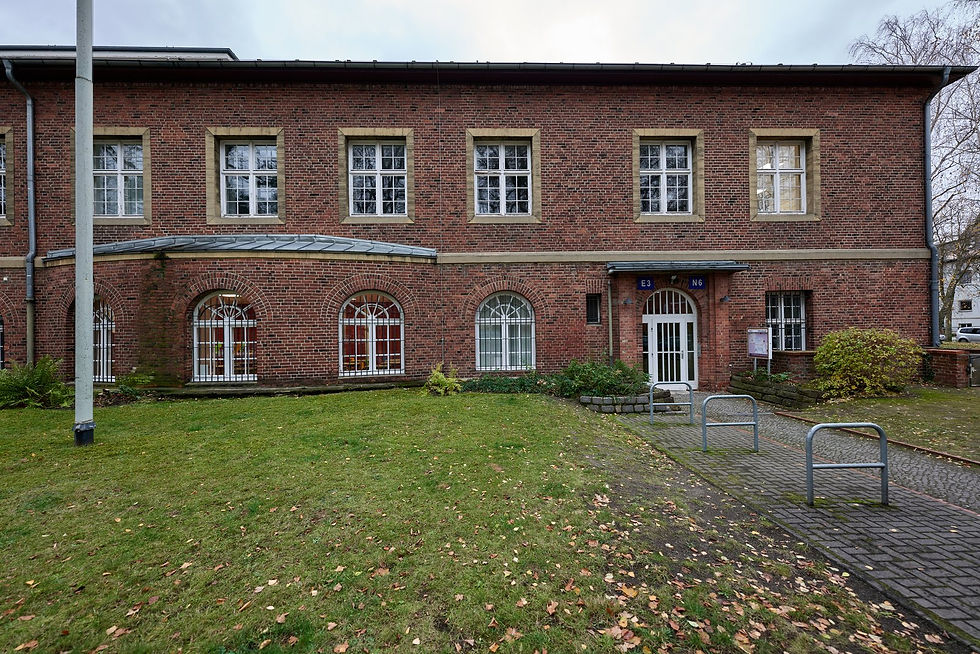
Volkshochschule Steglitz-Zehlendorf in Lichterfelde. Twelve buildings like this one, twelve counters, one fee ordinance.
The five days your employer already owes you
Berlin has a Bildungszeitgesetz, and it is the most reliably ignored benefit in the city. If you work a five-day week, you have a right to five working days a year of paid leave for a recognised course, and you can pull next year's entitlement forward to take ten days in one block if your employer agrees. You qualify six months into the job.
Two details decide whether this is useful to you:
Unused days do not carry over. Whatever you do not take by 31 December is gone, so the December decision is real money.
Recognition is granted course by course. A course either carries the Bildungszeit label in its listing or it does not, and you cannot make it count afterwards.
Ten consecutive weekday mornings of German at a Volkshochschule intensive course, paid by your employer's clock rather than your evenings, is a genuinely different experience from a Tuesday-and-Thursday class you keep missing. This is the one lever in the whole article that costs nothing and gets used least.
The two traps: the counter and the cancellation window
You cannot book a Volkshochschule German course the way you book a pottery course. Registration for German and integration courses happens in person, after a placement and advice appointment, and you need your passport or ID with you. Volkshochschule Mitte, for example, runs its German counter at Antonstraße 37 in Wedding, Mondays and Thursdays 11:00 to 14:00 and Tuesdays 14:00 to 17:00. Appointments can be booked online, and walk-ins are taken. The autumn and winter semester starts in September, with the programme published four to six weeks before and registration opening alongside it, so the good intensive slots are gone early.
The second trap is the cancellation rule, which is stricter than most people expect:
Free cancellation within 14 days of booking
After that, 20 per cent of the fee, minimum 10 euro
From the fifth day before the course starts, no cancellation at all. The full fee is due.
Book the course you will actually attend, not the ambitious one. That fifth day arrives quickly.

Volkshochschule Spandau. The far end of the S-Bahn, and exactly the same fee ordinance as the counter in Mitte.
What I would actually do
I run my tours in English in a city that runs its paperwork in German, and the pattern I see is always the same: people pay for speed when what they were actually missing was eligibility.
My advice, in the order I would do it:
1. Find out whether you can get a Berechtigungsschein for the Integrationskurs or the Berufssprachkurs. That one question is worth more than every price comparison on this page, because it can take your cost to zero. 2. If you are below B1, go to your district Volkshochschule first. The legal ceiling is 2.98 euro a unit, and the published Berlin school prices I checked start at roughly double that. 3. If you are above B1 and you hold a student card, an apprenticeship contract or a Berlin-Ticket S entitlement, say so at the counter. Above B1 that halves the fee, and below B1 it does nothing, which is the opposite of what most people assume. 4. Ask your employer about Bildungszeit in October, not in December. Ten paid weekday mornings will move your German further than six months of evening classes. 5. Then, and only then, compare private schools. They are worth their price when your calendar is the constraint. They are not worth it when a Berechtigungsschein was the constraint.
German is also how Berlin stops being a set of procedures and starts being a place. If you want a gentler way in while you wait for a course place, the signs you walk past every day are a good first vocabulary list, and the phrase set most people actually use covers the counters you will be standing at. When the German finally does arrive in the post, the Nebenkostenabrechnung guide is where it gets tested, and your district library has free language shelves and conversation evenings on a ten euro card.
If you want to read the rules yourself, the Berlin fee ordinance for the Volkshochschulen holds the base value and the B1 cap, and the federal integration-course cost page holds the 2.29 euro figure and the refund. The job-related German course regulation sets the 400-unit blocks, and the Berlin Bildungszeit page explains the five days.
Image credits
Source and licence details for the 3 photographs used in this article.
The Volkshochschule Friedrichshain-Kreuzberg building at Wassertorstrasse 4 in Berlin-Kreuzberg: Jörg Zägel, CC BY-SA 3.0, via Wikimedia Commons.
The Volkshochschule City West on Pestalozzistrasse in Berlin-Charlottenburg: Gunnar Klack, CC BY-SA 4.0, via Wikimedia Commons.
The Albert-Einstein-Volkshochschule on Barbarossaplatz in Berlin-Schöneberg: Gunnar Klack, CC BY-SA 4.0, via Wikimedia Commons.