Gemäldegalerie Berlin: The Old Masters Gallery Most Visitors Miss
Updated: Aug 24
Stand outside the Altes Museum on a summer morning and watch the queue curl across the Lustgarten. Now take one S-Bahn ride and a ten minute walk, and you are in a museum with two kilometres of galleries, a hall of Rembrandts, two Vermeers and a Caravaggio, usually with far less pressure than Museum Island. That museum is the Gemäldegalerie Berlin, and the fact that most visitors have never heard of it is one of the strangest gaps in Berlin tourism.
I send guests from my tour here more often than anywhere else when they ask for a quiet afternoon. This guide explains what the Gemäldegalerie actually is, why it stays calmer than Museum Island, which paintings are worth crossing the city for, and how to fold the rest of the Kulturforum around it.

A main hall of the Gemäldegalerie on a normal day. The bench is usually yours.
What the Gemäldegalerie Berlin actually is
The Gemäldegalerie is Berlin's old masters gallery: European painting from the 13th to the 18th century, shown in 72 rooms along roughly two kilometres of walking. The main floor hangs about 1,250 paintings, with several hundred more in the study gallery downstairs. This is the collection Prussia started building for its new public museum in 1830, expanded aggressively under museum director Wilhelm von Bode around 1900, and it plays in the same league as the Louvre's or Madrid's old master holdings.
The names are not obscure. There is a whole hall of Rembrandts at the centre of the building, one of the largest Rembrandt collections in the world. There are two Vermeers. There is Caravaggio's grinning Amor, Bruegel's proverb-packed village, Holbein's merchant with his carnations, van Eyck's tiny cathedral of a Madonna, plus rows of Raphaels, Botticellis, Cranachs and Dürers. In most cities any one of these walls would anchor the whole museum.

Velvet-grey walls, herringbone parquet and space to stand exactly where you want. Crowds look different on Museum Island.
Why the crowds gather on the other side of town
The emptiness has a simple, very Berlin explanation: geography and the Cold War. The paintings' old home stood on Museum Island, which ended up in East Berlin. West Berlin needed its own cultural centre, so from the 1960s it built the Kulturforum by the Wall at Potsdamer Platz: the golden Philharmonie, the Neue Nationalgalerie, and eventually a purpose-built gallery for the old masters, opened in 1998.
Then the Wall fell, tourism went to the reunited Museum Island, and the Kulturforum kept the paintings but lost the foot traffic. Today the plaza between the buildings is also a construction site: the new modern art museum called berlin modern is being built there. You cross some hoardings on the way in, and the galleries often feel calmer than the plaza outside. I consider that one of the best deals in Berlin.
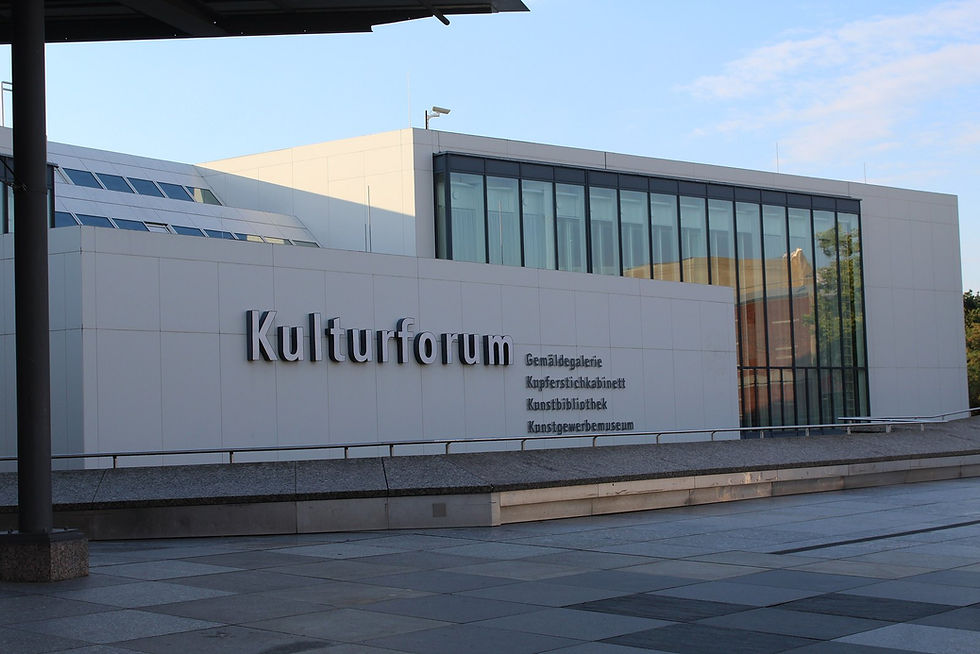
The shared Kulturforum entrance front. The architecture is quiet on purpose; the show is inside.
The five-painting rule for a 72-room museum
Here is the honest advice I give guests: do not try to see 72 rooms. I have made that mistake, and somewhere around room 40 every Madonna starts looking the same. The building makes a smarter plan easy, because the 18 main halls run in one numbered sequence around the central hall, German and Netherlandish painting on one side, Italian on the other. Pick a handful of targets, walk the loop once, and let everything between them be a bonus rather than a duty.
Use the tool below to build that plan. Tap through ten of the gallery's most rewarding paintings, read what to look for in front of each one, pick up to five, and you get them back in walking order.
Two stories the labels will not tell you
Two of my favourite stops deserve more than a museum label. The first is Bruegel's The Dutch Proverbs from 1559, a village where every figure acts out a saying: a man bangs his head against the wall, another is armed to the teeth, and in the centre a woman hangs a blue cloak on her husband, which meant she was cheating on him. Bruegel packed more than a hundred proverbs into one painting. Give it twenty minutes and it gives you a stand-up routine about human stupidity that has not aged since 1559.

The Dutch Proverbs, 1559. Every cluster of figures is a separate saying; the blue cloak in the centre is the most famous one.
The second is The Man with the Golden Helmet. For decades this was the most famous Rembrandt in Berlin, reproduced on postcards and biscuit tins. In the 1980s, researchers concluded it was painted not by Rembrandt himself but by someone in his circle, and the crowds thinned almost overnight. The painting did not change. Stand in front of it, move left and right, and watch the light catch the thick ridges of gold paint. It is the best free lesson in Berlin about why people look at art in the first place: the name on the label changed, the painting stayed magnificent.

The Man with the Golden Helmet, around 1650. Once Berlin's most famous Rembrandt, now credited to his circle, still worth the trip.
The fire that explains the gaps
If the collection feels like a greatest-hits album with tracks missing, there is a dark reason. In the war the most important paintings were stored in the massive flak tower at Friedrichshain. In May 1945, days after the fighting ended, fires swept the tower, and around 400 paintings were destroyed, among them three Caravaggios and Signorelli's famous Pan. Large works burned partly because they physically did not fit down the mine shafts used to evacuate the rest. The museum keeps a record of these works in its Lost Masterpieces research.
The survivors then spent the Cold War split between East and West Berlin, half at the Bode Museum, half in Dahlem, and were only reunited in the 1998 building. When you walk these rooms, you are looking at the half of Prussia's picture gallery that made it through. It makes the calm in here feel different.
Tickets, hours and the free-admission change
The practical block, checked in July 2026 against the official Gemäldegalerie site:
Tickets: 14 euros, concessions 7 euros, under 18 free. The Kulturforum day ticket at 22 euros covers all the neighbouring exhibitions too.
Open Tuesday to Sunday 10:00 to 18:00, closed Mondays. If your museum day lands on a Monday, my Berlin on a Monday guide exists for exactly that problem.
Book online if you want the smoothest arrival. The museum recommends advance booking to avoid waiting at the ticket counter; tickets are usually released four weeks ahead.
The free Museum Sunday is gone. Berlin's Museumssonntag ran for the last time on 1 December 2024 and was cut with the culture budget, so ignore older blog posts promising free first Sundays.
Big bags go in the cloakroom; the rules are the standard ones from my Berlin museum bag rules guide.
Make it a full Kulturforum afternoon
The Gemäldegalerie's neighbours are worth planning around, because they are individually famous and collectively ignored.

The Neue Nationalgalerie, Mies van der Rohe's glass temple for modern art, five minutes from the Gemäldegalerie's door.
Neue Nationalgalerie. Mies van der Rohe's steel-and-glass hall shows modern art in one of the most photographed museum buildings in Europe. Through 9 August 2026 it hosts a major Brancusi retrospective, and on the first Thursday of each month admission is free from 16:00 to 20:00. Check the Neue Nationalgalerie tickets page before you commit to a paid slot.
Philharmonie. Hans Scharoun's golden concert hall is the home of the Berliner Philharmoniker. From September to June it runs free lunch concerts on Wednesdays at 13:00, 40 to 50 minutes of chamber music with limited capacity, one of the best free classical experiences in Europe. In high summer the concerts pause with the season, so in July and August admire the building and plan the concert for a future trip.

The Philharmonie's golden folds. Scharoun put the orchestra in the middle of the hall, and half of Berlin's concert architecture has been answering him since.
Getting there, and where it fits your Berlin
The Kulturforum sits a ten minute walk from Potsdamer Platz station, which almost every S-Bahn and the U2 pass through; several bus lines also stop directly at the Kulturforum and Philharmonie stops. From Potsdamer Platz the walk is signposted and flat.
The clean way to combine it with my route: my free Berlin walking tour spends ~2 hours in the historic centre and ends at Hackescher Markt, where the S-Bahn runs straight to Potsdamer Platz in under ten minutes. Tour in the morning, Gemäldegalerie in the afternoon, and you have seen both the Berlin everyone photographs and an old masters gallery many visitors miss. If you only have limited museum energy in your trip, my museum pass comparison helps you decide where to spend it.
One last honest note. Berlin will eventually notice what it has at the Kulturforum, and the new museum building should bring more attention once it opens. Until then, the Gemäldegalerie offers a calmer old masters visit one S-Bahn ride from Museum Island, and I intend to keep sending people there.
Image credits
Source and licence details for the 7 photographs used in this article.
Gemäldegalerie main hall with altarpieces: Oursana, CC0 1.0, via Wikimedia Commons.
Gemäldegalerie gallery room: Oursana, CC0 1.0, via Wikimedia Commons.
The Dutch Proverbs by Pieter Bruegel the Elder: Google Art Project reproduction, Public domain, via Wikimedia Commons.
The Man with the Golden Helmet, circle of Rembrandt: Google Art Project reproduction, Public domain, via Wikimedia Commons.
Kulturforum entrance front: Oursana, CC0 1.0, via Wikimedia Commons.
Neue Nationalgalerie at dusk: Mandus70, CC BY-SA 4.0, via Wikimedia Commons.
Berliner Philharmonie facade: Singlespeedfahrer, CC0 1.0, via Wikimedia Commons.